Local Voices
Public Push Back on California Archive Center Closure
Will California lose the popular San Bruno National Archives "treasure trove of West Coast history"?



By Susie Ling*
Jewish refugees, Native American boarding school students, Punjabi pioneers, Alcatraz prisoners, Japanese picture bride, pre-WW1 veterans, and more. How are they related?
Their stories are in the 80,000 “A-files” at 1000 Commodore Drive at the U.S. National Archives and Records Administration (NARA) building in San Bruno.
Find out what's happening in Across Californiafor free with the latest updates from Patch.
Representative Kevin Mullin (CA-15) said, “This is a treasure trove of West Coast history.” Since 1935, the U.S. National Archives has been open to the public. In San Bruno, there are 100,000 cubic feet of primary documents that tell the stories of diverse Americans. Because of its location near San Francisco and Angel Island, about half the files are on Chinese Americans.
On the official website of NARA at San Bruno, it reads “The National Archives of San Francisco will be closing in the next few years.”
Find out what's happening in Across Californiafor free with the latest updates from Patch.
But the reasons are not indicated. There are hints that the files will be transferred very soon to Kansas City - 1800 miles away from the public that wants to view and research these public records.
Genealogy researchers like Grant Din have responded by joining “Save Our National Archives” (SONA). SONA wants to keep the San Bruno office open and is seeking to collect 10,000 signatures in a petition against the threatened closure. SONA indicates they have 9,940 signatures to date. SONA also seeks more Congressional support against this move.
As Mr. Din stated in a recent presentation to the Chinese Historical Society of Southern California,
“NARA belongs to the American people. I was able to search my maternal grandfather’s file and paternal grandfather’s file. And this led me to find other relatives.”
Grant not only searched his own roots, but he researched the files of Kane Mineta, mother of Congressmember Norman Mineta. He found Kehar Singh’s file; Kehar is the grandfather of author/lawyer Valarie Kaur.
And Grant told the story of Li Keng (Gee) Wong. Li Keng came through Angel Island when she was seven years old in 1933. Her U.S.-born father had applied for his family. But because of the anti-Chinese immigration restrictions of the time, Li Keng had to pretend that her mother was not her mother – but her “Ah Yi” or her father’s sister. She said that she was drilled to tell the immigration officer that her mother was dead. The transcripts indicate that the little girl held up to the pressure. Li Keng went on to become an elementary school teacher for 35 years –improving the lives of 1000 youngsters.
“There are paper files; there are photographs; there are hand drawn maps; there are even ‘kosekis’ (family registries). And there are professional archivists who know their work in San Bruno.” said Din. It would take special archivist experience to decipher 80,000 A-files. Marji Lee, an archivist, said, “Collecting and cataloging is one thing. Stabilization, search, retrieval, delivery, and interpretation is another,”
In a July statement, the Society of American Archivists expressed “alarm over the closure of multiple NARA facilities across the country.” They indicate that this government agency is already “woefully underfunded.”
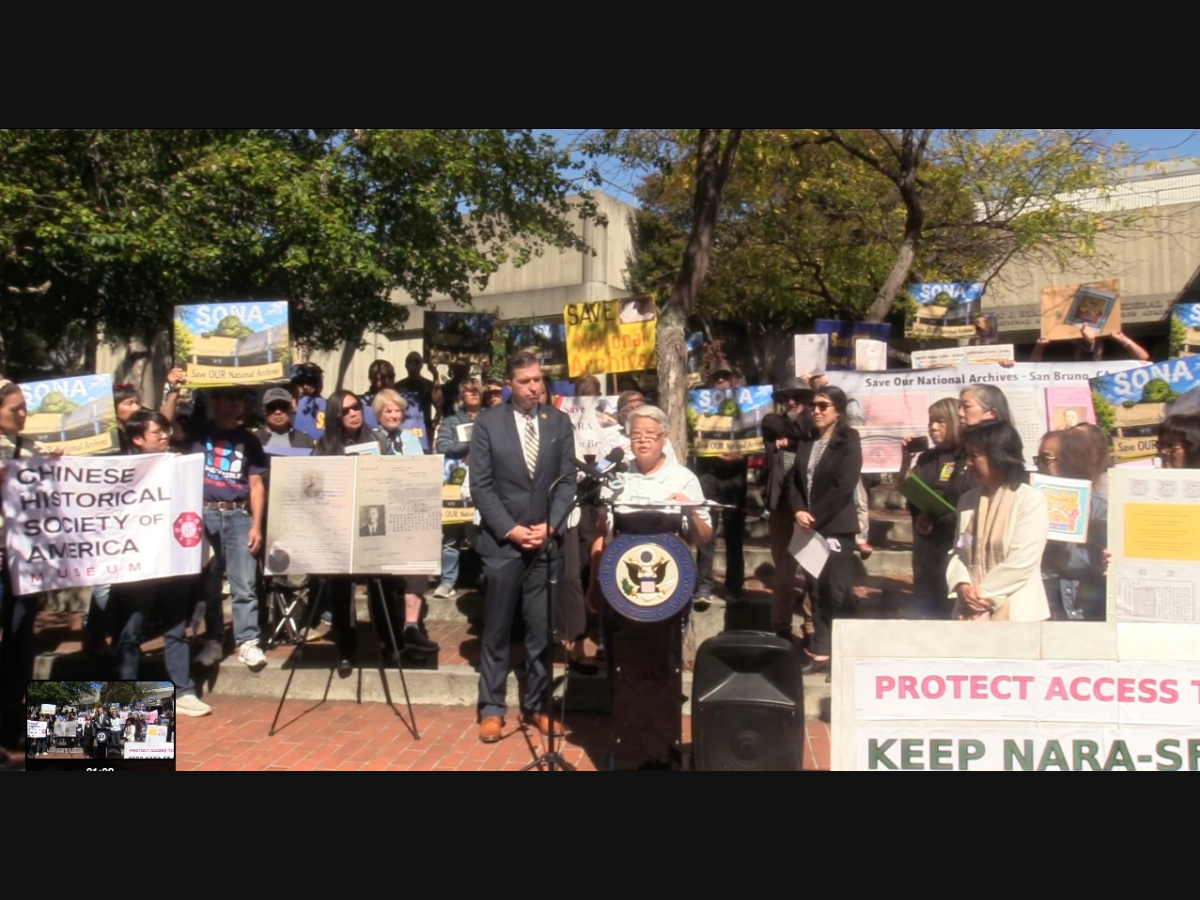
At the Save Our National Archives press conference organized by Representative Kevin Mullin on August 24, 2026, National Japanese American Historical Society Executive Director Rosalyn Tonai stated:
“The National Archives are a treasure that holds the truth of stories of millions of Americans who have secured their place in America’s history. Whether Native Americans, to the first immigrants that set foot on Angel Island, to civil rights leader Fred Korematsu who challenged the Supreme Court over the incarceration, to the over 5,000 Japanese American incarcerees that fought to restore their citizenship, these are records that are here and reveal that history.
Simply digitizing them are not enough. The National Archives should remain the place-keeper of the original, fragile documents, a safe-keeper of America’s public history. It should never be destroyed, buried or erased.”
On August 7, 2026, Congress confirmed President Trump’s nomination of Bradford P. Wilson as the chief administrator for NARA, replacing interim archivist Edward Forst.
* The author is the president of the Chinese Historical Society of Southern California.