Politics & Government
Thousands Voted In Poll Over 32-Hour Work Week
Lawmakers are considering a bill that would force big companies to nix the 40-hour workweek. Here's how Patch readers feel about it.


CALIFORNIA — Lawmakers in California are weighing a bill that would reshape the workweek for swaths of workers. We asked readers to share their thoughts on the possibility of a 32-hour workweek.
AB 2932 would force companies with more than 500 employees to shift to a four-day week, reducing the traditional work schedule by eight hours.
In our nonscientific survey, more than 62 percent of Patch readers said that bigger California companies should shift to the 32-hour workweek.
Find out what's happening in Across Californiafor free with the latest updates from Patch.
"It doesn’t make sense that we are still holding onto a work schedule that served the Industrial Revolution," Assemblymember Cristina Garcia (D-Bell Gardens), one of the bill’s authors, said in a statement, according to CNBC.
The survey, which drew 3,610 respondents and appeared in questionnaire form, was not meant to be a scientific poll but rather to give a broad idea of public sentiment.
Find out what's happening in Across Californiafor free with the latest updates from Patch.

The legislation — authored by Garcia and Assemblymember Evan Low (D-San Jose) — comes after millions of Americans walked off their jobs last year amid the pandemic. That trend hasn't shown many signs of slowing.
"There has been no correlation between working more hours and better productivity," Garcia has said.
The bill wasn't the only effort to shorten the workweek. AB 2932 is similar to a federal bill introduced by Rep. Mark Takano (D-Riverside). Takano is working to change the Fair Labor Standards Act.
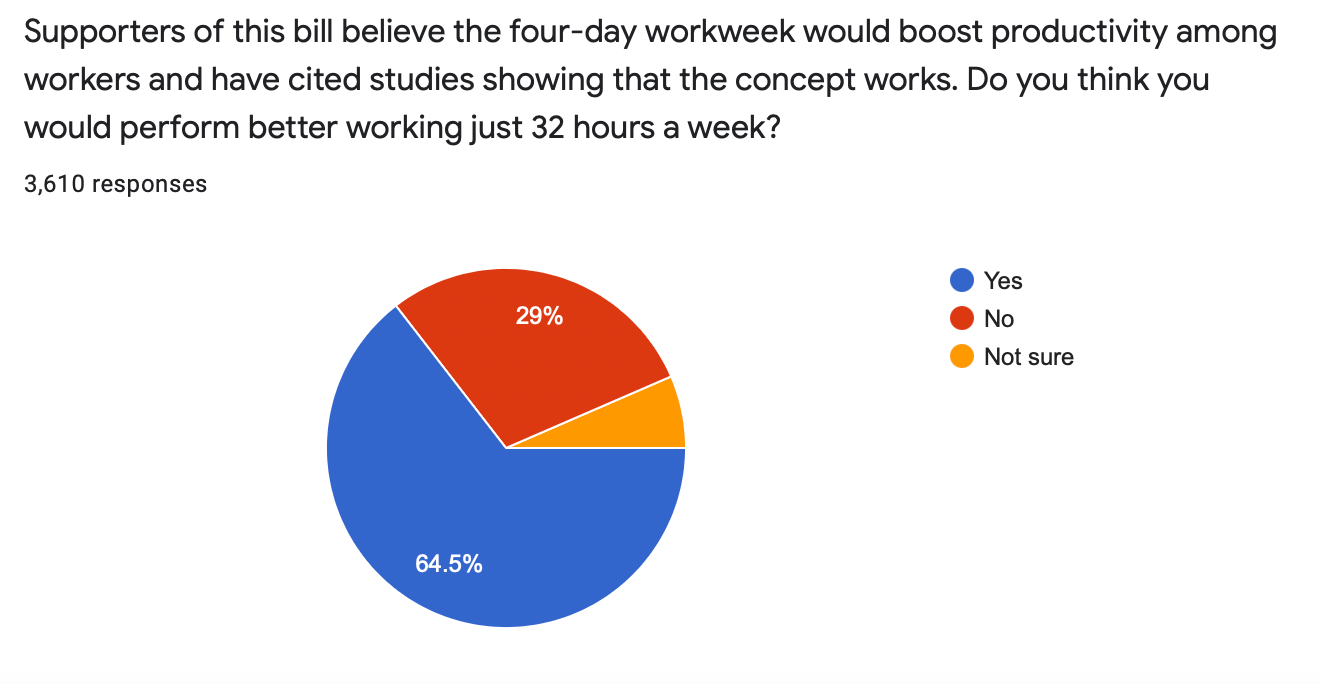
We asked readers whether they thought they would perform better working just 32 hours a week. Some 64.5 percent answered "yes," 29 percent said "no," and 6.5 percent were unsure.
"After a nearly two-year-long pandemic that forced millions of people to explore remote work options, it's safe to say that we can't — and shouldn't — simply go back to normal, because normal wasn't working," Takano said in a statement late last year. "People were spending more time at work, less time with loved ones, their health and well-being was worsening, and all the while, their pay has remained stagnant."
We Asked Readers To Share Their Thoughts On A Shorter Workweek
"It obviously wasn't working how we did it before. Working with only two days off. Now this seems more doable and it gets me motivated just thinking about it and I am not even working right now. It makes me want to get a job just to experience this."
"Most workers are working or available more than 8 hours each day. Much more. Often Saturdays are spent running errands which leaves Sundays to do chores and ‘hurry up and have some time to relax.’ On a rare 3 day weekend, the whole feeling about work changes. It takes pressure off."
"I feel a 32 hour work week benefits both the company and the employees. The employees will be more productive during the 4 days of work knowing that they are able to have more time to spend with family. Also physically and mentally the employees will feel better."
"I agree, however I believe it should apply to smaller companies as well."
"I think it should be encouraged as an option for employers, but not mandatory for OT after 32 hours. I suggest offering an incentive to employers to allow flexible work hours."
"I really think that it would boost morale. We as Americans for the most part work entirley too much!"
"This won’t work on government employees. They will adapt by doing even less work. I should know. I supervised some during the pandemic."
"This is ideal for those on salary but what about hourly workers? They cannot afford to get a decrease in pay."
"We are a 5 day a week operation. Management (owner) works 6-7 days a week. If we were forced to cut to a 4 day work week and pay overtime for those 'extra' hours I will close or move the business as the clients could not be taken care of properly."
Supporters of the bills believed the four-day workweek would boost productivity among workers and cited studies showing that the concept works.
Several countries tested a 32-hour workweek in the last decade, and the United Kingdom is gearing up to test its own four-day workweek in June. At least 30 companies have signed up for the trial, Bloomberg reported.
In Iceland, the four-day workweek was considered a major success, according to a report by think tank Alda and Autonomy.
"There is an established and growing body of evidence supporting the hypothesis that reductions in working time can increase productivity and improve workers' wellbeing and work-life balance. A key to this is the re-organisation of work and established working practices," researchers said in the report.
READ MORE: 32-Hour Workweek For Americans Proposed By RivCo Lawmaker
Takano argued that a shorter workweek would benefit employers and employees alike.
Pilot programs run by governments and businesses across the globe have shown promising results as productivity climbed, and workers reported better work-life balance, less need to take sick days, heightened morale and lower child care expenses because they had more time with their families and children, according to Takano.
Shorter workweeks have also been shown to further reduce health care premiums for employers, lower operational costs for businesses and have a positive environmental effect in some of the studies, he added.
"People continue to work longer hours while their pay remains stagnant. We cannot continue to accept this as our reality," Takano said. "Many countries and businesses that have experimented with a four-day workweek found it to be an overwhelming success as productivity grew and wages increased."
Patch editor Toni McAllister contributed to this report.
Get more local news delivered straight to your inbox. Sign up for free Patch newsletters and alerts.