Politics & Government
Supervised Drug Injection Sites Could Soon Pop Up In California. How Will They Work?
A handful of California cities and counties would operate supervised injection sites if Gov. Gavin Newsom signs the legislation.

August 11, 2022
In summary
Find out what's happening in Across Californiafor free with the latest updates from Patch.
A handful of California cities and counties would operate supervised injection sites if Gov. Gavin Newsom signs the legislation. The details of how the centers operate will be largely up to local officials.
For years, the idea of establishing supervised drug injection sites has been a long-standing goal for some progressive California leaders looking to address the burgeoning overdose crisis. Efforts to launch such programs have come close, but never to the finish line.
Find out what's happening in Across Californiafor free with the latest updates from Patch.
Now, as the latest legislation seeking to sanction these sites heads to the governor’s desk, proponents are gearing up to make these injection sites a reality — and they hope a success — in the Golden State.
Senate Bill 57 would authorize these overdose prevention pilot programs in Oakland, San Francisco and Los Angeles, which would operate through Jan. 1, 2028.
While former Gov. Jerry Brown rejected similar legislation in 2018, supporters are hopeful Gov. Gavin Newsom will sign this one after he said he was open to the idea during his campaign for governor.
“We have been engaging with the governor’s office for the past four years on this measure. We haven’t heard that he’s not going to sign it, so we’re hopeful that he’ll stick to his word from 2018,” said Jeannette Zanipatin, California state director of the Drug Policy Alliance, an advocacy group that works to decriminalize drugs and a co-sponsor of the bill.
Alex Stack, a spokesperson for the governor’s office, said they don’t comment on pending legislation.
But if Newsom does sign it, what exactly would these sites look like? Who would be responsible for staffing them and how will they be funded? The details and logistics will be left to local officials.
“They are asking us to help them address the escalations and crisis of overdose deaths that we’re experiencing in California.”
Sen. scott wiener, a san francisco democrat
Because San Francisco has been considering this idea for almost a decade, it would likely be the first ready to launch a program in early 2023, Zanipatin said. Supervised injection sites could cost a couple of million dollars per year to run, and cities and counties that choose to establish these programs will have to find their own source of funding.
Last year, New York City became the first to establish supervised injection sites in the U.S. Cities in other countries have operated such centers for years, including Vancouver, Mexicali and Barcelona. The Vancouver site is often referenced as a model — with about 1,700 individuals using it each month, the center is credited with reducing overdose deaths in its neighborhood and city. Switzerland was the first country to open a supervised injection site in 1986.
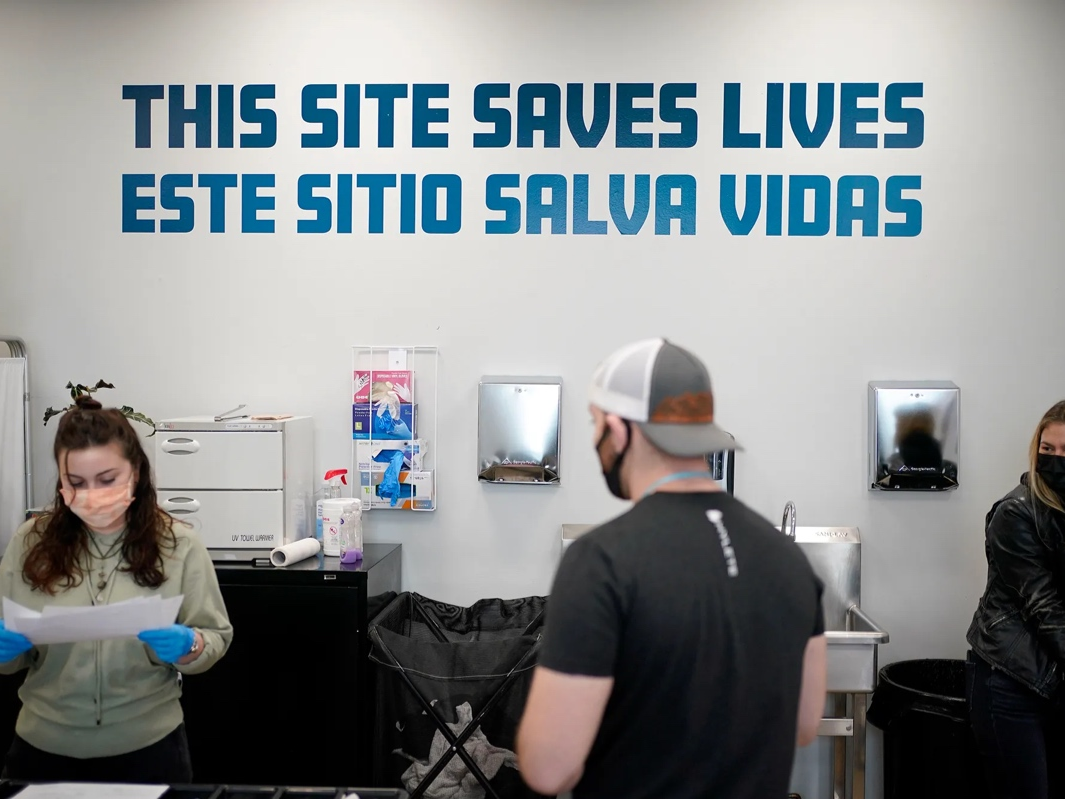
The goal of these programs, supporters say, is to provide drug users a safe, hygienic space where they can get clean needles and administer their own drugs under the supervision of trained staff. Staff members would monitor users and be ready to administer overdose reversal medications if needed, which could ultimately save lives. Medical groups in support of these programs have pointed out injection sites could also help reduce the risk of Hepatitis C and HIV infections associated with intravenous drug use.
Sen. Scott Wiener, author of the bill, said the jurisdictions that would pilot the programs asked to be included in the bill. “They are asking us to help them address the escalations and crisis of overdose deaths that we’re experiencing in California,” Wiener, a San Francisco Democrat, said during an Aug. 1 legislative hearing.
Those in opposition to Wiener’s bill, including Republican legislators and law enforcement groups, argue these programs are a type of addiction maintenance that normalize illegal behavior.
Before setting up their overdose prevention programs, the cities and counties must provide local health and law enforcement officials the opportunity to weigh in. Once set up, these centers must make referrals to substance use disorder treatment programs and other social services if the user wishes to access them. The bill would also protect people from criminal charges for using the sites.
The overdose crisis has become one of the most pressing public health issues, with deaths and emergency room visits spiking in recent years, in large part due to the infiltration of the synthetic opioid fentanyl. Overdose deaths from fentanyl jumped from 1,603 in 2019 to 3,946 in 2020, and then to 5,722 in 2021, according to the California Opioid Overdose Surveillance Dashboard.
California’s second swing at this policy comes as the Biden administration is also embracing “harm reduction” strategies — which focus on keeping drug users alive and safe rather than punishing them. Needle exchange programs and programs that distribute the overdose reversal drug naloxone are some examples.
Among those urging the governor to veto the bill is the Senate Republican Caucus. “Fueling the drug epidemic with drug dens and needle supplies is like pouring gasoline on a forest fire. It merely worsens the problem,” the caucus wrote in an Aug. 1 letter to Newsom.
Law enforcement organizations have stated their opposition to the bill, saying it sends the wrong message to the public and fails to address addiction at its root.
Wiener and supporters of the bill say supervised injection sites will not solve the overdose crisis. Rather, the goal is to prevent deaths.
Opponents have also raised concerns about the bill not providing a “cognizable strategy for figuring out how to get the addict to the injection site,” John Lovell, a lobbyist with the California Narcotic Officers’ Association, said during last week’s hearing. “What injection sites do is there is a magnet effect so that people come into the area,” but that doesn’t mean they will actually go inside the facility, he said.
Laura Thomas, director of HIV and harm reduction policy at the San Francisco AIDS Foundation, another co-sponsor of the bill, said she doesn’t think getting people into these centers will be a challenge. “Overwhelmingly, people would prefer to use in a clean space. No one wants to be using drugs on the sidewalk. If we give people a better option they will use it,” she said.
An often-referenced survey of 602 injection drug users in San Francisco showed that 85% would use a supervised injection site. About 75% of them said they would use it at least three days per week.
“Fueling the drug epidemic with drug dens and needle supplies is like pouring gasoline on a forest fire.”
Senate Republican Caucus
The idea, according to supporters, is to build trust with people who come in, prompting them to spread the word and eventually link people to treatment when they are ready. These centers often look like a clinic, and people usually go through a brief interview when they first walk in.
Thomas said that while it would be ideal for such centers to be open 24/7, realistically, hours of operation would be dependent on funding. That same San Francisco study showed that 62% of the drug users surveyed preferred a supervised injection site to be open from 8 a.m. to 4 p.m.
Funding could prove to be a challenge in the long term. In New York City, where two safe injection sites opened last fall, the city and state do not pay for them. The nonprofits running the programs seek private donations, making it difficult for the centers to extend their hours or expand into other neighborhoods.
A supervised injection site in San Francisco is estimated to cost about $2.6 million a year, according to RTI International, a nonprofit research institute.
Thomas said California community organizations that already work in the field of substance use disorders would be best-equipped to run the programs, but funding should come from public health departments because they are a public benefit.
Some of the cities and counties included in the bill have potential public funding streams. For example, Los Angeles County voters in 2020 passed Measure J, which allows the county to use at least 10% of its locally generated, unrestricted funding for community investment programs, which could include overdose prevention programs.
“We’re also hoping that these pilot projects serve as a catalyst and identify some private-public partnerships,” Zanipatin said.
California confronts opioid addiction, an ‘epidemic of despair’
Although the opioid crisis has not gripped California as it has some other states, rural areas have been hit especially hard. Some lawmakers say the state should do more.
by Elizabeth Aguilera
October 29, 2017
Legal spots to shoot up illegal drugs? Why California may OK them
(Update: On Sept. 12, the Senate voted down AB 186. Its sponsor, Assemblywoman Susan Eggman, said “I am committed to finding a way forward next year.”) Many California communities could open centers inviting addicts to shoot up hard drugs under a little-noticed bill that has cleared the state Assembly and now awaits a vote on the Senate…
by Laurel Rosenhall
July 26, 2017
We want to hear from you
Want to submit a guest commentary or reaction to an article we wrote? You can find our submission guidelines here. Please contact CalMatters with any commentary questions: commentary@calmatters.org
The story you just read was funded by people like you.
CalMatters is a nonprofit newsroom and your tax-deductible donations help us keep bringing you and every Californian essential, nonpartisan information.
CalMatters gives me vital California legislative updates, especially on health and environment issues.
Manijeh, Long Beach
Featured CalMatters Member
CalMatters.org is a nonprofit, nonpartisan media venture explaining California policies and politics. Sign up for our newsletters and follow us on Facebook, Twitter and Instagram.