Schools
St. Mary's and All Angels School Hosts Film 'Race to Nowhere'
The documentary questions scholastic expectations for kids in school today.


Devon Marvin was a 13-year-old straight "A" student, but when she received an “F” on a math test, .
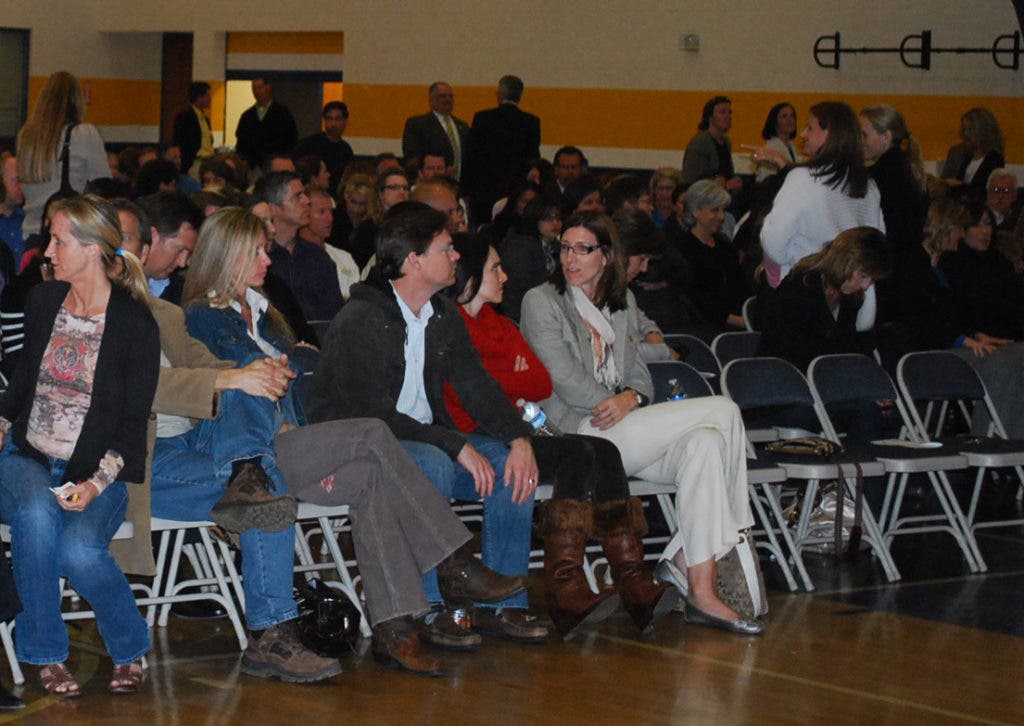
The documentary Race to Nowhere is dedicated to Marvin and depicts the pressures placed on students like her. On Tuesday evening, St. Mary's and All Angels School screened the film in Aliso Viejo to an audience of 420 people.
Race to Nowhere questions current popular teaching methods and the tests used to determine scholastic achievement. The film also warns against the rising pressure placed on students and teachers to perform.
Vicki Abeles, who began noticing signs of stress in her children, created the documentary. Her son, Zak, would cry before going to elementary school. Jamey, her daughter who was in junior high school, began showing symptoms of depression.
"I wanted to understand what was going on," Abeles said in the film.
Find out what's happening in Aliso Viejofor free with the latest updates from Patch.
Abeles asked students, teachers, administrators and psychologists their thoughts on the current educational system in the United States.
From talking to students, Abeles gathered that young people today are expected to be superhuman. Many children go to school, participate in sports, participate in extracurricular activities, volunteer in their communities, meet with tutors and complete hours of homework. In each arena, they’re supposed to excel.
As a result, more young people are suffering mentally and physically, the film says. Psychologists are seeing more children facing nervous breakdowns. Sleeping and eating disorders are on the rise. Students take stimulants and depressants to help them keep up with the educational demands placed on them. Under their clothes, some children hide the results of “cutting,” or habitually slicing their skin to help deal with stress.
"Metaphorically as well as literally, they're bleeding underneath," clinical psychologist Dr. Madeline Levine said in the film.
The film discusses the 2001 federal law known as No Child Left Behind. The No Child Left Behind Act requires that standardized tests be taken in government-funded schools to assess yearly progress made by students. The film asserts that students who are required to take standardized tests learn how to memorize, not to "think outside the box."
Find out what's happening in Aliso Viejofor free with the latest updates from Patch.
The movie also presents evidence showing that cheating is on the rise and says the amount of homework students are saddled with should be reduced. The Case Against Homework, a book by Sara Bennett and Nancy Kalish, is cited in the film. The book says homework "overload is compromising our parenting choices, jeopardizing our children's health, and robbing us of precious family time."
"Countries outperforming the U.S. actually have less homework," Stanford University School of Education senior lecturer Denise Pope says in the film.
Toward the end of the documentary, Abeles discusses how time spent with her family changed.
"We don't ask about homework," Abeles says. "We don't ask about grades. We asked the school for less homework. We have dinner together, and we play games together. Right now, for me, success is just getting her [Jamey's] health back."
***
Parents weighed in on the film's message.
Julie Gillespie, a mother of two children, volunteered at the film screening.
"I feel like my kids are burning it at both ends. We've got to pare down. You have to keep a balance," Gillespie said.
Sitting next to Gillespie was fellow volunteer and mother Kim Principale.
"I love the movie," said Principale. "I think everyone should see it and decide how it fits into your home life."
A credentialed multi-subject teacher, Zareen Charna, came to the screening.
"The movie reinforced things that I already know," said Charna. "You have to take these issues seriously when kids get into high school. They're so overwhelmed."
Mother of two Karen Lieber said, "It's very sad ... overwhelming, sad, and frustrating. I'm guilty of these things. I think I'll change what I do at home."
St. Mary's School now has "no homework days" when no homework is assigned.
"St. Mary's has a policy that says if you've been working on a school project with your child for 1½ hours and your child just 'doesn't get it,' you're allowed to write the teacher and say, 'It just didn't work out for us,' " said Lieber.
Sitting next to Lieber was Beth Randolph, a mother of three.
"I see all of this in my 13-year-old," said Randolph. "She will say, 'I got a B on my test,' and I will say, 'That's awesome!' and she will say, 'No, it's not.' "
Outside the auditorium, mother of three Cindy Smith said, "I think as a society we've gotten narrowly focused on how to get to an end point. There are many ways to get there, and you have to choose what's best for your child. School's don't allow for being 'outside the box.' "
Smith's friend Erica Ierardi and mother of two said, "Sometimes it's about what's best for the system. Kids should be celebrated as kids and not as cogs in a machine."
Father of two Steve Canto said, "The film reinforced my ideas that I have at home. Plus, there are so many different solutions to get into college."
Canto's wife, Kerry, said, "You can teach your own kids through home schooling or they can attend charter schools."
Melissa Friedl was a public-school teacher for 11 years from 1994-2005.
"I chose to put my own kids in a private school," she said. 'I want my kids to be happy. I want them to think outside the box."
***
After the film, members of a five-person panel were introduced from up on a stage. In attendance were Don Cardinal, dean of the College of Educational Studies at Chapman University; John T. O'Brien, headmaster at St. Mary's School; Patricia Merz, assistant head of school at Sage Hill School; Walt Linaweaver, head of St. Mary's Middle School; and Gregory L. Koch, Ph.D., licensed child and adolescent psychologist.
"I think it's OK for kids to feel some stress, but it's just 'how much?' It's important that expectations are in line with the individual child," Koch said. "Kids are always changing, but when you see a negative change in sleeping ... if your child is not sleeping, that's a big red flag. Or a change in eating, or despite the amount of time they spend on schoolwork, it's never enough. Or they don't have time to see friends."
An audience member asked for some of the reasons that admission to college is so difficult now.
"There is an institution which I cannot name, but their admission rate used to be 60 percent 15 years ago. Now the admission rate is 15 percent," O'Brien said.
Cardinal suggested that students go to a community college for two years and then apply to a four-year school.
Another audience member asked if there is a purpose to having so much homework and when homework becomes busy work.
"We have lead teachers for each grade level who monitor homework. Sometimes they have to 'right the ship,' " Linaweaver said.
St. Mary's director of marketing communications Kay Fernandez hosted Tuesday evening's event.
Fernandez said, "We were very happy with the turnout ... and ... we share the sentiments of the film."