Politics & Government
Officials Detail City Employee Salary Negotiations
The city manager, council members and employees provide insight on how city salaries are determined each year.
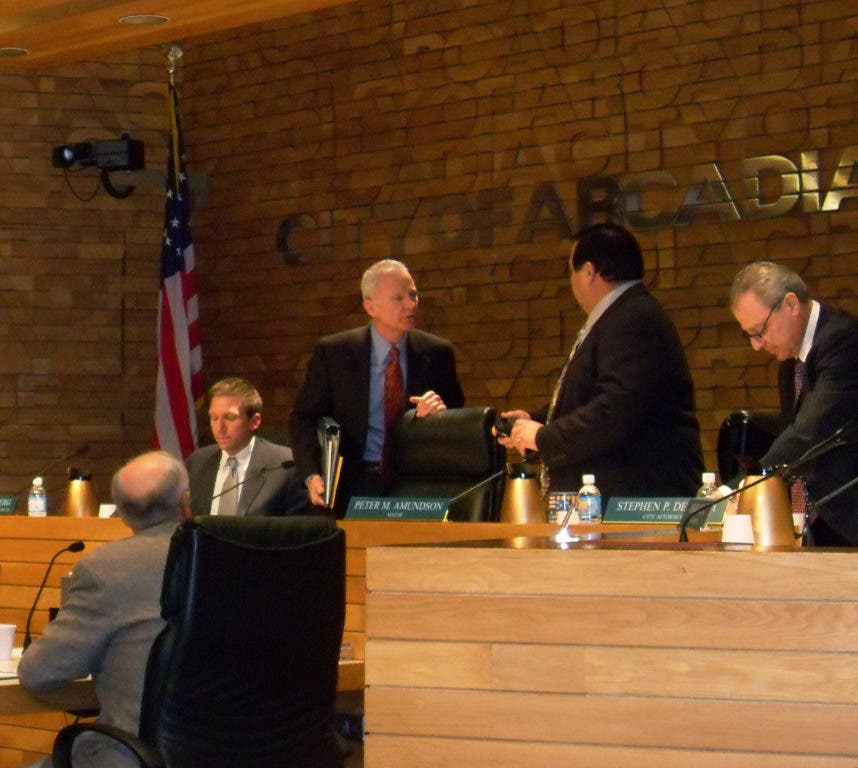
Arcadia officials and representatives of five city employee associations have begun laying the groundwork for the upcoming fiscal year's salary contracts.
Since the scandal last year in Bell that featured a city official looting a nearly $800,000 salary from taxpayers, closer scrutiny has fallen on local governments in cities such as those near the San Gabriel foothills and other parts of Los Angeles County.
Municipal top brass in Arcadia all make six-figure salaries, according to documents posted on the city's website. City Manager Don Penman's annual take in 2010 was the highest at $214,032, followed by eight department heads who received between $125,000 and $175,000.
Find out what's happening in Arcadiafor free with the latest updates from Patch.
All Arcadia city salaries for 2009 are listed on the state controller's website.
Penman explained how he and other officials decide on payroll structure, which is set up according to state law requirements and ultimately approved via an Arcadia City Council vote.
Find out what's happening in Arcadiafor free with the latest updates from Patch.
"[Officials informally] survey other cities that we believe are comparable to us in terms of population and services provided," Penman said. "We try to pay comparable salaries to those cities so we can remain competitive and use a similar approach when determining benefit packages, including health care."
Tom Devlin, president of the Arcadia Firefighters Association, leads contract negotiations on behalf of co-workers.
"Like every city everywhere, budgets are tight so we have to maximize the bang for the buck," said Devlin. "We're trying to work with the city in a variety of avenues on budget cuts and concessions."
The veteran fireman noted the balance of interests that goes into agreements on employee compensation.
"We walk a very delicate line because we look at ourselves as part of the community, not just a labor group working for the city," Devlin said.
Until January, Detective Troy Hernandez of the was the police association's president and still serves on its contract negotiation team.
"Much has come out in the media about public employees and their benefits, and rightfully so," said Hernandez. "I believe an employee should be compensated a fair wage for what their job classification and duties dictate. As a new, young police officer a veteran once told me, 'you don't get paid for what you do; you get paid for what you might have to do.'"
Hernandez said he believes "the salary negotiation process is thorough and equitable for all involved. Because public safety is unique in and of itself, so is our overall computation of total compensation."
Police base their collective bargaining position on a survey of law enforcement salaries in Los Angeles County and 13 nearby contract cities including Alhambra, Burbank, Monrovia, Monterey Park and Pasadena, according to last year's salary contract.
"In the past, one of the most challenging parts of the negotiation process was the information being relayed to the city council by past city officials," Hernandez said. "In more recent times, our association has been able to promote positive relationships with City Manager Don Penman and honorable city council members such as Mickey Segal and Bob Harbicht."
Judy Cook, president of the Arcadia Police Civilian Employees Association, didn't have as rosy an outlook on how the city does business.
"The negotiation process in this city needs to be improved," she said. "The city claims to want to treat all groups of employees equally, but a review of the differences between safety employee contracts and nonsafety employee contracts quickly proves that is not what happens."
Cook described what she perceives as management's apparent lack of interest in nonsafety departments.
"In the past, 'meet and confer,' the state law term for collective bargaining, has turned out to be 'meet and explain' for nonsafety employees," Cook said. "The Arcadia Police Civilian Employee Association is committed to reversing that trend."
Anthony Pulido and Shelly Polifka, presidents of the Public Works and Arcadia Civilian Employees associations, declined to comment on their experience negotiating wages.
While Penman acknowledged that "salary negotiations can be contentious," he denied favorable treatment for police and firefighters.
"Some might argue that public safety associations have more clout, but in Arcadia our city council tries to treat all employee groups the same," he said. "That doesn't always mean each group gets the same salary and benefit package. In the end compromise is important, but the city must balance the needs of employees with the resources we have."
Penman also detailed what the council draws from public funds. In line with state law and the city charter, council members receive $500 per month and $30 per Redevelopment Agency Board meeting not to exceed two per month, he said.
Council members are eligible for the city's health care plan available to all other employees, but "they do not receive anything else," said Penman. "Many cities in the San Gabriel Valley provide their elected officials with car allowances, cell phones or cell phone allowances and expense allowances. Arcadia does not do that."
He said the city has a relatively small travel budget for council members compared to other cities in the area, and members don't go to many conferences.
"To my knowledge, no one on the Arcadia City Council puts in an expense account for mileage or other such expenses," said Councilman Bob Harbicht. "Why? The people I've served with on the Arcadia City Council—and there have been a lot of them over the last 25 years—have been in it to serve the city, not to serve themselves."
Penman described the council as "a conservative group which is reflected in their spending in general, so they are not looking for these types of benefits," he said. "All of them have been or are successful in their own private careers, and they do not expect to be reimbursed for every expense they incur for their work as council members, though they still spend many hours on city matters."
Harbicht cited the need for attractive salaries in order to secure "top talent" in department positions.
"Since we're the ones who set their salaries, I have to say [wages] are about right," said Harbicht. "We have an outstanding group of department heads, and we're lucky to have them. I think the combination of the fact that we pay competitive salaries and the outstanding city that Arcadia is to work for attracts top talent."
Councilman Roger Chandler said department-head salaries were "just right" and council members' low salaries and lack of perks was a "good thing."
Human Resources Administrator Mike Casalou is one of several officials who represent the city in employee contract negotiations. He spoke on Arcadia's safe fiscal position in the midst of the nationwide economic downturn that has forced most small cities to make major cuts in services and staff.
"Compared to most cities that rely solely on property and sales tax, Arcadia is very financially sound with the way we've handled things," said Casalou. "We're not looking at layoffs, and the city is very financially sound."
Casalou credited Arcadia's "diverse portfolio" for this break from the cash-strapped municipal norm as the national economy takes its time to recover from the worst recession in generations.
All city employee contracts expire June 30, and negotiations are ongoing up to that point.