Business & Tech
Banning's Energy Plans Go Vertical
Banning has joined a group of California cities buying alternative energy from a solar chimney to be built in Arizona.

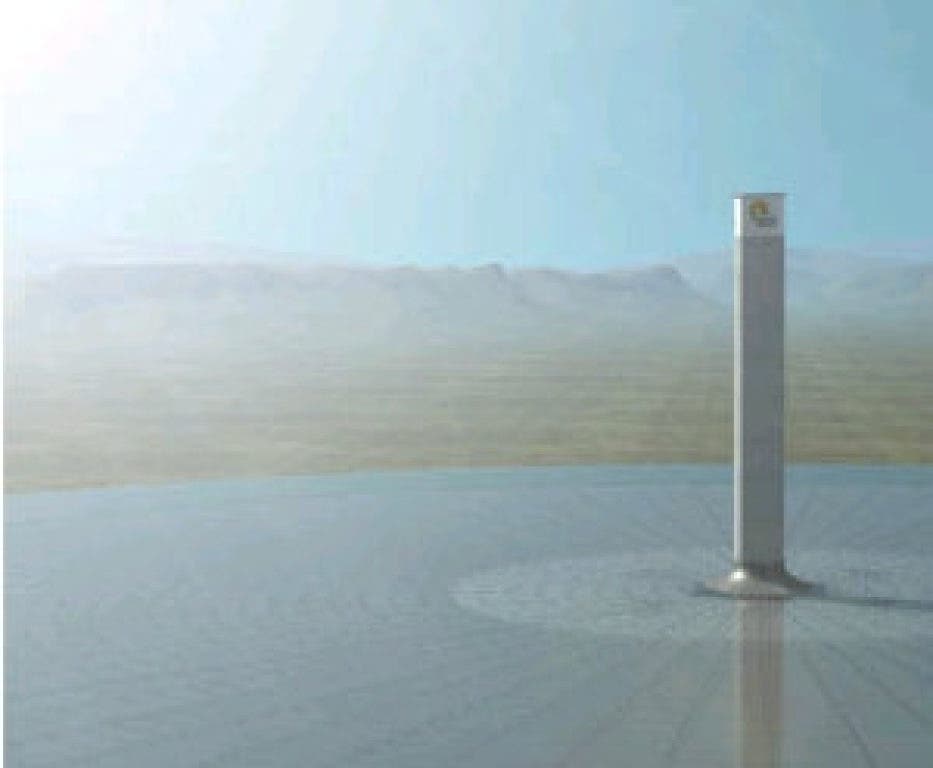

Banning’s plans for alternative energy are taller than the Empire State Building.
The city council voted 5-0 on Jan. 25 to join a Southern California Public Power Authority group buying power from a proposed EnviroMission solar chimney in western Arizona near the Colorado River. The solar chimney, which would be a reinforced concrete structure 1,000 meters tall—more than twice the Empire State Building's height—would be surrounded by a 5,000-acre greenhouse. Air heated in the greenhouse would rise through the solar chimney, creating a wind tunnel that would drive 32 turbines similar to the windmills in the San Gorgonio Pass. The turbines would continue to turn for several hours after sunset because of passive solar heat absorption into the ground.
“The reason I liked this project is that it provides the most electricity at times of peak demand,” said Fred Mason, director of Banning Electric, the city-owned power company. “The solar chimney facility would be putting out the most electricity on hot days when air conditioners drive power consumption to its highest levels.”
Find out what's happening in Banning-Beaumontfor free with the latest updates from Patch.
The solar chimney concept has been around since the 1960s, but low fossil fuel prices kept it from being developed. With California mandating that utilities develop significant percentages of their power from energy sources other than fossil fuels, the concept is once again moving forward.
The only working solar chimney so far has been in Manzaneres, Spain—a prototype 50kw plant that successfully produced electricity from 1982-89. The Arizona EnviroMission plant would be a 200Mw plant far bigger than the prototype.
Find out what's happening in Banning-Beaumontfor free with the latest updates from Patch.
Southern California Public Power Authority
The SCPPA group that is buying half of what the facility is expected to generate is a consortium of Southern California cities including Azuza, Anaheim, Burbank, Glendale, Imperial Irrigation District, Los Angeles, Pasadena and Riverside in addition to Banning.
Mason said that the SCPPA would not provide any funding for construction of the facility. If the project failed to meet construction milestones, the SCPPA could void its contract and would collect a fee from the developer. The only obligation to SCPPA is the buying of electricity if the facility is successfully completed.
Banning would buy about 2Mw of the power, which would “represent about five percent of its projected retail load in 2015,” according to the city council agenda.
Banning was the first California city to meet its alternative energy quota of 20 percent, much of it generated by a geothermal plant in Imperial County. If La Paz produced according to projections, the Banning share of the electricity would satisfy the state’s mandate for 2015 of 24 percent.
Will It Work?
Critics of the project say that the 1,000-meter chimney would cause severe air turbulence, that keeping dust off the glass greenhouse in the desert will be difficult, that the project won’t be cost effective, and that the huge chimney will be far more difficult and expensive to build than EnviroMission realizes.
EnviroMission chairman, CEO and major stockholder Roger Davey, an accountant who headed the largest stock brokerage in Australia before Merrill Lynch acquired it, has minimized the challenge of building the concrete tower, since it won’t require the windows, wiring and other complexities of a tall building. Davey thinks that the idea of a water- and pollution-free method of power generation will attract the investors needed to fund the $750 million facility (the High Desert Power Plant in Victorville, a gas turbine generating plant, cost as much).
The plant would be built on state land in La Paz County, Arizona, which may make it easier to acquire property. La Paz County has only 20,000 residents—one-third of whom are senior citizens— spread out over 4,500 square miles. Its largest towns are Parker and Quartzite, a popular stopping point for Interstate 10 travelers. EnviroMission has applied for two 5,500-acre sites there.
SCPPA will pay 9.5 cents a kilowatt hour for the first 15 years of La Paz electricity, which Mason said was “a very good price.” The long-term agreement would add a penny per kilowatt hour each of the next 15 years.
Get more local news delivered straight to your inbox. Sign up for free Patch newsletters and alerts.