Politics & Government
Beaumont Becomes First IE City To Oppose State's Sanctuary Law
Though the city will need to vote on the final resolution, council voted 3-2 in favor of opposing SB 54.


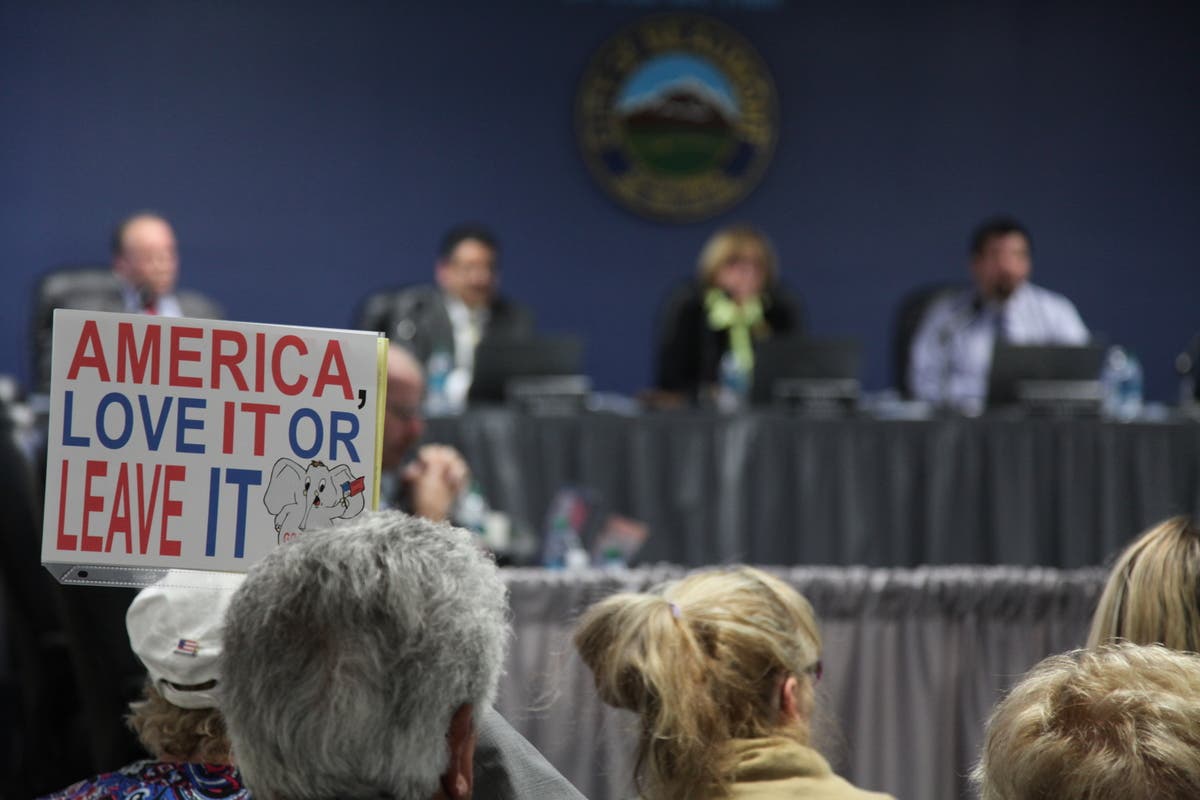


BEAUMONT, CA — In front of a packed house (and packed overflow room), and after dozens of people spoke on the issue, the Beaumont City Council on Tuesday night voted 3-2 to oppose the state's so-called "sanctuary law," or SB 54. The law, which took effect Jan. 1, limits local law enforcement cooperation with federal immigration authorities and has been a divisive issue across California communities. (Scroll down for the full video from Tuesday's meeting, which Patch streamed live on Facebook.)
"This is not about illegals versus legal... this is about criminals and about the rule of law," said Beaumont City Councilman Lloyd White — who drafted the resolution that the council approved Tuesday night — after nearly three hours of discussion and comments on the issue.
In total, more than 60 people spoke about their concerns with the state's law, called The California Values Act.
Find out what's happening in Banning-Beaumontfor free with the latest updates from Patch.
The vote to "oppose" the law was done as a way to show the state that the local leaders believe SB 54 is incompatible with federal law and, therefore, illegitimate. However, the mayor and city attorney also stressed that it will not make a difference in everyday life in Beaumont; rather, it's a "statement."
"We're not going to change the world... we might be pretty good at politicking... but we're not really going to change anything," Mayor Nancy Carroll said before voting against the resolution.
Find out what's happening in Banning-Beaumontfor free with the latest updates from Patch.
Julio Martinez was the other one to vote against the resolution, while councilmembers Lloyd White, Mike Lara and Rey Santo voted for it.
"We don't have a right to decide whether the federal government has stepped over a line, or whether the state has stepped over a line," Carroll added. "I have my own personal thoughts on this, but I'm not even going to bring them up because that's not my job on the dais. My job on the dais is to try to do the right thing for the city, so I do not think that this is a city issue."
The resolution will return to council for a second reading and approval at their next meeting on May 1.
Tuesday's 6 p.m. meeting started with a few other items, but it didn't take long for the council to delve into the main attraction that drew more than a hundred people out to the normally quiet council chambers. One-by-one, community members — and several people from other Southern California cities — voiced their concerns about SB 54.
"Please do not allow Beaumont to become a hateful city," one person said.
"The image of the city is beginning to improve, why are you seeking to get involved in a controversial issue?" another echoed.
"Don't let all the noise disturb your conscience," said another.
There were political candidates in attendance, who made their stance known on the issue. Gary Jeandron, a former police chief of Palm Springs who is running for the Pass Area state assembly seat, spoke against the state's law, urging council to file an opposition.
"I was a police officer when 9/11 occurred," he said. "The biggest criticism we had was was that we operated in silos of information. We didn't share information. What this law does, is it interferes with and creates an artificial silo; and that to me is very dangerous."
Another person who urged the council to pass the resolution Tuesday night was Agnes Gibboney of Rancho Cucamonga, who said she is a "legal immigrant" whose first-born son "was murdered by a previously deported illegal alien."
"I find it very difficult to believe that I'm standing up here before you, asking you to uphold federal laws," she said. "Where was my son't sanctuary? Where was my sanctuary?"
Overall, those who came to speak in Beaumont maintained a respectful demeanor throughout the evening of differing views on the issue, though there were a few periods of exited shouting during the evening. One woman was asked to leave the room after an extra loud whelp was let out while council was speaking.
Orange County recently passed its own similar resolution, with the supervisors voting to join a U.S. Department of Justice lawsuit filed against California last month seeking to invalidate SB 54, which Attorney General Jeff Sessions compared to an act of "secession" from federal jurisdiction. Orange County cities that have passed resolutions backing the lawsuit include Aliso Viejo, Fountain Valley, Huntington Beach, Los Alamitos, Newport Beach, Orange and San Juan Capistrano.
Sen. Kevin De Leon, D-Los Angeles, who authored SB 54 and is now running for the U.S. Senate, has been stumping against surging opposition to the bill, which Gov. Jerry Brown signed into law on Oct 5.
De Leon argued in literature attached to SB 54 that "65-75 percent of all deportations nationwide are the result of collaboration between law enforcement agencies and Immigration Customs Enforcement or Customs and Border Protection," and the practice must be stopped to prevent the "devastating impact deportations have" on undocumented immigrants and their families.
Most components of the legislation were opposed by the California State Sheriffs' Association, which voiced concerns about the ability of law enforcement officers to apprehend criminal immigrant offenders and coordinate with federal agents to ensure that they face prosecution.
SB 54 makes it illegal for county or municipal peace officers to do any of the following:
- ask about an arrestee's immigration status
- honor a federal immigration hold request or detainer, unless it's specifically authorized by a judge
- arrest a person based on a civil immigration warrant
- notify federal authorities about the pending release of a jailed illegal immigrant, with a couple of exceptions based on criminal history
- participate in task forces that target illegal immigrant offenders
- utilize immigration officers as interpreters during local interactions with suspects
SB 54 also mandates that schools, health facilities, libraries and courthouses serve as "safe zones," where undocumented immigrants can come and go without risk of detention.
SB 54 was an expansion of Assembly Bill 4, the so-called "Trust Act" of 2013, which prohibits honoring federal detainer requests, specifically for foreigners arrested or suspected of minor offenses.
The cities of Loma Linda, Redlands and Yucaipa may be considering anti- SB 54 resolutions of their own soon.
Patch photos by Renee Schiavone / City News Service contributed to this report.
Get more local news delivered straight to your inbox. Sign up for free Patch newsletters and alerts.