Business & Tech
UPDATED: Asparagus Tips, as a New Crop Comes Up
Warmth and sun, after a good rain, should bring more to market soon.

Updated with asparagus prices and a report on what's fresh and available in the market on Sunday, April 3.
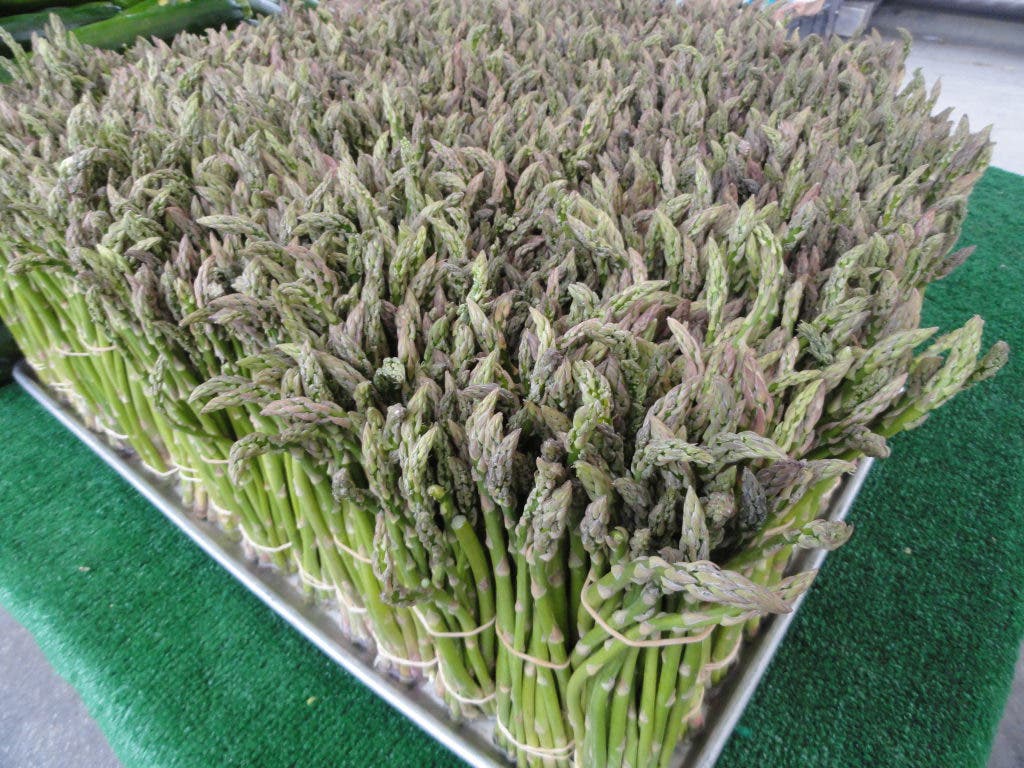
This week the asparagus season should start to peak with the sun and high temperatures California has seen. After being delayed by rain, the harvest is starting in the state's top-producing area, the San Joaquin Delta, according to the California Ag Network.
Asparagus benefits from moisture, though, so agricultural experts think that the winter rains will be good for the crop in the long run, and the network quotes farmers as saying that the 2011 asparagus yield will be about the same size as last year's: about 40 million pounds. (It's hard to say what that means for prices, though, with the cost of fuel and food continuing to rise.)
This morning at the Sunday's Harbor Area Farmers Market at the Marina, you can find asparagus at the R.S., Zuckerman's and Smith Farms stands and maybe some others, too. (Some stands were still setting up when I was there.) Depending on the size and quality, expect to pay from $2 to$3.50 a bunch.
When I was growing up on a farm in Michigan, asparagus was our earliest crop of the year. And we had to get up early to pick it -- at dawn -- because that's when it's at its best, in the coolest part of the day. It grows incredibly fast, even faster than the bamboo that the creeps in from a neighbor's yard.
We had to pick it while the heads of the spears were tight, and before they started to sprout seeds and "fern out" or it was unsaleable (which can be a matter of hours). And short, plump spears were the most desirable. (Most of what we picked probably ended up jarred or in cans.)
That's not to say we didn't have to pick the fields after school, too--because keeping them well-picked encourages new growth. And what we couldn't sell, we could eat right then or freeze--or give to the chickens (who loved it).
At the end of its cycle, the asparagus plant grows into a bush that's full of tiny red berries and looks like a scaled-down tumbleweed. It acts like a tumbleweed, too, blowing and rolling in the wind, scattering seeds. That's why in agricultural areas you can sometimes find "wild" asparagus plants on roadsides and quite a distance from fields.
Frankly, a lot of what you see at farmers markets and in grocery stores is what we considered then a little past its prime--already starting to branch a bit and "seed out." It's still good, but the best and most tender are the smooth, tightly tipped spears. Just-picked asparagus is even good raw -- nicely crunchy and sweet, and by just-picked, I mean within minutes.
Along with looking for tight tips, avoid spears that show purple or white skin at the base. That part is tough and inedible because it's already turning to wood. Some of it can be salvaged, though, by using a potato peeler to strip off the outer flesh until you get to the tender center. And, of course, it's important to keep asparagus cool and not let it dry out. That's why you'll sometimes see bunches standing up in a shallow pan of water at markets.
Back on the farm, we always lightly boiled or steamed it. Or we pan fried it in butter with eggs for breakfast--which almost made up for having to get up so early to pick it. But lately I'm partial to roasting or grilling it--especially if it has a little age on it.
Find out what's happening in Belmont Shore-Naplesfor free with the latest updates from Patch.
According to the USDA's nutrition data, ½ cup of cooked asparagus has about 20 calories from fat, 4 grams of carbohydrates, 2 grams of fiber (about 7% of the daily requirement), 1 gram of sugar and 2 grams of protein. The amount of some daily recommended vitamins and minerals it supplies are: 18% of vitamin A, 12% of vitamin C, 2% of calcium and 5% of iron. It has no cholesterol.
Along with strawberries, oranges, apples and grapefruit, you can find the following in abundance and looking very good at the Sunday market, as of this morning:
Find out what's happening in Belmont Shore-Naplesfor free with the latest updates from Patch.
- lemons
- oranges (including Cara Cara)
- tangerines
- carrots
- broccoli, Broccolini and Chinese broccoli
- peas (snow, snap and English)
- spinach (including Savoy)
- lettuce (romaine, red leaf, butter) and mixed greens
- cabbage
- cilantro
- beets
- brussels sprouts
- artichokes
- potatoes (several varieties and sizes)
- yams
- sweet potatoes
- garlic (including Chinese and garlic)
- onions (including Maui)
- avocados
Also available:
- tomatoes (including on-the-vine)
- green beans
- blackberries
- red raspberries
- blueberries
- parsnips
- turnips
- mushrooms
- Savoy spinach
- bok choy
- Chinese broccoli
- artichokes
- shallots
- leeks
- Jerusalem artichokes
- kale
- kohlrabi
- radishes
- parsley
- avocados
Harbor Area Farmers Market (Long Beach Southeast). Alamitos Bay Marina, on East Marina Drive, one-quarter mile south of East Second Street, just west of Pacific Coast Highway. 9 a.m.-2 p.m. (though some vendors are ready to sell at 7 a.m.). www.goodveg.org.