Health & Fitness
It's Crafty: To Scour or To Cower? A Fleece Cleaning
Faced with the task of cleaning unprocessed fleece, one might ask "Is there anything I should know before I start?" A revealing discussion (with experiences) about cleaning unprocessed fleece.



A maker is one who makes. We are all makers in a sense. We've all made something, created something out of other things. Some more than others.
I'm a , very interested in fiber and fabric and recently have been dabbling in spindles and spinning wheels. I've been visiting with some spinners at the Greater Los Angeles Spinning Guild (GLASG), and had a grand idea for Lowell Elementary's Colonial Days demo! I'd need to learn a few things in order to do it, a bonus for me!
A Grand Idea about Scouring.. Cleaning... Fleece
Find out what's happening in Belmont Shore-Naplesfor free with the latest updates from Patch.
Colonial Days! What a great opportunity for an interactive hands-on experience with wool! I'd heard of GLASG's experiences helping the sheep farmers sort the fleeces after shearing and knew that some had done their own wool preparation from newly shorn fleece. Wouldn't it be cool to find some unprocessed fleece that the kids could help to scour and hand-pick? Nothing better than getting elbow deep in the experience! I knew it would be icky, but a little hot water and wool detergent would get the dirt out, wouldn't it?
Finding the Fleece
Find out what's happening in Belmont Shore-Naplesfor free with the latest updates from Patch.
If you're looking for unprocessed fleece, where do you go?
I sought out fleece from a local rancho, a local Long Beach community farm, our very own Long Beach sheep farm (Shoestring City Farm), a Michigan sheep farm and the GLASG Yahoo! Group. Several could provide wool or fleeces, the others were seeking sheep for shearing and wool for felting.
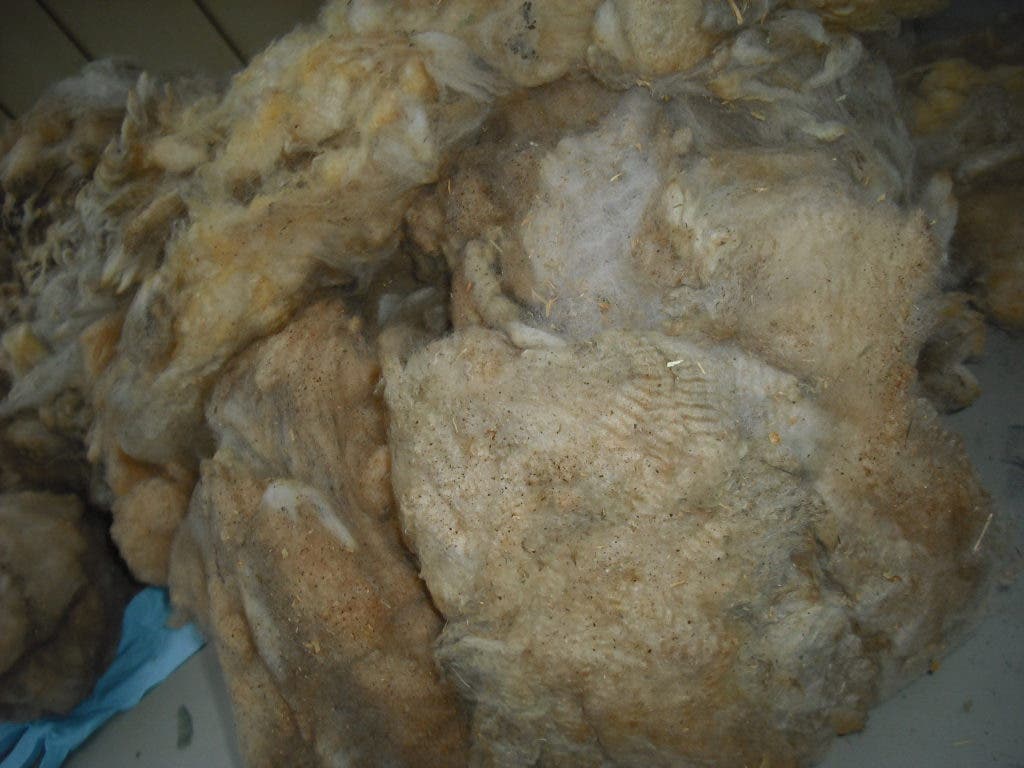
The Michigan sheep farm had a great price on unwashed fleece, and the local sheep farm had some possibilities. However, my most generous offer came from GLASG member Jill Borders who had an "unskirted Dorset fleece" and - get this - "was thinking about just getting rid of it."
Fleece Cleaning Concerns - Cower!
I'd jumped into this project without knowing what I was doing. If I didn't get the fleece, there would be no point in researching how to clean it. I had some vague notions about the raw wool having lanolin on it, and there being a bunch of vegetable matter in the wool, especially if the sheep hadn't worn a coat. (Sheep wear coats?)
Again, GLASG members came to my rescue with much welcome, though unexpected information. Ercil and Lorinda spoke of "health concerns", "fecal residue, obvious chunks or not" and "nasty diseases from skin ailments to tetanus".
Laura Silverman-Splayer who suffers with Lupus, had a very personal experience to share -
"I have an extremely compromised immune system so my case is quite exceptional, but for those of you who were not around when I got it or those who don't remember, I contracted a case of Brucellosis by processing my own raw fleeces rather than having them sent out for cleaning.
Brucellosis is a very rare disease, mostly associated with those working on professional factory farms, and there are less than 200 cases diagnosed in the United States each year, so you can imagine how horrible it was getting sicker and sicker and sicker with daily fevers that rose past 105, and nobody, not even the infectious disease experts at Cedars Sinai, could figure out what was going on. Finally, 11 months after the symptoms first appeared, they - just on a fluke because they decided to run blood tests for pretty-much every infectious disease known to man - it was diagnosed. It is so rare that they didn't believe the results, so they ran the test for it 3 more times before they confirmed that it was what I had. At that point, I asked what it was and how it was contracted; they were shocked because I did not tell them about my spinning hobby."
OK! That's it!!!!! I'm running for cover!
The Answer is Yes - Scour, but in certain situations, Cower
The point my GLASG advisors were all trying to make was that while they and those wanting to get a little closer to the wool's source might know the risks involved and still choose to do their own scouring, one should be extremely cautious about the potential of exposing unwitting strangers to those risks.
Sorry kids, no washing or picking of vegetable matter from that fleece for you!
At the petting zoo and the county farm, we all pet the animals, but we quickly follow that with hand-washing and sanitizing. We don't fluff the wool or even touch it for very long. Demonstrators and fiber folk, will continue to get close to the wool, but it's their choice! To quote Laura opined, "most would not have an issue, but you never know what health issues strangers might have."
Laura provided me with her outside processing contact and company, Shari McKelvy at Morro Fleece Works. I do plan on sending some of the wool to her as part of this experience. In an attempt to keep it local, I took a quick look around - this was the closest fiber processing to Long Beach that I could find.
I also plan on doing some myself.
Spinning Conference in Our Backyard
From the Hand Weavers Guild of America website: HGA's Convergence® 2012 Long Beach will be held at the Long Beach Convention Center, July 15 - 21, 2012. The Convergence conference is organized and sponsored by the Handweavers Guild of America, Inc. Along with many dedicated fiber enthusiasts and the Long Beach CVB, HGA is pleased to welcome you to Southern California.
Thanks to the many GLASG members who lent advice for this fun!
You may find on the Belmont Shore Patch and at the Handmade Penguin blog.