Politics & Government
Update: City Council Approves Study on new regulations for 2nd Street Bars
The agenda item seeking to curb excessive partying on Second Street, which passed with a vote of 7-2, turned City Hall into its own sort of "party" last night.
Editor's Note: This is the full Patch story on the meeting which elaborates on our earlier story.
The agenda item seeking to curb excessive partying on Second Street, which passed with a vote of 7-2, turned City Hall into its own sort of "party" last night.
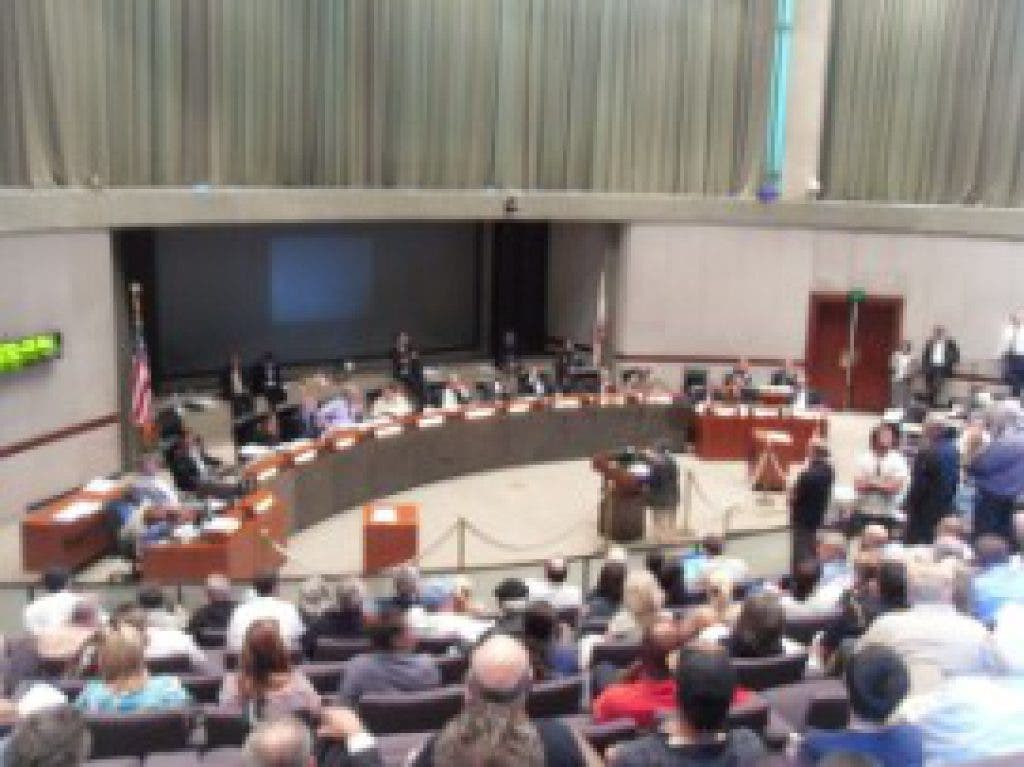
The room was packed, filled with hundreds of people invested in the late night goings-on in Belmont Shore. They ranged from residents to business owners, patrons and employees. Whistling and clapping from the crowd after certain comments prompted Mayor Bob Foster to admonish the audience.
Find out what's happening in Belmont Shore-Naplesfor free with the latest updates from Patch.
"This is not," he said at one point, "a sporting event, people."
The unusually large attendance was due to potential changes on the table for businesses. What everyone was so up in arms about was this: Councilman DeLong proposed to have the Planning Commission conduct a study about whether changing requirements for Conditional Use Permits, specifically for businesses on Second Street that are open after midnight, might improve conditions in the Shore, i.e. extreme disturbances by intoxicated persons exiting the bars.
Find out what's happening in Belmont Shore-Naplesfor free with the latest updates from Patch.
While some harken back to a nostalgic past when, they say, the drunks were not as prevalent and some maintain that conditions are as good or bad as they have ever been, DeLong's hope is to "create a set of operating conditions that will reduce the negative impact of the bars on the surrounding neighborhood," he said in an e-mail.
At Tuesday night's watershed meeting, in which longtime allies had clearly become adversaries--business owners and a pro-business Councilman--DeLong tackled what some residents had been wondering: why is this finally being addressed now?
"I hope the one thing we can all agree on is that there is a problem in Belmont Shore, he said. "We can discuss what appropriate actions can be taken. And if anything, I can be accused of being too late, taking five years to realize there is a problem."
Aileen Colon, president of the Belmont Shore Resident's Association with a membership of several hundred, including some residents who own businesses, spoke for that group , when she stated her support "to evaluate potential benefits of CUPs for bars after midnight."
Indeed, for some residents, this is a long time coming. Among those who waited in a long line to address the Council was Mike Ruehle, former president of the BSRA, a longtime adversary of DeLong's on this and other issues. Ruehle, who sold his home on LaVerne earlier this year to relocated elsewhere in Long Beach, supported DeLong's study proposal. But he noted that it was five years in coming, adding, "It's about time."
As it stands now, CUPs are anchored to the land, passing from one owner to the next without any action needed. DeLong's proposal would require a CUP for application renewals and any change in ownership, allowing the city more operational control over all the late-night bars, not just ones with entertainment permits, and it could address such things as exterior lighting, hours of operation, security and requiring I.D. checkers. Exactly which operations would be affected would be determined after review.
While no one knows yet what the conditions will be, or if they will change, some seem certain a change will end up forcing businesses to close early, and some already are closing early themselves. Though not quite a clash of titans, the two figureheads on this issue each made their cases, one for free enterprise and one for checks and balances.
It's no secret that Gene Rotondo, owner of the the largest business on Second Street, the popular sports bar Legends, is an outspoken voice against government restrictions on business; in fact, he is selling the place, which he has owned since 1988 and rebuilt after a fire in 2007, because of what he called unnecessary interference of government on business.
"To us this is a hostile environment, and [leaving] is a risk management decision. Council Member DeLong changed his business friendly position after his second term, and has been intending to move up on the political food chain," Rotondo said at the podium.
Employees of the bars on Second Street voiced concerns that shutting down businesses at midnight would threaten jobs, revenue and the right to free enterprise. DeLong continually denies any intention to impose a midnight curfew.
Rotondo said bluntly in an earlier interview, “I am leaving because of Gary DeLong. I think he’s lying. Just like the patio restrictions, this is just a study, but his intention is to shut down the bars at midnight."
Police Chief Jim McDonnell shared statistics from a study conducted between October 2009 and October 2010. Between the five after-midnight bars, (Panama Joe's, Legends, Shannon's, EVO (now Dogz) and Acapulco Inn), there were 138 arrests for public intoxication during that time period, 81 of them from Legends.
DeLong also mentioned a recent citation of a bartender at Legends, who was reported to have served a man who was obviously drunk and "unable to care for himself."
This was a heated issue for many sides, and not least was the emotional testimony from residents expressing their need to feel safe in their own neighborhoods. Elizabeth and Kurt Borsting reported an attempted break-in by a drunk, and other residents frequently voice concerns about urination, defecation, vomit, fights, destruction of property and noise in the neighborhoods bordering Second Street.
Some of these concerns DeLong read aloud from emails that he said he received in the past few days, expressing what one resident said is "downright frustrating," to which the pro-business audience members started up a coughing and groaning spree, prompting further rebuke about rudeness from the Mayor.
Any findings that the Planning Commission or other agencies report would have to come back to the Council for approval before any changes are made, but some Council members commented on the ambiguity of the proposal.
Council Member Patrick O'Donnell critiqued the proposal's vagueness and lack of direction or objective, and expressed concerns about taking up too much time and money. DeLong responded by saying he wished it to be open-ended to allow input from the Planning Commission as well as community members.
The strongest opponent on the Council, Council Member Rae Gabelich, called DeLong's move "hiding behind the skirts" by sending an issue regarding CUPs off to the Planning Commission and asking them without any direction to change it. She proposed a substitute motion to request city staff to come back with recommendations or ideas related to a CUP or other options to create the environment DeLong is looking for, which the mayor promptly denied. She also questioned why DeLong is making this move now, after recently approving the Panama Joe's entertainment permit.
Councilmember James Johnson raised concerns that a CUP fee would be too burdensome and expensive for businesses to shoulder, priced currently at $8,500, but reiterated a need for balance between businesses and residents' quality of life. Assistant City Manager Suzanne Frick said they would assess the matter and have a better idea of a figure in about two weeks.
DeLong amended the proposal after this to include considering any ideas, even outside of amending CUPs, to address the problems in the Shore. "I'm not wedded to the CUP process," he said.
Councilmember Steven Neal said he realizes their "obligation as policymakers to residents's quality of life," and that the residents had swayed him from being against the measure to being in support of it, but then he voted against.
Councilmember Suja Lowenthal stated her support and need for balance between residents and businesses, and Councilmember Gerri Schipske stated tentative support.
Councilmember Robert Garcia peppered the city staff with clarification questions and voted in support because he says he "views this as a way of getting information."
When asked why he has decided to start taking action now, DeLong replied simply, "In retrospect, I probably should have moved faster."
The next step is to hear reports from the Planning Commission.