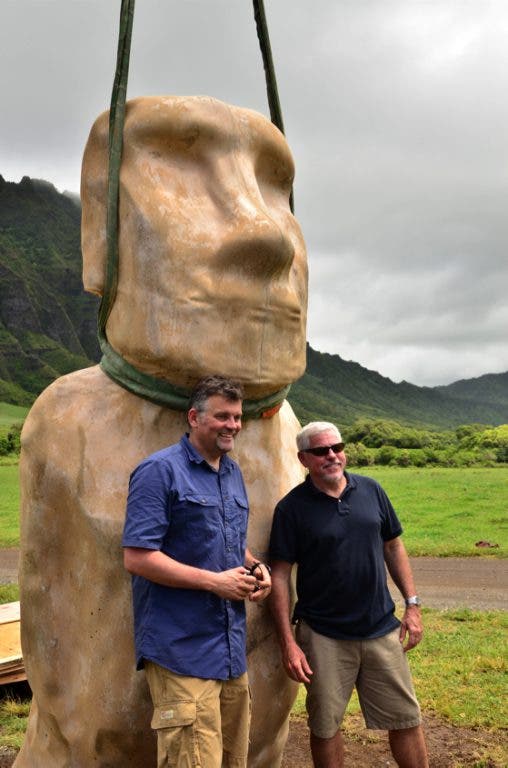


The enigmatic moai statues of Easter Island (Rapa Nui) have long intrigued explorers and researchers including anthropology Professor Carl Lipo of California State University, Long Beach (CSULB).
Lipo and research colleague Terry Hunt, an anthropology professor at the University of Hawai’i at Manoa, have spent 10 years studying Easter Island culture, including how the multi-ton statues were moved from rock quarries in the island’s interior to coastal platforms. Their book, The Statues That Walked, led to a PBS NOVA/National Geographic television documentary, “The Mystery of Easter Island,” that will air Wednesday, November 7 at 9 p.m. on PBS SoCaL TV (KOCE) and was the cover story in July’s National Geographic magazine.
PBS SoCaL and CSULB’s College of Liberal Arts (CLA) will host a screening of documentary excerpts and a public discussion of the program at 7 p.m. Tuesday, Oct. 30, at the Art Theatre, 2025 E. 4th St., Long Beach. The event includes introductory comments by CLA Dean David Wallace, presentation of excerpts of the documentary with remarks and a question and answer panel with Lipo, Hunt, and NOVA executive producer John Bredar, and moderated by Wallace.
“Islands are well known as great laboratories for studying how evolution shapes change,” Lipo said. “In the case of Easter Island, we have a really remote place that is completely isolated from the rest of the world. Once people arrive on the island, they’re subject to the limits of whatever the island has. Leaving the island to get some missing resources simply isn’t possible when the nearest bit of land is more than 1,500 miles away by open ocean. Yet, here on Easter Island we have some of the greatest examples of art and ingenuity in the prehistoric world. This apparent paradox really intrigued me: why would people in this place, of any place in the world, have made and transported nearly 1,000 multi-ton statues? I just had to go there to figure out why.”
The documentary focuses on Lipo and Hunt’s findings that island residents likely moved moai statues by a back-and-forth “walking” motion rather than on tree trunk rollers as other scientists proposed. “Oral traditions recorded as early as the 1880s mention that the prehistoric statues ‘walked,’ but most researchers have assumed that this line of evidence is simply a fanciful story,” Lipo explained.
Tickets cost $10 and are available at www.brownpapertickets.com/event/282141. Proceeds from the event will benefit CSULB students.
For more information on the event, visit www.pbssocal.org, www.csulb.edu/colleges/cla/departments/anthropology, www.4thstreetlongbeach.com, www.arttheatreoflongbeach.com or call Valerie Christian at CSULB at 562/985-8785.
About PBS SoCaL
PBS SoCaL, formerly KOCE-TV, is Southern California’s PBS station dedicated to interactively educating, entertaining, and enlightening the greater Los Angeles area. With its three unique broadcast channels. PBS SoCaL HD, PBS OC, and WORLD TV, PBS SoCaL provides award-winning programs like Frontline, NewsHour, NOVA, Nature, and Masterpiece, as well as local productions Real Orange, SoCaL Insider with Rick Reiff, and Bookmark With Maria Hall-Brown. Through community outreach initiatives including PBS SoCaL Education, PBS SoCaL provides local schools access to new media materials that engage students in 21st century learning. Explore the future of PBS in Southern California at www.pbssocal.org.