Arts & Entertainment
Pianist Robin Spielberg Put Faith in Music to the Test During Frightening Ordeal
The shock of a premature birth and subsequent health problems revealed how music can be used to heal.

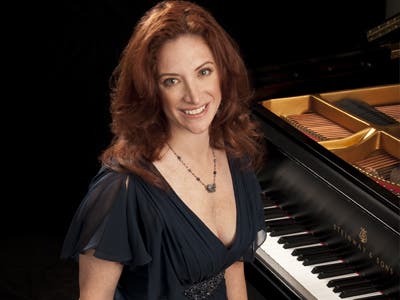

Pianist Robin Spielberg has long been aware of music’s deep-seated power. With a career that includes three Carnegie Hall appearances and hundreds of thousands of records sold, fans have often written to her about the times her soothing music inspired thoughts of love during their wedding procession, helped their colicky baby fall asleep or helped them cope while mourning.
In Sept. 1998, Ms. Spielberg was confronted with the greatest tragedy of her life, a tragedy that would challenge her in many ways and provoke her faith in the power of music. Just 23 weeks into her first pregnancy, an infection claimed the life of one of her twins in the womb. The other, Valerie, was born extremely prematurely and weighed less than a pound at birth.
“She was wrapped in saran wrap because her skin was too fragile,” Ms. Spielberg recalls. “I think it was four weeks and three days we couldn’t hold her. She was extremely tiny, very fragile.”
Unable to hold her child, Ms. Spielberg searched for some way to reach out to Valerie as she struggled to survive. Adding to her worries was the environment her tiny baby was kept in, a room constantly flooded with bright lights, the hustle and bustle of the nursing staff, and the incessant blare of alarms.
“For a young infant you picture cooing and lullabies,” she said. “It didn’t seem to be the kind of place anyone would do well healing. Which brought me to the idea of therapy.”
Ms. Spielberg asked the nursing staff if she could bring music that she had written and recorded to play in her daughter’s presence to help drown out some of the abrasive sounds of the hospital. They agreed.
While the music was playing, Ms. Spielberg and the nursing staff noticed improvements not only in Valerie, but in all the other premature babies within earshot.
“Her blood pressure stabilized, her oxygen saturation levels increased, there was a real, palatable difference,” she said. Valerie needed heart surgery and 13 blood transfusions, but the music seemed to help stabilize her heart’s rhythm.
Valerie spent four months in the hospital. Today, she is a talented 17-year-old who plays marimba, drums and piano, and who was recently notified that she will be inducted into the National Honors Society.
Ms. Spielberg doesn’t claim her music cured her daughter. But she says it helped, and points to the research of Dr. Jayne Standley of Florida State University, who for decades has published research on the therapeutic impact of music. Through her experience, Ms. Spielberg was introduced to the American Music Therapy Association, and has since served as their spokesperson for the last 15 years.
A few weeks ago, Ms. Spielberg was invited to talk about music therapy at the Mayo Clinic. She will spend one week in residency at Cal State Long Beach in workshops and discussions regarding music therapy, culminating in her free Carpenter Center performance Jan. 29, provided by Arts for Life.
Besides helping soothe and improve the lot of premature infants, music can help reduce pain, Ms. Spielberg said.
“When people experience music prior to an operation they need less pain medication and recover sooner,” she said. “There’s even evidence that doctors do a better job when certain music is played in the O.R.”
Other studies suggest that music can enhance memory, and as a result may be especially helpful for those suffering from Alzheimer’s disease and students with learning disabilities.
“Now I’ve come across music therapists who work in a variety of settings,” she said. “It’s astounding how music helps us on a health level.”
Robin Spielberg Jan. 29, 7 p.m. (562) 985-7000