Community Corner
Transit of Venus: How and Where to See it Safely
Watching today's special celestial occurrence requires special precautions, but you can watch it on-line, as well.
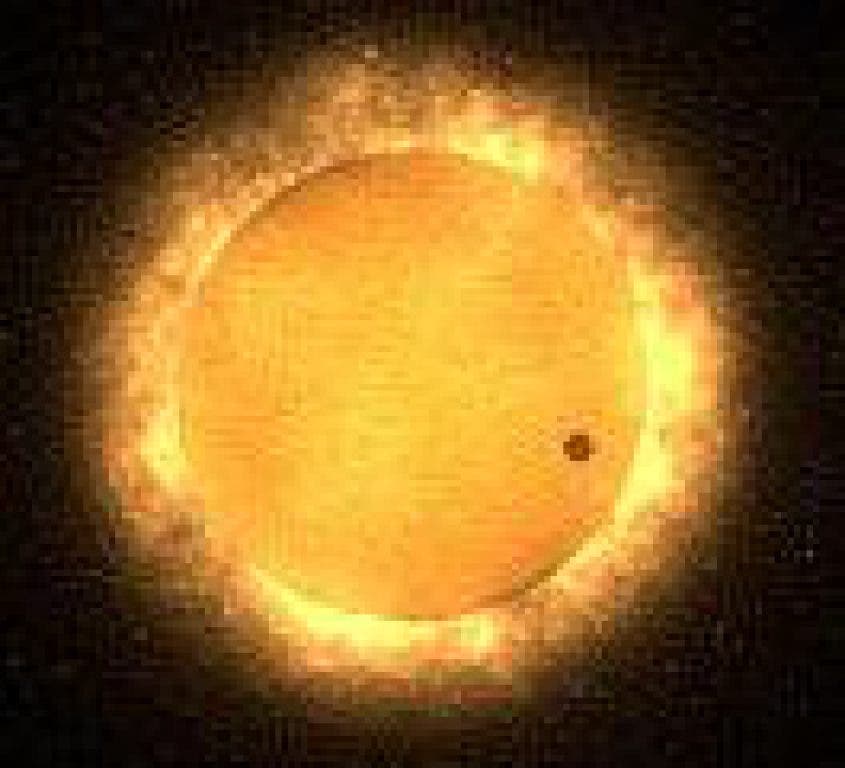
Happy Venus Transit Day 2012! Given that its a twice-in-a-lifetime experience, you might want to check it out.
Although Venus is one of five planets visible to the naked eye, viewing its silhouette as it travels between Earth and the Sun will require specialized gear.
Known as the Transit of Venus, the extemely rare astonomical event occurs when the orbits of Earth and her fiery little sister allign with the Sun, which is exceptionally rare due to the fact both planets are tilted at different angles.
Commencing at about 3:06 p.m. and lasting for another hour and 45 minutes past sunset at 8:02 p.m., the spectacular event lasting more than six hours won’t happen again for 105 years, according to NASA.
While a bigger rarity than the recent that transformed the sun into a crescent for southern Californians, watching it without proper equipment can harm eyes in the same way.
“The reason people should be careful when viewing the Transit of Venus is because they can damage their eyes, including their corneas and retinas,” said Christine Douglass, public relations manager at the American Academy of Ophthalmology. “And that damage can result in vision loss.”
Find out what's happening in Belmont Shore-Naplesfor free with the latest updates from Patch.
Looking at the phenomena for any length of time is dangerous, Douglass said.
For safe viewing, a number of methods are recommended, from do-it-yourself projects the whole family can partake in to top-notch technological depictions that can be viewed from the comfort of home.
Pinhole cameras can be constructed in a matter of moments from two light-colored pieces of paper or posterboard and a pin. Simply insert the pin into the middle of one sheet of paper and with your back turned to the sun, hold it in front of the other paper to project a small image.
A slightly more advanced version of the pinhole camera, one can also duct tape one lens on a pair of binoculars and use the other lens to capture the sun’s rays and magnify a slightly larger image onto a piece of paper.
However, since Venus is such a small planet and the Sun is so massive, using professional equipment will improve the visual aspect of this once-in-a-lifetime opportunity.
The Griffith Observatory is hosting a public viewing with free telescopes outfitted with the necessary filters from noon to 10 p.m., and solar viewing glasses will be available for purchase at the gift shop. Another viewing party hosted by UCLA will occur at the university’s planetarium, where filtered telescope will be offered free-of-charge.
But for those who can’t make the drive or don’t want to brave throngs of eager observors and the expected parking nightmares, live images of the event will provided online by the observatory, as well as NASA, which will utilize truly state-of-the-art technology to broadcast a live-streaming video feed.
Scientists will also be available to live-chat on NASA’s web site from 1:30 p.m. to 10 p.m.--click here for the schedule of featured scientists.
Historically, in Rome, Venus symbolized the Greek goddess of love and beauty, Aphrodite. In other ancient cultures, the planet was actually perceived as two stars.
Like long-ago Egyptians, Chumash Indians native to the southern California coast considered the morning Venus to be a postive omen while associating the evening Venus with the underworld, according to www.ancientx.com.