Community Corner
A Few Good Bugs
Create a welcoming environment for the beneficial insects that are important for your garden.


A number of years ago I used to think all bugs were creepy except lady bugs. But when I took Master Gardener classes I learned there are good bugs and bad bugs.
Initially, I had a hard time identifying them and knowing who was who. I began to enjoy looking for bugs (properly called insects) when I completed the Plant Pest Control & Management Class at Solano Community College, at which each student was required to put together an insect collection . Now I really enjoy identifying insects and taking pictures of them as I garden. I don’t collect them anymore, but if I can find them holding still I use my magnifying glass to get a closer look.
It is important to know which insects are beneficial to our gardens so we can attract them by creating the right environment. To make things easy, there are three types of beneficial insects.
Find out what's happening in Beniciafor free with the latest updates from Patch.
First, there are predators that feed on other insects. They include the Ladybird Beetle, otherwise known as the Ladybug, which is an easy to spot, small, round insect with black dots on a red body. The ladybug and their larvae (which look like teensy alligators with black bodies and orange or yellow markings) help rid our gardens of aphids, scale, mealy bugs, mites, whiteflies and many more pest insects and their eggs.
Their life cycle from egg to adult is four to seven weeks and one ladybug can lay about 300 eggs and have as many as six generations in one year. Plus, adults can spend the winter in leaf litter or under tree bark and mulch and be ready to produce new generations in the spring.
Find out what's happening in Beniciafor free with the latest updates from Patch.
I have many more ladybugs in my garden since I stopped using pesticides on my roses. To increase the population, I recently purchased a container of 1,500 ladybugs from Mid-City Nursery. The cost was just over $7 and they are available only in the spring, so call before you go.
Purchased ladybugs are notorious for crawling out of the container and flying off to the neighbor’s garden but there are some things you can do to encourage them to stay close by. First, water the area where you want to release them.
Next, release them at the base of a plant on which there are insects they will feed on. Their favorite food is aphids, which are small, soft-bodied insects usually found in large groups on new growth of tender vegetables, fruit trees and roses in the spring.
Finally, the most important thing is to release them after the sun is down. Ladybugs do not fly at night. Given food, water and some shelter, they are likely to stay close by and aside from being colorful, each one can consume up to 5,000 aphids in its lifetime.
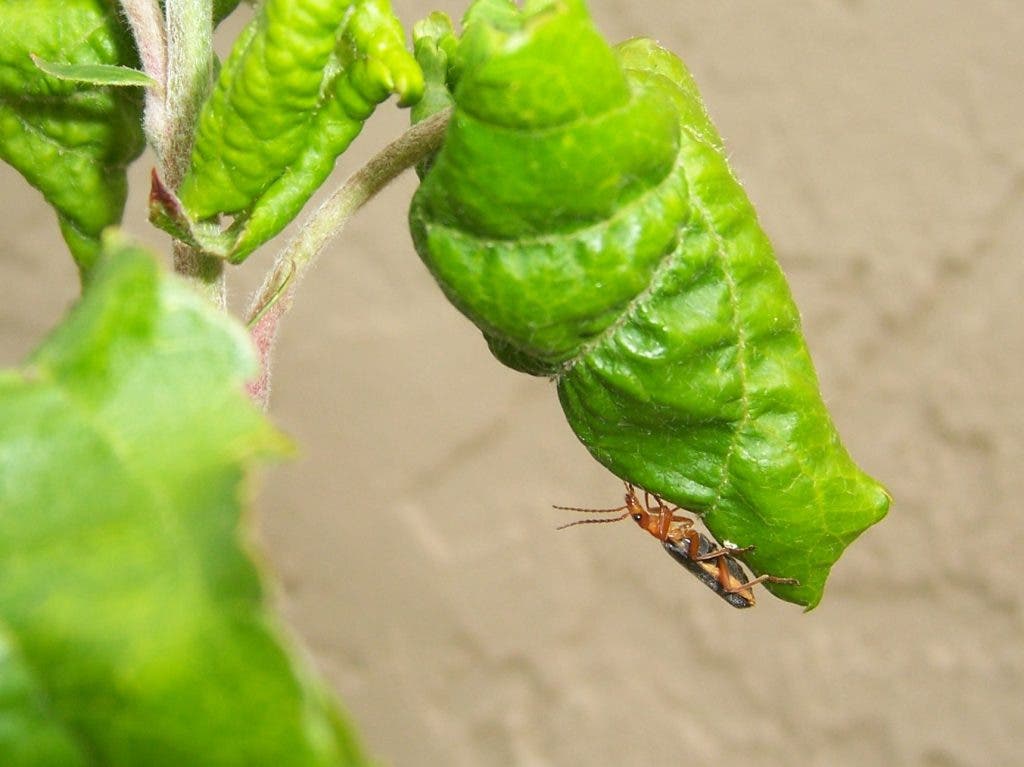
Another predator I see in my garden is the soldier beetle. The adults are easy to spot. They are narrow, elongated beetles, have long threadlike antennae and are patterned with yellow or red and black markings. Often the head is red and body black and underbody is gold with brown stripes.
In April I spotted a large group of them when I disturbed the soil in a wine barrel. Since then I have seen one or two at a time feeding on aphids in the apple tree and on other plants. They also feed on mealy bugs and other soft-bodied insects. I have not been able to spot the larva yet, which has a red or orange head and dark body, but I am still looking.
The second group of beneficial insects in the garden is the parasitoids such as the Tachinid fly and the Trichogramma wasp. They lay their eggs on the pests or within the eggs of caterpillars, grubs, aphids, cutworms, cabbage loppers, codling moths, tomato hornworms, scale or white flies. When the larva hatches it eats the pest, thereby reducing the population. It is harder for me to spot these beneficials because they don’t stay in one place very long.
The third group is the pollinators. These insects travel from flower to flower depositing and picking up pollen. As they buzz or flutter inside the petals of the flower, they pick up pollen from the male flower or the male portion of the flower and deposit it in the female flower or female portion of the flower. And there you have the making of fruits and seeds.
Bees are the best known pollinators. Kevin J. Hackett in the Agricultural Research/March 2004 /Forum stated, “One mouthful in three of the foods you eat directly or indirectly depends on pollination by honey bees.
"They also pollinate more than 16 percent of the flowering plant species, ensuring that we’ll have blooms in our gardens.”
Usually bees live in colonies in hives, but some native bees live alone in ground nests and are active during the middle of the day. Honey bees are the most recognized pollinators but there are many others, including cutter bees (you know they are in the garden when you see a half circle eaten from the edge of a rose leaf) sweat bees, syrphid flies, digger bees, butterflies and even yellow jackets , although I wouldn’t encourage them in my garden!!
There are some great identifying photos of bees on the USDA Natural Resources Conservation Service site.
How can you attract the beneficial insects to your garden? First, it's important to be able to identify them so you are not tempted to stomp, squish or spray them. A great resource is the pamphlet “The 10 Most Wanted Bugs in Your Garden,” with pictures of insects and their young. It states that “97 percent of the insects you see fall into the beneficial category.” That is good news.
Next, you will want to meet their needs of food, water and shelter. They thrive in diverse flower gardens rich in pollen and nectar. Even the predators will eat pollen when insects are not available. Water your garden regularly and in the fall allow some leaves to stay on the ground so they have shelter for the winter. Bark mulch also works well, but be sure to leave some bare ground for the solitary native bees that nest in the soil.
Finally, limit or discontinue the use of pesticides. Broad-spectrum pesticides kill many beneficials as well as many pests. If you look closely at the tiny creatures in your garden you will begin to see and appreciate the many beneficial insects and understand the importance of creating a welcoming environment for them. I know I do.
Happy gardening!