Community Corner
Wild Turkeys Spotted Throughout Benicia
Irrelevant and useless information on wild turkeys and other stuff.

Thanksgiving is here. In order to divert your attention from the food shopping, the four plus hours of cooking, the 30 minutes of eating (if you're lucky), and for some, the days of clean-up after Thanksgiving, below are little known and irrelevant facts about the wild turkey.
For most the relationship to turkeys is very predictable. It starts early in our lives, in preschool or kindergarten, taking home a drawing of a turkey using the shape of our hand. We look at pictures of turkeys with their plumage and we find out Benjamin Franklin wanted the turkey to be the national bird. We learn about the Mayflower and the pilgrims and the first Thanksgiving.
As we get older our relationship with the turkey changes and evolves. Thanks to good marketing, turkey is not just for Thanksgiving. It fact turkey has an identity crisis. Now there is turkey Italian sausage, turkey meatloaf (isn't that an oxymoron), and thurkey hotdogs. However, that image of a roasted turkey at Thanksgiving is indelibly etched into our brains.
Find out what's happening in Beniciafor free with the latest updates from Patch.
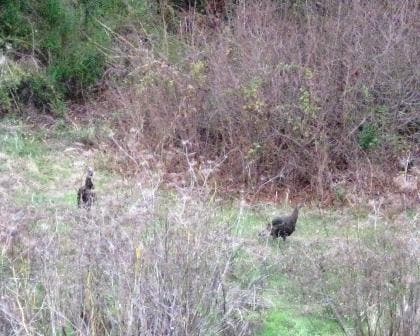
In Benicia, besides Raley's and Safeway, turkeys have been spotted at the Southampton I-780 on-ramp, near Southampton Rd and Cambridge, meandering on East 5th Street and Valero property, nesting near Lake Herman, at the trail to the East Third Street freeway underpass, and in Southampton Park.
So, how does the sighting of wild turkeys in Benicia jive with your visions of the Thanksgiving turkey. First you should know wild turkeys are not native to California. Thanks to the California Department of Fish and Game and some private ranchers who liked to hunt turkeys were introduced to California in 1877.
Find out what's happening in Beniciafor free with the latest updates from Patch.
Those first turkeys didn't do so well, but they tasted good, so more introductions were made. In fact the last liberation (Fish & Game's word not mine) of turkeys into California occurred in 1999.
The Benicia wild turkey species is Meleagris gallopavo sub species Rio Grande. Wild turkeys like to roost in trees to sleeping and avoid predators. They like grasslands for nesting and food.
Rumor has it the wild turkeys in Benicia came from Vallejo; however Fish & Game liberated wild turkeys in Sonoma. So you may ask, how did the turkeys get to Benicia?
While turkeys are able to walk at about two miles an hour, it is more likely they flew. Yes, wild turkeys, unlike their domesticated cousins who are too top heavy, can fly. Wild turkeys fly low to the ground, but not for long distances. And they can fly straight up like a helicopter. Unfortunately, the liberation of wild turkeys has become a bit of an annoyance in some urban areas.
For a city like La Conner, Washington, wild turkeys have gone from a tourist attraction to a public health issue. The City Council polled residents to help decide the disposition of the turkeys with questions like 'are you pro or anti turkey".
It seems there are more anti-turkey people because the turkeys have been liberated to a turkey farm. Fish & Game, sensing the wild turkey as a growing problem throughout California, produced, in 2004, a Strategic Plan for Wild Turkey Management which concluded that no more turkeys should be liberated in California.
In 2005 Fish and Game updated their Guide to Hunting Wild Turkeys.
Fortunately it doesn't seem like the wild turkey population in Benicia is a problem, yet.
If pondering the issues surrounding wild turkeys in Benicia isn't enough, let's ponder the butterball, turkey trot, and trimmings.
Both babies and turkeys can be butterballs. Calling a baby a butterball is an endearing term to describe a baby who is chubby. Butterball is a brand name for turkey that has been around since 1940. One in every five turkeys sold in the United States is a Butterball brand turkey. To keep things clear, babies should not be called butterballs on Thanksgiving Day or when buying a turkey. It may make "what's for dinner" a suspect question.
The turkey trot actually has nothing to do with turkeys. The Turkey Trot, which most likely evolved into the Fox Trot, is a dance. The dance was invented in San Francisco in 1909. It was thought to be a scandalous dance in its day because couples danced dangerously close to one another. Today the turkey trot is a reference to running/walking races held on Thanksgiving Day.
What is Turkey with all the trimmings? As it turns out, the trimmings also have nothing to do with the turkey. Although it would make sense that the trimmings are some part of the turkey, like the things stuffed into the bag inside the turkey.
The trimmings are side dishes served with turkey. They are called trimmings when served with turkey, but not when served with other foods. So, mashed potatoes and gravy are considered trimmings when served with turkey, but not when served with pot roast.
It is unclear if green beans are considered trimming unless they are part of a green bean casserole that has those onions from the can.
Cooking a turkey, like most cooking, is a learned skill. Since it is only done once a year it is relearned for several years. That is until you learn to buy your husband a turkey fryer. Then you just need to learn first aid for various degrees of burns.