Health & Fitness
‘Dead Metaphor’ Is Funny Yet Serious Look at Returning Vet
A vet of the war in Afghanistan returns home and can't find a job — except as an assassin. But that scenario's played, successfully, for laughs.

When it comes to comic plays, I’m a tough sell.
They typically make me smile only three or four times despite my craving instant relief from gloom-inducing daily headlines.
Find out what's happening in Berkeleyfor free with the latest updates from Patch.
And I agree with playwright George S. Kaufman’s avowal that “satire is what closes Saturday night.”
But Dead Metaphor, the new darkly comedic A.C.T. offering by Canadian playwright George F. Walker in San Francisco, kept me grinning throughout — right up to its unexpected, uncomfortable dramatic ending.
Find out what's happening in Berkeleyfor free with the latest updates from Patch.
Many in the opening night crowd — less critical than I — roared with hilarity so often they drowned out more than a few punchlines.
The play’s clever, ubiquitous humor varies from your standard theatrical fare. It’s verbal and cerebral, and missing buffoonery and pratfalls.
Dead Metaphor, at first glance, is nothing to laugh at.
A vet of the war in Afghanistan returns home to a tanked economy in which he can’t find a job because his only expertise lies in being a sniper. After fleetingly becoming a sleazy ultra-right-wing candidate’s gofer, he contemplates making big bucks as a paid killer.
Dead Metaphor, as each character unhurriedly unravels, is everything to laugh at.
Especially the farcical complexities stemming from just about everyone the frustrated veteran encounters requesting he murder somebody.
Initially, Dead Metaphor appeared to cloak serious subjects in brisk but shallow humor, but that impression dissipated as Walker fleshed out his characters in the second act.
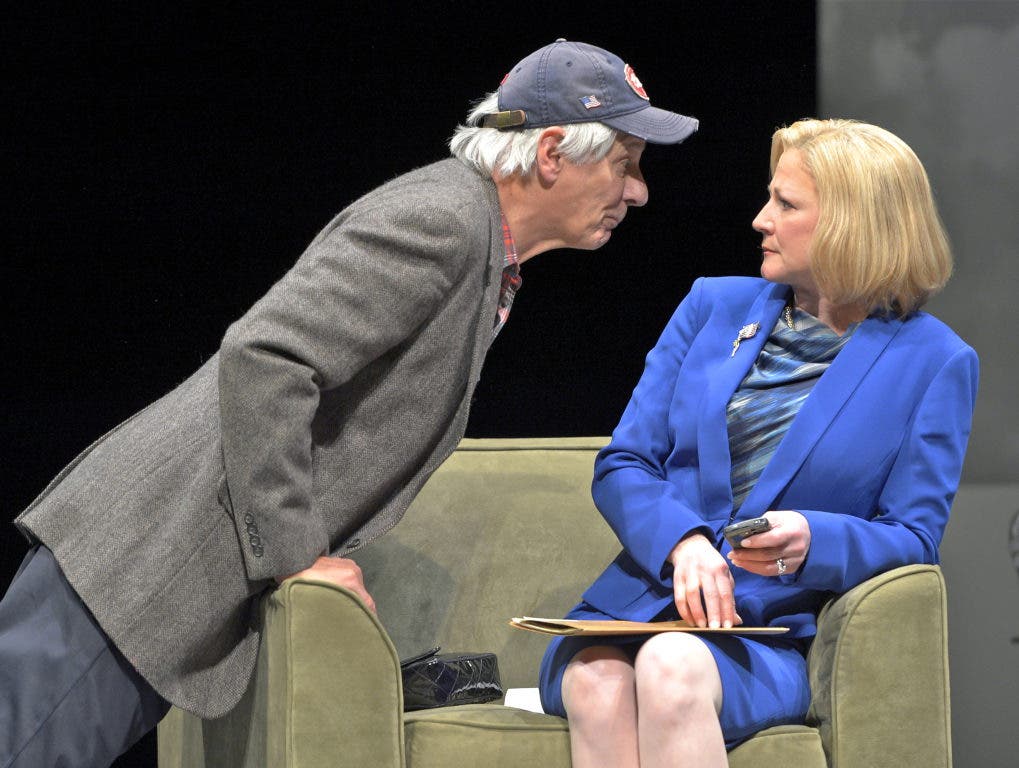
Dean Trusk (adroitly portrayed by George Hampe as physically and mentally strong but slightly bumbling) has difficulty coping with all those around him — his dying, dementia-riddled father, Hank (Tom Bloom), and frantic mother, Frannie (Sharon Lockwood); his pregnant wife, Jenny (Rebekah Brockman); the unfeeling reelection-seeking politico, Helen Denny (René Augesen); and her left-wing mate, OIiver (Anthony Fusco).
Along the way, aided by a breakneck pace encouraged by director Irene Lewis, the playwright impales office-seekers without conviction who pander to their extreme base, countries who send soldiers to war with no real re-integration strategies, job counselors who become ineffectual bureaucratic cogs, and — oh, yeah — hypocrisy in its many-colored stripes.
Not one weak link exists in the ensemble cast. Each of the six actors carves out a distinct persona.
Walker’s dialogue helps.
As in Helen’s telltale derision, “You’ve got a degree in social work, Oliver — you might as well be a Communist.”
Or her mega-serious self-testimonial: “My ultimate goal is to save this country.”
Or her husband’s acidic description of her “skills that may have been a gift from Satan.”
The usually in-motion turntable floor by set designer Chris Barreca allows frequent, seamless changes of scene, and the many quick costume changes fashioned by Lydia Tanji underscore the today-ness of the play.
A dead metaphor, you may already know, is a phrase that’s become so common its origins have become forgotten — labeling a person a “snake,” for instance. According to Walker, the play’s title refers to returning soldiers who “only get noticed when they’re in trouble.”
Dead Metaphor will definitely be noticed.
It’s the latest link in a chain of successful comedic plays and performances by Aristophanes, Bertolt Brecht, Gilbert & Sullivan, the San Francisco Mime Troupe, Sacha Baron Cohen, Jon Stewart and Stephen Colbert.
Dead Metaphor, I think, is funnier that any of those.
In modern Show Biz slang, when a stand-up is a smash onstage, the comic’s apt to proclaim, “I killed.” It’s fitting, therefore, for me to say this about the tone, plot and comedic efforts of Dead Metaphor:
It killed.
Dead Metaphor plays at the American Conservatory Theater, 415 Geary St., San Francisco, through March 24. Night performances Tuesdays through Saturdays, 8 p.m. matinees, Wednesdays, Saturdays and Sundays, 2 p.m. Tickets: $20 to $95. Information: (415) 749-2228 or www.act-sf.org.