Neighbor News
The #1 Reason Therapists Burn Out (And How to Fix It)
The #1 Reason Therapists Burn Out (And How to Fix It) Body Mechanics in Massage Therapy: How to Protect Yourself and Give Better Sessions

The #1 Reason Therapists Burn Out (And How to Fix It)
Body Mechanics in Massage Therapy: How to Protect Yourself and Give Better Sessions
Watch Our Class https://youtu.be/cISzPh6wrwU
Book The Session https://massagerxla.com/
Masterclass on Patreon https://www.patreon.com/c/liferxhealth
Most massage therapists don’t quit because they don’t love the work. They quit because their hands, wrists, shoulders, or low back can’t take it anymore.
Body mechanics isn’t “extra.” It’s your career insurance.
When your posture is organized and your pressure comes from your legs and core, two things happen:
Find out what's happening in Beverly Hillsfor free with the latest updates from Patch.
- You stop injuring yourself
- Your clients feel a stronger, smoother, more effective session
This article will give you a simple routine and rules you can use in every session — Swedish, deep tissue, sports, or manual therapy.
Why Therapists Get Injured
Most injuries come from these mistakes:
Find out what's happening in Beverly Hillsfor free with the latest updates from Patch.
- Pressure comes from the hands instead of bodyweight
- Rounded back + forward head posture for 60–90 minutes
- Wrists bent while pushing (compression = tendon irritation)
- Shoulders elevated and tense (neck + upper trap overload)
- Working too far from the table so the body is always “reaching”
- Trying to “muscle through” instead of using leverage and angles
If you fix only one thing, fix this:
Don’t chase pressure with your arms.
Bring your body to the tissue and let gravity do the work.
The Therapist’s Golden Rules (Easy to Remember)
1) Neutral spine is non-negotiable
Your spine should stay long and stacked.
If your low back is rounding — you’re stealing from your future.
Fix: widen your stance, bend your knees, and hinge at your hips.
2) Stance = power
A strong stance is like a tripod: stable and controlled.
- One leg forward, one leg back (lunge stance)
- Knees soft (not locked)
- Weight shifts forward/back smoothly
3) Stack joints for safe pressure
Your force should travel in a straight line:
Shoulder → elbow → wrist → tool (hand/forearm)
If the wrist is bent or elbow flares out, you lose power and load the small joints.
4) Use bodyweight, not hand strength
Pressure is not squeezing. Pressure is leaning.
- Lean in with your whole body
- Exhale as you sink
- Control the exit (don’t “pop off”)
5) Work close to the table
If you’re reaching, you’re stressing your back and shoulders.
Rule: keep your hips close enough that you can use legs, not arms.
Your Session Routine (The “Therapist Warm-Up” — 3 Minutes)
Do this before every shift or before your first client.
- Neck reset (20 sec): slow head turns + chin tuck
- Shoulder set (20 sec): roll shoulders back, then “down and wide”
- Thoracic opener (30 sec): hands behind head, open chest, breathe
- Hip hinge practice (30 sec): 6 slow hinges like a deadlift pattern
- Lunge rock (30 sec): shift weight forward/back to feel stance power
- Wrist prep (30 sec): circles + gentle palm stretch
- Breath + brace (20 sec): inhale into ribs, exhale and lightly brace core
This is how you walk into the session already organized.
How to Apply Body Mechanics During Massage (Real Examples)
Example 1: Deep pressure without pain
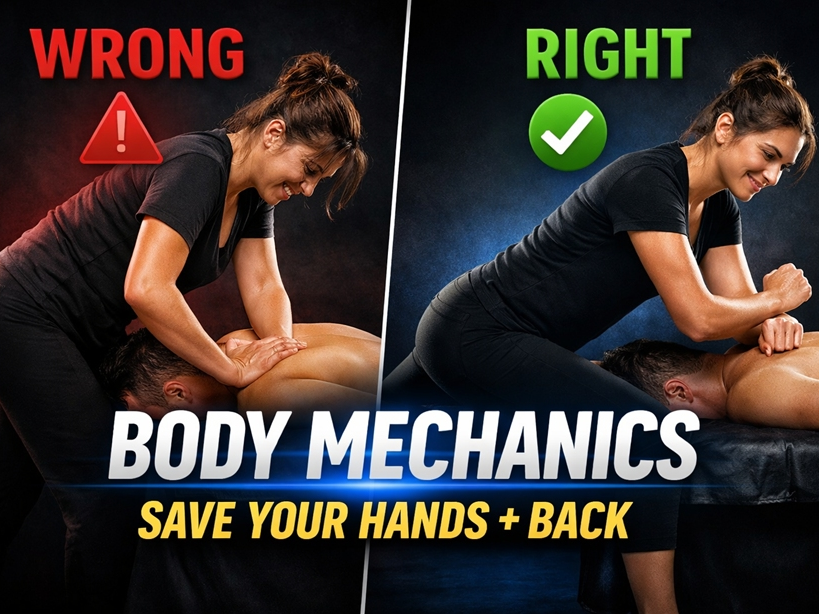
Wrong: leaning with a rounded back, wrists bent, shoulders up
Right: forearm tool, lunge stance, neutral spine, weight shift forward
Key tip:
Move your feet, not your shoulders.
Example 2: Long strokes (Swedish / flushing)
Wrong: reaching, dragging with arms, tight traps
Right: step with the stroke, like dancing. Your feet guide the motion.
Example 3: Trigger points / static pressure
Wrong: thumb-only pressure, squeezing hard, shaking hand
Right: stack joints, use knuckle or elbow/forearm when needed, breathe out and lean.
Table Height: The Quick Rule
Table too low = back pain
Table too high = shoulder/wrist pain
Rule of thumb:
- For forearm/deep work: slightly higher
- For long flow strokes: slightly lower
- If you feel yourself shrugging shoulders — it’s too high
- If you feel your low back rounding — it’s too low
Tools That Save Therapists
You don’t need to be a hero.
Use tools that protect small joints:
- Forearms (best friend)
- Soft fists/knuckles
- Elbows for focused pressure
- Cupping / scraping tools when appropriate
- Heat + movement prep to reduce brute force needs
Smart therapists last longer.
The Biggest Mindset Shift
You are not “pushing” tissue.
You are organizing your body and letting leverage, angles, and breath create results.
A therapist who moves beautifully gives clients:
- deeper work with less discomfort
- more consistent pressure
- better therapeutic outcomes
- a calm, confident session energy
Mini Checklist During Every Session
Quick scan every 5 minutes:
✅ Spine long?
✅ Shoulders down?
✅ Wrist neutral?
✅ Feet stable?
✅ Pressure coming from bodyweight?
✅ Breathing smooth?
If you fix these, your career changes.
Want the Full Training?
If you want structured training with real demonstrations (stance, forearm pressure, table height, bodyweight transfer, and therapist injury prevention), follow Life RX Wellness and join our education content.
Life RX Wellness — classes for massage therapists + manual therapy skills
You’ll learn how to work harder for your clients without breaking yourself.
#MassageTherapist #ManualTherapy #BodyMechanics #MassageEducation #TherapistTips #InjuryPrevention #Ergonomics #Posture #Biomechanics #SelfCareForTherapists
#DeepTissue #SportsMassage #MyofascialRelease #TriggerPointTherapy #SoftTissueWork #Leverage #PressureControl #BodyAlignment #CoreEngagement #Breathwork #LifeRXWellness #LosAngelesMassage #MobileMassage #MassageTraining #MassageCoach #TherapistLife