Community Corner
Beverly Hills Attorneys: Is Your Website Driving Wealthy Clients to Your Competitors?
High-net-worth clients judge credibility in seconds. An outdated website may be costing your firm consultations you never knew you lost.

This is a paid post contributed by a Patch Community Partner. The views expressed in this post are the author's own, and the information presented has not been verified by Patch.
In Beverly Hills, where elite law firms crowd nearly every block, the competition for high-net-worth clients no longer begins in the conference room — it begins on a phone screen, and it's often decided there. Long before a prospective client reads your credentials or hears your pitch, your website has already told them whether you belong in their consideration set. Here's what they're seeing in those first few moments, and why it may be quietly costing you clients you never knew you lost.
The Five-Second Verdict
A prospective client in Beverly Hills doesn't read your website. They judge it. In the first five seconds — before a single word of your firm's history registers — they've already decided whether you're the kind of attorney who handles matters like theirs. That judgment usually happens on a phone screen, often late at night, frequently with two or three competing firms open in adjacent tabs.
For most businesses, a dated website is a minor liability. For a Beverly Hills law firm courting high-net-worth clients, it's a silent disqualifier. The people you most want to reach — the ones with complex estates, eight-figure disputes, and businesses worth protecting — are also the ones most fluent in the visual language of credibility. They notice when something feels off. And when it does, they don't call to ask why. They quietly move to the next firm on the list.
Why Beverly Hills Is the Hardest Legal Market in the Country to Win
Few areas pack as many attorneys into as little real estate as 90210 and the blocks around it. Estate planners, entertainment lawyers, litigators, family-law specialists, and boutique firms are all competing for the same discerning, well-resourced clientele — clients who can afford to be selective and treat that selectivity as a standard. In a market this saturated, the substance of your legal work might be exceptional, but it stays invisible until someone trusts you enough to make contact. Your website is where that trust is either established or quietly lost, long before a consultation is ever booked.
What High-Net-Worth Clients Are Actually Evaluating
Wealthy clients aren't scanning your practice-area list or counting your years in business. They're reading signals — the kind that tell them, instinctively, whether your firm operates at their level. Is the site fast, secure, and effortless on a phone? Does it look bespoke, or like a template a thousand other firms also bought? Do the attorney bios convey genuine authority, or read like placeholders? Every one of those impressions answers the single question the client is really asking: if this is how they present themselves, how will they represent me? The next few seconds decide it.
What a Wealthy Client Notices in the First Five Seconds
None of these judgments are conscious, and none take more than a glance. Together, though, they decide whether a prospective client keeps reading or closes the tab. Here's what they're measuring, usually without realizing it.
Does It Work on Their Phone?
Most high-net-worth prospects find you on an iPhone, frequently after business hours. If your site forces them to pinch, zoom, or hunt for a tap target — if the menu overflows or the text spills off the screen — the verdict is immediate. A site that fumbles on mobile signals a firm that hasn't kept pace, and they'll assume the practice hasn't either.
Does It Load Before They Lose Patience?
Affluent clients are not patient ones. A few seconds of blank screen, or a hero image that crawls into view, and they're already back in the search results. Speed reads as competence: a fast, polished site implies a firm that is organized, current, and responsive — exactly the qualities someone wants in the attorney handling a complex matter.
Do the Trust Signals Hold Up?
In that first scan, clients look for proof you're the real thing — bar admissions, notable results, recognizable affiliations, genuine credentials, and the small padlock confirming their information is secure. A site missing HTTPS, leaning on vague claims, or padded with stock "scales of justice" imagery raises a quiet flag. For discretion-minded clients, one flag is enough.
Do the Attorney Bios Read Like Substance — or Filler?
The bio page is where capability is judged most closely. A high-net-worth client can tell the difference between a profile that conveys real authority — specific matters, meaningful outcomes, a credible photograph — and one padded with boilerplate about being "dedicated" and "client-focused." Generic bios suggest a firm that treats its own positioning as an afterthought, and invites the question of how it will treat theirs.
Is the Intake Secure and Effortless?
When a serious prospect is finally ready to reach out, the contact experience either closes the gap or reopens their doubts. A clunky form, an insecure connection, or a phone number buried three scrolls down introduces friction at the exact moment they're motivated to act. Sensitive legal matters demand a secure, frictionless intake — anything less, and they reconsider.
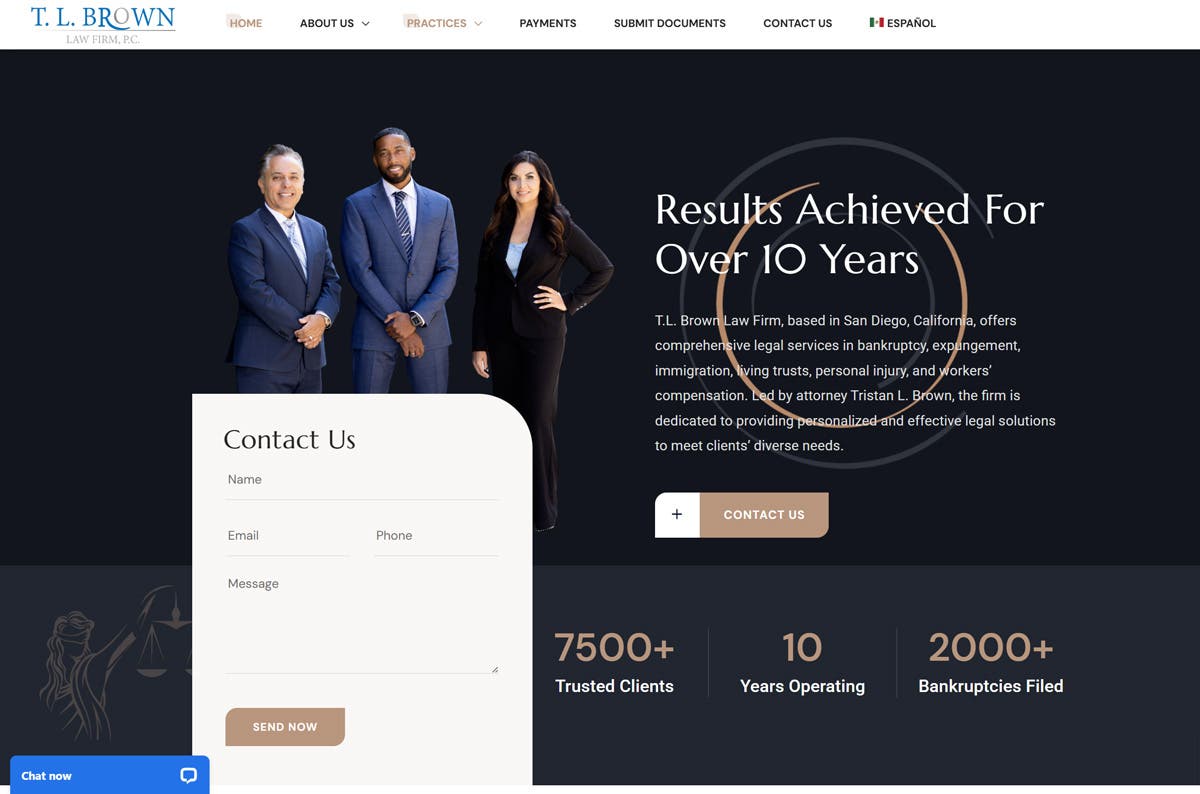
The Template Flood Made Credibility a Differentiator Again
There's an irony in how easy website-building has become. As templates and AI builders made it trivial for any firm to launch something reasonably polished, "reasonably polished" stopped being enough to stand out. When everyone clears the same low bar, clearing it no longer signals anything.
A visually fluent client recognizes the signatures without needing to name them: the predictable gradient hero, the stock photo of a diverse team in a glass conference room, the three-column "practice areas" grid, the generic icons, the familiar rhythm of an auto-generated layout. In a market as design-literate as Beverly Hills, those cues read as off-the-shelf — and, by quiet extension, as off-the-shelf representation. Custom design does the opposite: real photography, distinct typography, and a structure built around the firm's actual positioning read as intention, investment, and seriousness.
How AI Builders Homogenized Law Firm Websites
Tools like Wix ADI, Framer AI, and Webflow's AI features — alongside the usual template marketplaces — now produce competent, interchangeable sites by the thousand. They lean on the same hero patterns, the same section flow, the same safe choices. The result is a wave of law firm websites that look strikingly alike. For a practice trying to signal it operates a cut above, blending into that sea of sameness works directly against the goal. The technology that made websites cheap also made them forgettable.
The Tells a Discerning Client Spots Instantly
A visually fluent client recognizes the signatures without needing to name them: the predictable gradient hero, the stock photo of a diverse team in a glass conference room, the three-column "practice areas" grid, the generic icons, the familiar rhythm of an auto-generated layout. In a market as design-literate as Beverly Hills, those cues read as off-the-shelf — and, by quiet extension, as off-the-shelf representation. Custom design does the opposite: real photography, distinct typography, and a structure built around the firm's actual positioning read as intention, investment, and seriousness.
The Hidden Cost of a Site That Undersells You
The damage here is invisible, which is exactly why it persists. There's no error message, no alert telling you a prospective client just left. A site that quietly undersells the firm simply produces fewer calls than it should — and nothing in your analytics names the clients you never heard from.
The $2,000-an-Hour Mismatch
A firm commanding premium rates, presenting itself through a bargain template, creates an immediate dissonance. The client is being asked to trust a high-stakes matter — and substantial fees — to a practice whose own storefront looks like it costs fifty dollars a month. That mismatch undercuts your rate before a word is exchanged. Worse, it invites a comparison you can't win on appearances: the competitor with the polished, custom site looks like the safer, more capable choice, even when your legal work is plainly superior.
What a Single Lost Retainer Is Actually Worth
Run the math. In Beverly Hills, one estate-planning engagement, business matter, or litigation retainer can represent tens of thousands of dollars in fees — often far more in lifetime value. You don't have to lose many before the cost of an outdated website becomes staggering. The site never reports these losses; the prospects simply don't call. A redesign that recovers even one or two such clients a year pays for itself many times over — which makes treating the website as an expense rather than an asset the genuinely costly decision.
What a Credibility-First Beverly Hills Firm Site Looks Like
A website built to win high-net-worth clients doesn't shout — it reassures. It loads quickly on a phone, runs on a secure connection, and feels effortless to navigate from the first tap. The design is custom rather than a recognizable template, with photography and typography chosen to match the firm's actual standing instead of pulled from a stock library. The attorney bios do real work, conveying specific authority and meaningful outcomes in place of boilerplate. Credentials, results, and affiliations are present and easy to find without being loud about it. And the path from interest to contact is short, secure, and dignified, so a serious prospect can act the moment they're convinced.
None of this is about flash. In a market where the audience is fluent in design, restraint and precision read as confidence. The goal isn't a site that impresses other designers — it's one that quietly confirms, in those first few seconds, that the firm operates at the client's level, and removes every small reason to look elsewhere. For a Beverly Hills practice, that quiet confirmation is often the difference between a consultation booked and a tab closed.
Frequently Asked Questions
How much does a custom law firm website cost?
It varies with scope, but a professionally designed, custom law firm website in the Los Angeles market generally runs from the mid-four figures into five figures — driven by page count, depth of custom design, content and photography, and integrations like secure intake or case-management tools. Measured against the value of a single retained client, it's usually a modest investment.
Isn't a clean-looking template good enough?
A template can look clean — and that's precisely the problem. Because thousands of firms use the same handful of templates, "clean" no longer signals anything distinct, and a design-literate Beverly Hills client recognizes the pattern instantly. Templates also constrain how well the site reflects your specific positioning. For a firm competing on credibility, looking interchangeable is the real risk.
How long does a website redesign take?
Most custom law firm redesigns take roughly four to six weeks, depending on scope, content readiness, and how quickly the firm supplies materials and feedback. Smaller, focused projects move faster; sites with extensive practice areas, attorney bios, or custom functionality take longer. The biggest variable is usually how promptly content and approvals come from the firm's side.
Does website design really affect client acquisition?
For high-value, trust-based services, yes — significantly. Prospective clients form a judgment about credibility within seconds, and most never report why they didn't call. Design influences whether a referred or searching prospect trusts you enough to make contact in the first place. It won't replace your reputation, but a weak site quietly suppresses the leads that reputation earns you.
See How Your Firm Stacks Up
If you're wondering how your own site holds up in those critical first seconds, you don't have to guess. Sunlight Media offers Beverly Hills law firms a free 15-minute conversion audit: we'll review your homepage, intake flow, and mobile experience against three of your direct competitors, and show you exactly where prospective clients are most likely to drop off. No pitch, no obligation — just a clear, candid read on whether your website is working as hard as you are. Schedule your free audit.
This post is an advertorial piece contributed by a Patch Community Partner, a local brand partner. To learn more, click here.