Schools
Students Learn About Nature Near the City
Calabasas High students are taught about the delicate conditions of local nature and wild animals that abut the urban environment.
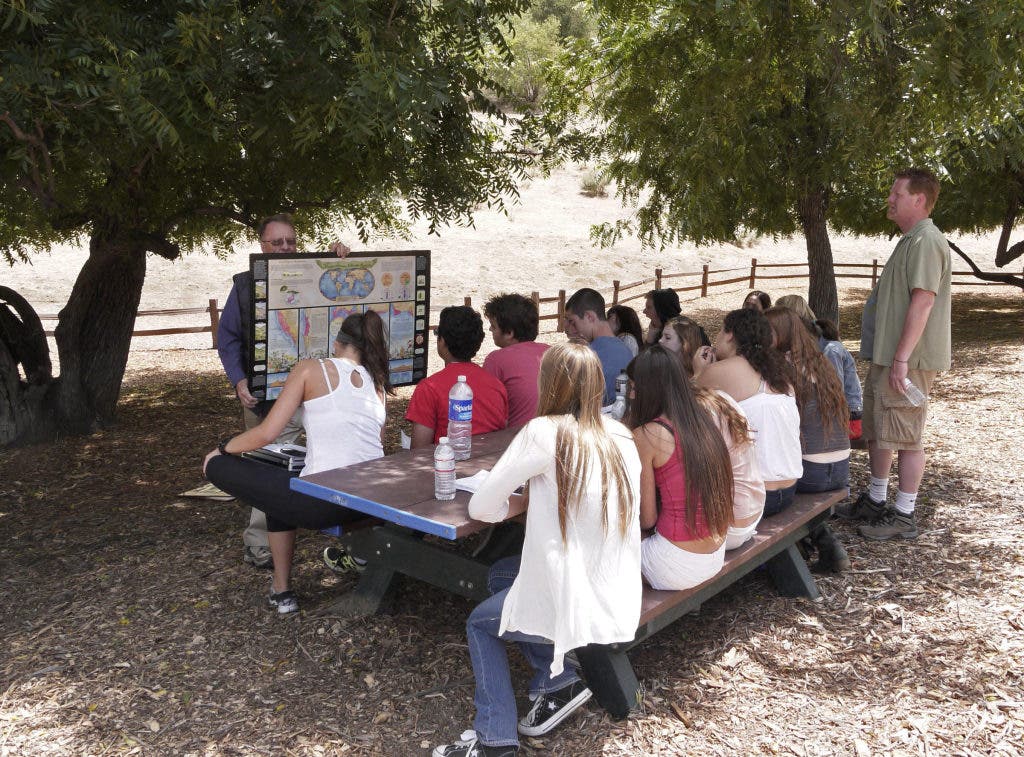


students enrolled in a science course participated in a new environmental program last week conducted by Mountains Restoration Trust (MRT).
The land conservancy organization introduced about 1,300 students to the nature of things at the edge of the urban rural interface.
Named EcoHelpers, the new program focuses on the scientific principles where wild lands meet urbanization in the Santa Monica Mountains.
Find out what's happening in Calabasasfor free with the latest updates from Patch.
Students took a field trip to where four stations on climate, watersheds, invasive species and animals were staffed by MRT experts and volunteers who discussed how humans impact the local Mediterranean biome.
Found only on 2.5 percent of the planet, the local biome occurs between 30 – 40 degrees latitude above and below the equator where it borders a cool ocean with hot, dry summers and cool, wet winters.
Find out what's happening in Calabasasfor free with the latest updates from Patch.
A hot spot for biodiversity and appealing to humans, the Mediterranean biome is one of the most vulnerable to be severely altered by population.
“These areas provide 16 percent of the world’s plants,” explained volunteer Bruce Benson, a science writer. “The human population of our area puts a lot of pressure on both the plants and animals.”
Nancy Helsley, an environmental educator and coordinator of the Cold Creek Docents, gave the students an example of that pressure with a taxidermy Ringtail, a mammal related to the raccoon family.
She pointed out the nocturnal Ringtail’s large brown eyes. “It was killed on Las Virgenes Road blinded by the continual pulsing of cars’ headlights when it entered the road way at the wrong time. After continual light blasts it can take up to 40 minutes for the Ringtail’s eyes to return to normal,” explained Helsely.
At the invasive plant and animal stations, the students learned how the introduction of foreign species can take over and wipe out indigenous species, jeopardizing a healthy ecosystem.
“I never heard about invasive and non-invasive plants and animals before,” said Alana Mandrick, 16, a junior taking chemistry. “We learned how people can bring in species that alter and pollute local streams—like crayfish from Louisiana living in Malibu Creek. They have no predators here.”
Mountains Restoration Trust offers information to the public on how to live lightly at the urban rural interface. For more information, visit www.mountainstrust.org.