Health & Fitness
A Brief Lesson on Capitola and Soquel History
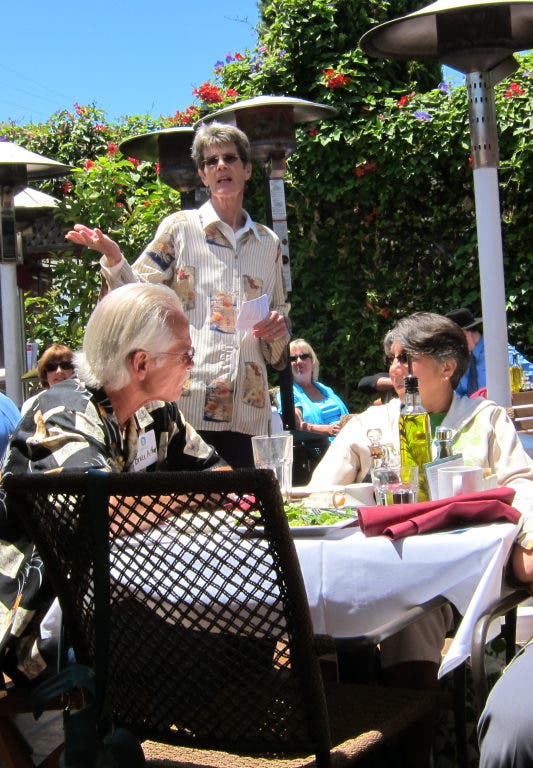
Carolyn Swift, the local history museum's director, spoke to the chamber this week about the kinship of two towns.
I started this blog as a way to find out how to get involved in my hometown, and then summer snuck up on me, with a trip out of state and out-of-town visitors. Now my calendar’s booked until I leave for vacation in August, so I’m not sure when I’ll find time to blog.
But an hour before the Capitola-Soquel Chamber of Commerce started its monthly luncheon this week out on the patio at Café Cruz, I realized I could be spontaneous for a cause. If I’m going to live here, I really do need to learn more about the history of Capitola, and what better way to start than with the Capitola Historical Museum director, Carolyn Swift.
She spoke to the chamber group about the kinship between Capitola and Soquel, which goes back to their early days when they were one and the same. As the Soquel Pioneer and Historical Association wrote in the book, Soquel, the two villages were once “an unbroken landscape of small farms, bulb and flower fields, chicken ranches and orchards.”
Find out what's happening in Capitola-Soquelfor free with the latest updates from Patch.
When Highway 1 was built in 1949, it geographically split the two towns, but in truth, Swift said, Soquel and Capitola had distinct personality differences long before that — Soquel, the older, rough-and-tumble brother who wore overalls, and Capitola, the young girl in a frilly dress who liked to go to the beach.
Swift attributes that colorful metaphor to the “history dude,” Sandy Lydon, a retired Cabrillo College history teacher, author and tour guide.
Find out what's happening in Capitola-Soquelfor free with the latest updates from Patch.
The two of them, it turns out, have a business called Central Coast Secrets, in which they give history walks. Coming up is “The Secrets of Three Villages: Soquel, Capitola, Aptos.”
As I found on Lydon’s website, the two historians “disagree on some things, and it is enlightening to watch and listen to them trade theories about things historical.” I think I’d like to see that—and get out for one of their history walks.
At the chamber lunch, Swift talked about Capitola’s beginnings as a seaside summer camp, beginning as Camp Capitola back in 1874. A San Francisco businessman named Henry Allen Rispin bought it shortly after World War I, with the dream of modernizing his "Capitola-by-the-Sea" so it would appeal to city vacationers taking the train from up north. I read that he went bankrupt right before the Great Depression, which is around the same time someone proposed a joint Soquel-Capitola municipality of “Sotola" (Soq-i-tola?), which didn’t pan out.
Over the years, Soquel and Capitola continued to develop as two different communities, Swift said, Soquel with its Soquel-orama parade, and Capitola its Begonia Festival, which is in its 59th year—truly a tribute to Capitola’s flowery past.
And, with that, my appetite for all things Capitola has been whetted, and I’ll continue to pick up tidbits on my way to becoming more involved in my town.
Do you have any ideas of volunteer work or others ways to get involved in Capitola and Soquel? Please leave a comment!