Community Corner
Tales of the Wilson Ranch: a Rural Carlsbad Childhood from 1942-1958
I always thought "You'll shoot your eye out!" was just a funny line from a classic Christmas movie until I read "Tales of the Wilson Ranch." These recollections from the Wilson family's four boys, cousins and friends will have you laughing and reminiscing
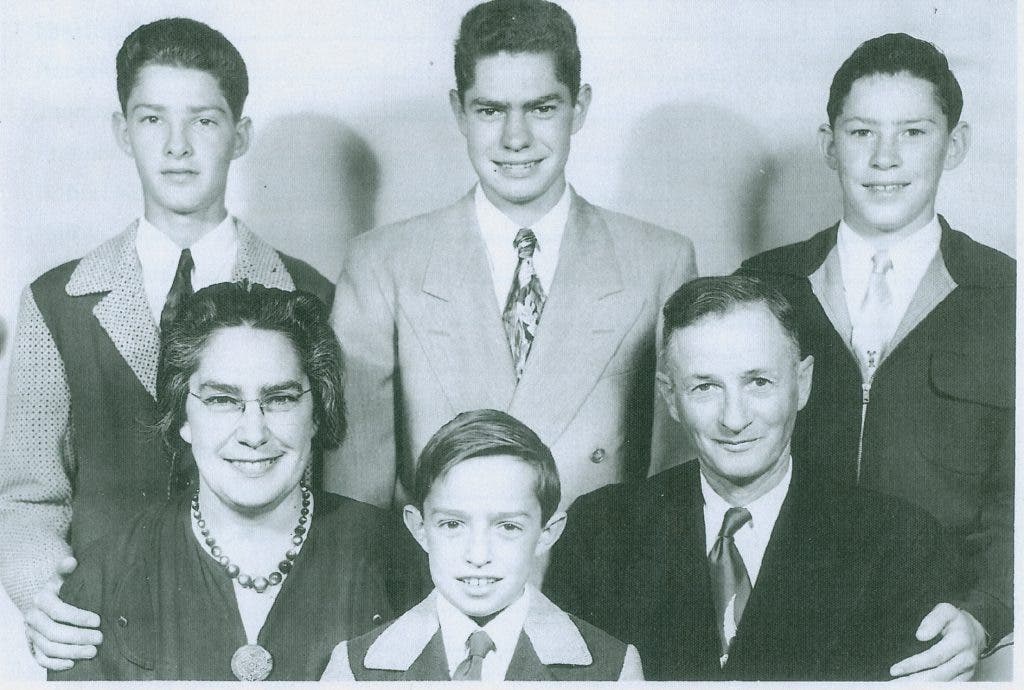


Growing up mid-century has always seemed magical, idyllic to me. Reading Tales of the Wilson Ranch reinforces that belief through its imagery and recollections that seem ingrained in the American fabric from that time. We have had this book of Wilson family memories for some time in the and have just received two more copies that will soon be available for circulation. It is a joyful trip back in Carlsbad’s history, as well as a nostalgic look at childhood and rural life during that time.
The Wilson and Rawson families have lived in Carlsbad since the 1920s. Charles and Ruth (Rawson) Wilson lived with their children, James (Jim), Arthur (Art) and Richard (Dick) “in town” (now the north part of Carlsbad, west of Highland) in the beginning of the 1940s. However, in 1942, they bought 160 rural acres for $6,320. The price included a house, though without plumbing or electricity. The land adjoined Leo Carrillo’s property on San Marcos Road (now Palomar Airport Road) and El Camino Real. They soon relocated to their “new” ranch. In 1943, Lewis Wilson, author of the Tales, was born. Charles and Ruth lived on the ranch and raised their children until 1958, when they moved back into town.
Many of us drive El Camino Real with its four lanes and speedy traffic. However, the Wilson family had a different experience when they went to look at the property one Sunday before they bought it: They got stuck in the mud! Yes, El Camino Real was a dirt road in 1942. It was just being “upgraded from a dirt trace through the countryside to an oiled road” (Page 22). The Wilson’s recall from their days living on the ranch, “If we saw six cars go by all day, we wondered where everyone was going” (Page 41).
Find out what's happening in Carlsbadfor free with the latest updates from Patch.
Before they moved out to the ranch, the family had enjoyed electricity and indoor plumbing like everyone else. Jim considered “it as more of an adventure than a hardship” when they moved to a house that didn’t have these conveniences. Apparently this was not uncommon for rural properties.
According to Wessels Living History Farm website:
Find out what's happening in Carlsbadfor free with the latest updates from Patch.
“Only about 10 percent of U.S. farm families had central station electricity in the mid-30s. Nebraska's average in 1929 was even lower—only 5.9 percent of farmers had electricity. Almost all urban people had power” (Living History Farm). “Private utility companies, who supplied electric power to most of the nation's consumers, argued that it was too expensive to string electric lines to isolated rural farmsteads. Anyway, they said, most farmers were too poor to be able to afford electricity” (New Deal website).
Franklin D. Roosevelt signed an order in 1935 creating the Rural Electrification Administration, which provided $100 million in low-interest loans to the power companies to build power lines in rural areas. And so, in the mid-1940s, the Wilson family was one of the beneficiaries of this program. Having electricity not only provided the family with lights and a refrigerator, but also provided running water because it powered the electric pump. Dick recalls that when they got home from school one day to find out that they had electricity, “I just stood there and flipped the switch up and down watching the light go on and off” (Page 43).
The family also got a telephone in 1943 when Ruth was pregnant with Lewis. At that time, people shared their phone line with other families. Each family had a distinct ring, so you knew when the call was for you. These multiple phones for one line were called party lines. Sometimes when you picked up the phone to make a call, another household/phone number could already be on, so then you would have to wait to make your call. The Wilson family’s phone number at the time was 4730. If you were calling long distance, you would dial 0 for the operator, who would then dial the number for you.
The book covers farm life from the recollections of the Wilson children, their cousins and friends. There are also stories from their parents and many wonderful photos and maps, etc. There’s a chapter on the various animals that the family owned. This is much like the booklet written by Allan O. Kelly about the horses his family owned. We love our pets now, so can you imagine having even more animals to know and love? Not having ready access to equipment that one might need, or the tedium of daily life, can lead to wonderful inventions of the mechanical kind. Charles Wilson invented equipment for the farm, as well as altered many of the existing machines/equipment to fit his needs. Whereas, the boys used car parts, etc., to create vehicles, motorized bikes, etc., with some success and some funny misadventures! The inventions are described and illustrated in detail in the book.
Farming has long been a part of life, not just in Carlsbad, but everywhere. Dry farming was a commonly used method of growing crops. Dry farming involves no irrigation. The only water comes from rain and the soil is tilled deeply to prepare the ground to soak up as much as possible. To replenish the nitrogen, the Wilsons planted garbanzos and black eyed “beans (not peas …)” (Page 68). Later, it is also explained that garbanzos are not beans, but peas. The Wilsons raised beans and grain, chickens, cows and “a quarter acre of peanuts … for munching on rainy evenings” (Page 91). The family also had a kitchen garden: string beans, squash, cucumbers, corn, peas, tomatoes, watermelons and cantaloupes. Ruth “would walk out to the garden, pick enough corn for dinner, husk it on the spot, leaving the husks on the ground for mulch” (Page 83). “Besides leaving the corn husks as mulch, we would bury our garbage in the garden. This would rot down to fertilizer” (Page 83).
Following gopher holes, playing “Cowboys and Indians,” hunting, building forts were among the many activities enjoyed by this family of four boys, their cousins and friends on their ranch. Tales of their adventures are a pleasure to read, for example, Lew’s imaginative play:
“In my cavalry career, I worked my way up through the ranks to become a full Colonel commanding a company of cavalry infantry troops. In those days promotions were earned by shooting imaginary Indians. I know that is politically incorrect, but they should have been more cooperative. My company of soldiers rid the Wilson Ranch of any renegade Indians. Since I was very instrumental in achieving this victory, this is how I earned those rapid promotions. After retiring from the cavalry, I became a U.S. Marshal. I had a matched set of cap pistols that were chrome plated Colt Peacemakers with plastic ‘carved ivory’ handles. With them I was able to rid the Wilson Ranch of any bad hombres. With peace established, I turned my imagination to new adventures. Why not reinstate the pony express?” (Page 95).
Hunting was a common activity and the boys and their families had a variety of guns. They generally hunted rabbits and found them to be quite tasty. One of the cousins, Dave Rawson, recalled the time he had a near miss with a BB gun: “One day I had the BB rifle and I was alone (at about 8 years of age) and in the fort on top of the haystack. I had never really fired any weapon, as I recall, being a suburban California kid growing up in the San Gabriel Valley about 20 miles east of downtown Los Angeles. For some reason, I also had a switch: a firm, sturdy, length of branch maybe a quarter-inch thick. … I jammed the switch into a far bale of hay so that it stuck straight up and then I retreated about 20 feet. I laid out the BB gun across a bale of hay and sighted the barrel as I had been taught. … Carefully, I sighted. … Satisfied that there was a sweet spot of alignment past which I couldn’t improve, I slowly squeezed-not pulled-the trigger and shot myself between the eyes! I had done such a perfect job of not only hitting the switch, but hitting it dead center such that it flexed and instantly shot the BB straight back at me. Zzzzap. Smack into the bridge of my nose. It actually took me quite a few seconds to figure out what must have happened and when I did, every story I had ever heard about little boys putting an eye out playing with BB guns came forward with such force that it was quite a while until I again handled a rifle or a pistol” (Page 178).
There are many snake stories, aviation stories (from when the airport was at the end of Chestnut Street, parallel to El Camino Real), tales of swimming in the swimming holes on their property, Boy Scout stories, and trips into “town” about once a week for mail and other sundries. The mail boxes at the post office had ornate bronze doors with knobs for the combinations to open them. Ice cream from Stillman’s Pharmacy would be a special treat while in town.
The reader is fortunate in that the Wilson family shares many of their home recipes, including several for cold remedies and insect sprays, in the book. There are also many sayings (some very humorous!) of family and friends in the back of the book, as well as an appendix with various documents related to their life on the ranch. Whether you lived this life as a child or have heard about the good ol’ days of childhood mid-century, Tales of the Wilson Ranch will serve to reinforce the belief that they really were the good ol’ days!
Sources:
Tales of the Wilson Ranch by Lewis Wilson, 979.498 WIL
livinghistoryfarm.org/farminginthe30s/money_19.html accessed Aug. 8, 2011
newdeal.feri.org/tva/tva10.htm accessed Aug. 8, 2011
loc.gov/rr/scitech/mysteries/blackeyedpeas.html Accessed Aug. 9, 2011