Community Corner
'Canoe Sign' Gets a Second Look: If Artist is Willing, Sculpture Might be Relocated
Town leaders have decided to find out whether the artist would allow the sculpture to be relocated to Lake Chabot or the Castro Valley library. Contractually, she gets to decide.

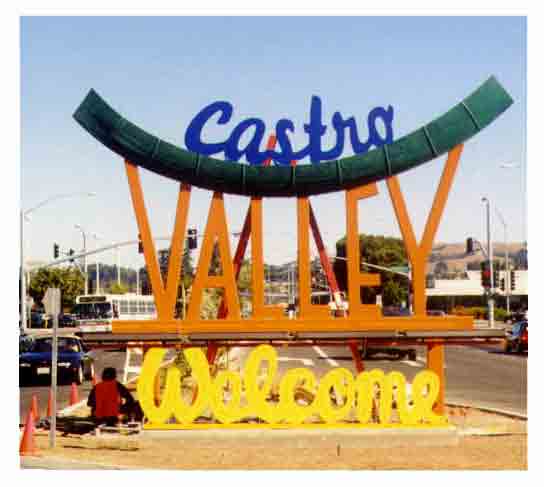
If the artist is willing, town leaders will look into the cost and desirability of taking a controversial $100,000 sculpture out of storage and installing it on county property near Lake Chabot or at the Castro Valley library.
Contractually, Sheila Klein, the Washington state-based artist who created the piece, has the right to veto any decisions the county makes. It can’t be demolished or relocated without her permission.
The Municipal Advisory Council decided Monday night to ask Alameda County Arts Commission officials to contact the artist and gauge her willingness.
Find out what's happening in Castro Valleyfor free with the latest updates from Patch.
If she’s receptive, the council would then ask the county to investigate the cost of moving, installing and maintaining the sculpture, and the availability of funds for that purpose.
The "canoe sign," as it has come to be known because it features a symbolic rendition of an Ohlone canoe, was intended to honor the town's Old West roots.
Find out what's happening in Castro Valleyfor free with the latest updates from Patch.
It has been warehoused since 1997, after having seen very little light of day.
“It definitely took me longer to build and conceive the piece than the amount of time it sat on Redwood Road,” Klein said in an interview with Patch in December, 2010, when the council was wrapping up a survey of public sentiment about the art work.
Klein said she never intended the sculpture to be used as a sign, but residents viewed it that way because its major features are the words "Castro Valley" and "Welcome." The words are stylized, with "Castro" in blue letters sitting atop a forest-green symbolic representation of a canoe.
The canoe is a nod to the Ohlone Native Americans who lived in Castro Valley — as well as all throughout the San Francisco Bay Area, Monterey Bay area and Salinas Valley — in declining numbers through the 1800s, when Spanish conquerors decimated the population.
The word "Welcome" resembles a lasso, symbolic of the American cowboy. Castro Valley today retains a semi-rural feel and an annual rodeo at Rowell Ranch but is closely connected to cosmopolitian and suburban centers on all its sides, and is known for excellent schools.
Donna Sire, the only Castro Valley resident to speak up at the council meeting tonight, said the sculpture looks like it belongs at a carnival.
"It's kind of humiliating for Castro Valley to be represented by that," she said. "If you have to save it, ... put it in a museum."
Last fall, Castro Valley resident John Lindon asked that town leaders consider taking the sign out of storage and finding a public home for it.
Community opinion was split 56 percent against and 43 percent in favor of re-installing the sign somewhere in Castro Valley, according to a survey conducted in November and December of last year.
"If you had to pay for it from scratch today, it might be another matter," Lindon said in an interview with Patch Monday. "But given that $100,000 has been spent on it, we might as well put it to use. It’s a cool sign. It has character."
Lindon describes the sign as having "Route 66" character: "Wild West, down home, warm, welcoming, sort of funky."
Get more local news delivered straight to your inbox. Sign up for free Patch newsletters and alerts.