Business & Tech
DeafHope Executive Director to Join Alameda County Women's Hall of Fame
Julie Rems-Smerio, a long-time Castro Valley resident who now lives in Pleasanton, founded DeafHope in 2003 to provide services and resources to deaf survivors of domestic violence and sexual abuse.
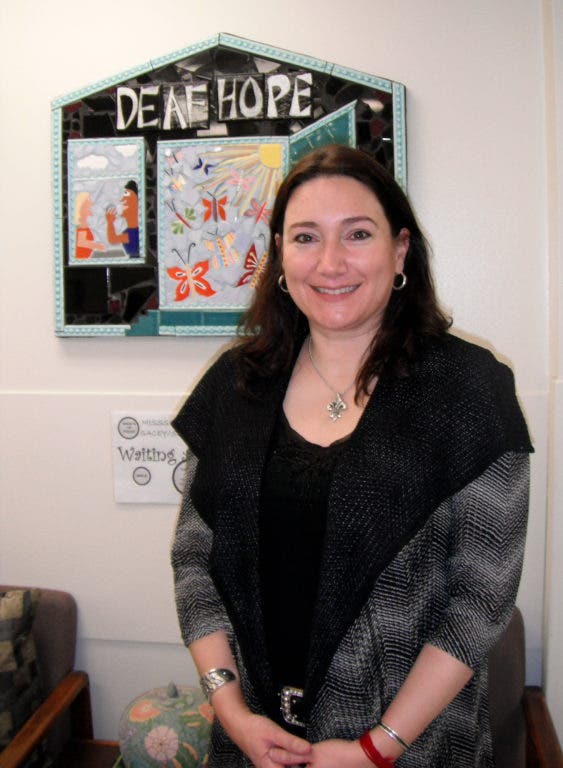
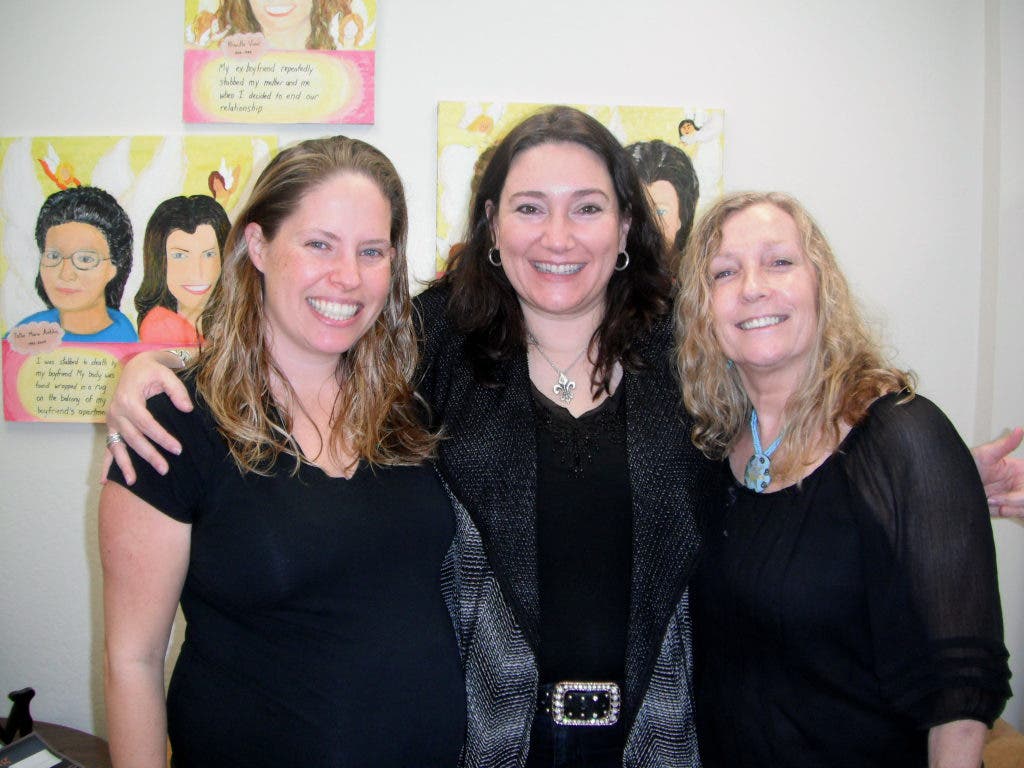
Julie Rems-Smario, a former Castro Valley resident, will be inducted into the Alameda County Women’s Hall of Fame on March 19 for her work as executive director of DeafHope in Oakland. DeafHope was founded in 2003 to provide services to deaf survivors of domestic and sexual abuse.
Rems-Smario, who has been deaf since birth, was born in Long Beach. Her family later moved to Hayward, where she graduated from Hayward High School. She earned a bachelor’s degree in liberal studies and a master’s in deaf education from California State University, Northridge.
She began her career with the deaf community in 1990 with Five Acres Deaf Program in Pasadena, working with at-risk families on child abuse prevention.
Find out what's happening in Castro Valleyfor free with the latest updates from Patch.
After moving to northern California in 1993, she joined the Catholic Charities Hearing Impaired Program to work with at-risk deaf families on parenting skills.
She then worked at the California School for the Deaf in Fremont as a teacher for deaf preschoolers and their families and simultaneously earned a master’s degree in Rehabilitation Counseling for the Deaf and Hard of Hearing from San Francisco State University.
Find out what's happening in Castro Valleyfor free with the latest updates from Patch.
She subsequently became a counselor for Deaf Services at Ohlone College in Fremont before founding DeafHope in 2003.
Rems-Smario was also the recipient of the 2007 International Femtor Award for Humanitarian of the Year for her work with DeafHope.
The 45-year-old longtime Castro Valley resident now lives in Pleasanton with her husband and three children.
We asked Rems-Smario about her work with DeafHope:
Q: Why does DeafHope spell Deaf with a capital D?
A: At DeafHope we avoid the word “deafness” because it is used in the medical field to label what is wrong with us, reinforcing the culture of audism.
We choose the word Deaf with a capital D to take back our power as a group with a rich linguistic and cultural identity.
It is about our journey to free ourselves from audism, similar to feminism’s effort to free women from sexism.
What inspired you and your fellow founders to start DeafHope?
DeafHope was founded in 2003 by eight women from the Deaf community. All of us had experienced violence, either directly or indirectly.
When I was 25, I worked at Five Acres Deaf Program in Pasadena as a social worker for at-risk families. It bothered me that the system told Deaf mothers that if they could not protect their children from an abusive partner, their children would be taken from them.
There are no shelters specifically for abused Deaf women in California. There are many hearing shelters, but it is isolating at these shelters because no one knows American Sign Language (ASL). It is easier to go back to a Deaf abuser who knows sign language than to stay at a shelter with those communication barriers.
The system sets Deaf women up for failure. As a result, families are torn apart. The children are placed in hearing foster homes where signed language is not used. So Deaf children forget their “mother tongue” or “mother hands” and become delayed in learning.
The choices for abused Deaf women are a travesty. It is either “lose my family,” “lose my life” or “lose my sanity,” or all of the above.
How did DeafHope get started?
We all want to see violence against women cease. So the founders of DeafHope got together at Starbucks to brainstorm our vision for DeafHope. We chose the name because we wanted to let other Deaf women know there is "Hope" for them.
We did not have much money except for $8,000 from a performance of The Vagina Monologues by Deaf women. With that, and our own money, we rented a house in Hayward on Mission Boulevard and started DeafHope.
I have to emphasize that the majority of Deaf women who come from Deaf families have been exposed to ASL since birth, so they are generally the best self-advocates empowered by their foundation of language.
Unfortunately, many Deaf women from hearing families did not learn adequate communication skills because their parents were told by doctors and teachers not to use ASL. The access to communication can also be delayed by a long period of grieving by their hearing parents for having a Deaf child.
At DeafHope. all the advocates are fluent in ASL. Some of the survivors are surprised to find that the executive director is also Deaf. It sends a powerful message to the Deaf community that this place is run by and for Deaf survivors.
At DeafHope, the survivors can focus on domestic and sexual violence issues without worrying about communication barriers.
How was your early home life?
My mother, who is from Spain, inspired me because she created a home of love and compassion. (Yes, I grew up with paella!)
I thought that was a normal childhood until I became an adult and discovered that my mother is really a gem, because there are not many homes filled with that kind of compassion.
Every child deserves a violence-free home and unconditional love. That’s my motivation: to ensure that we have a Deaf-centered shelter and transitional home for abused Deaf women and their children.
What are the primary services that you provide?
Currently we provide advocacy services, system advocacy, court accompaniment, peer counseling, a weekly support group, a weekly children’s group, and technical assistance and training to shelters and law enforcement.
We also have a hotline during our business hours, Monday to Friday, 9 a.m. to 5 p.m. Due to reduced staffing we no longer run it full time.
At DeafHope, we ask the survivors what they need. We believe the survivors know what is best for them. We are only facilitators providing resources and brainstorming on solutions to help empower them.
How many clients does DeafHope serve? What geographic area do you serve?
We serve an average of 60 cases per month with a staff of only four. Soon we will lose one advocate due to loss of funds.
We serve all 10 Bay Area counties including Alameda, Santa Clara, Contra Costa, Solano, San Francisco, San Mateo and Sonoma.
We limit our travel distance to one hour because we do not have the staff or manpower to drive longer distances.
When we started receiving referrals from the Sacramento area, we partnered with NorCal Center for Deaf and Hard of Hearing to hire a full-time sexual violence advocate to serve that area.
Can you tell us about some survivors that DeafHope has helped?
DeafHope is a place where survivors can make their own decisions without fear.
We helped one pregnant Deaf woman whose life was threatened by her incarcerated ex-boyfriend. She took the train and traveled 400 miles to DeafHope. We found a shelter, transitional home and finally an apartment for her. She had her baby and found a job. She also changed her name. Now she is happily raising her beautiful child.
Another survivor was imprisoned by her family since childhood and repeatedly raped by her brother. She became pregnant but escaped and was brought to us. We helped her find a home where she lives independently and continues to have a relationship with her child.
Another woman was severely beaten by her husband who also tried to strangle their son. She and her son escaped and came to DeafHope. Through our services, she found a new home far away from the abuser and created a new life for herself with a new job and a new partner.
In another case, a Deaf immigrant woman’s husband threatened to have her deported if she told about the abuse. She came to DeafHope, where she found resources to become a U.S. citizen, find a job and even bought a home.
Are Deaf women more susceptible to domestic violence than hearing women?
I think it is about the same, but the system is not accessible to Deaf women, so they are at greater risk for fatality.
Deaf women also have more strikes against them because of audism, which is on a par with racism and sexism. Hearing people may regard Deaf people as inferior and do not provide them equal access.
Just as in the hearing population, abuse is about power and control. But Deaf women in abusive situations face additional challenges.
For example, when a Deaf survivor calls 911 for help, the police who arrive on the scene only talk with the hearing abuser instead of getting an interpreter for the Deaf woman. The police close the case based on the hearing partner’s story, which is often to say that there isn’t a problem. In some cases the hearing abuser even claims the Deaf partner is at fault and the Deaf woman gets arrested.
Are there other organizations like DeafHope?
DeafHope is the only Deaf-centered place run by Deaf survivors for Deaf survivors. It is not clinical. It is community-based.
Our board of directors consists mostly of survivors. They know first-hand what it is like to experience domestic and/or sexual violence.
The first agency for abused Deaf women was founded during the 1980s in Seattle. It is called Abused Deaf Women Advocacy Services (ADWAS). I received my training from them in 1998.
The model used by ADWAS is incredible, but I learned that one size does not fit all. We had to design a program that fit our community’s needs.
For example, in the East Bay, we have one of the nation’s largest schools for the Deaf called California School for the Deaf in Fremont. So we established a children’s art therapy program and weekly support group at the school for children who witness or experience violence.
What plans do you have for the future of DeafHope?
In a hearing shelter, the average length of stay for a Deaf survivor is 24 hours. It is easier for the woman to return to a Deaf abuser who knows ASL than to feel isolated in a shelter where she can’t communicate.
We have a wonderful plan to build a shelter of our own called Safe Deaf Space.
It will be based on architectural principles of Deaf Space, meaning that the building will be designed to fit our visual ASL (such as lighting without glare) and plenty of space so we can walk without bumping into a post or the corner.
The stairs will not have steps. Instead it will be an upward spiral so we can continue to communicate in ASL while walking up.
I am very excited about the Safe Deaf Space project. It will be the first one in California and second in the nation. I invite the community of women and everyone to join DeafHope to make this incredible dream come true.
Who nominated you for the Hall of Fame honor?
I suspect it was the Alameda County district attorney, Nancy O’Malley, whom I met 10 years ago.
She once questioned me why I was pursuing a nonprofit for abused Deaf women because in her experience, she had only encountered two Deaf women. I told her it is because Deaf women do not trust the system, especially the court and law enforcement, due to communication issues.
If the Deaf community sees a Deaf-centered agency for Deaf survivors of domestic and sexual violence, they will come out of the woodwork.
Nancy asked me to partner with her at the Alameda County Family Justice Center (FJC). In 2009 alone, we had over 350 Deaf individuals show up at FJC for DeafHope services.
How do you feel about being chosen for the Alameda County Women’s Hall of Fame?
I feel honored, especially since this came from Nancy O’Malley, who was once a naysayer!
I see this as validation that the system recognizes the importance of including Deaf people in political scenarios for system change. I always say “Nothing about us without us!”
This award is a symbol of my hearing sisters’ recognition of Deaf women leaders as equals, not tokens. In this case, we are truly partners in our campaign to end domestic and sexual violence.
If you visit DeafHope you will find life-size wooden silhouettes displaying a picture and handwritten letters for each Deaf woman murdered by her partner. These tragedies constantly remind us of our mission: to end domestic and sexual violence against Deaf women and children through empowerment, education and services.
The 18th Annual Alameda County Women’s Hall of Fame Awards Luncheon will be held on Saturday, March 19, 12:30 to 3 p.m., at the Greek Orthodox Cathedral, 4700 Lincoln Ave., Oakland. Tickets are $75. For tickets and information, call 510-272-6510 or visit www.acgov.org/cao/halloffame.
DeafHope will hold “An Evening of Miracles,” its 8th Annual Glimmer of Hope fundraiser, on Saturday, Feb. 26, 5 p.m. to midnight, at Wedgewood Banquet Center, Metropolitan Golf Links, 10051 Doolittle Dr., Oakland. There will be dinner, entertainment and a keynote address. Tickets are $100.Purchase tickets through PayPal at www.Deaf-Hope.org or send a check payable to DeafHope to: DeafHope, 470 - 27th St., Oakland, CA 94612. (Please specify your dinner choice of filet mignon, salmon or pasta primavera).Mailed reservations should be postmarked no later than Feb. 16. All proceeds benefit DeafHope services.