Arts & Entertainment
Israeli Documentarian Debuts 'Violins During Wartime' at UCLA
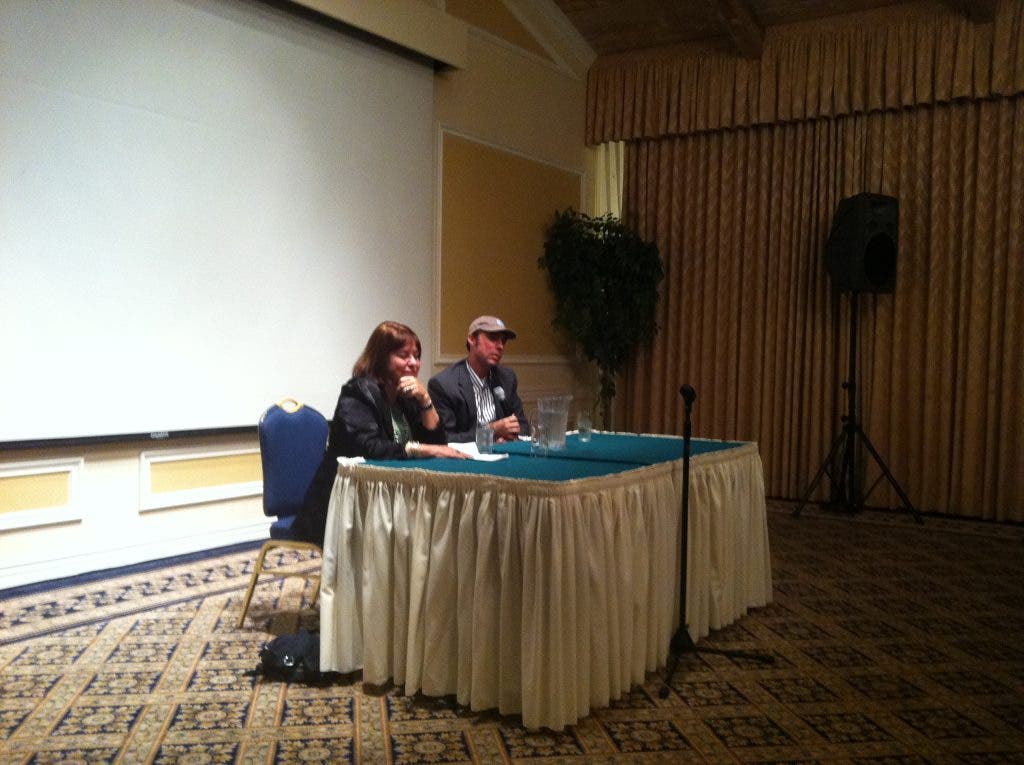
Yael Katzir and her son Dan Katzir, who also makes documentaries, lead a robust Q & A after the premiere of her film about making music in turbulent times.


If hoary clichés are to be believed, most Jewish mothers want their sons to be docs. Not Yael Katzir. She’s content that her son makes docs.
That’s because Israeli filmmaker Katzir, like her son Dan Katzir, an L.A.-based producer, makes documentaries for a living. On Thursday night, mother and son took questions after the debut screening of Violins in Wartime, Yael Katzir’s latest film, at UCLA.
Sponsored by the UCLA Younes and Soraya Nazarian Center for Israel Studies, the premiere packed the Faculty Center’s California room with about 200 attendees.
Find out what's happening in Westwood-Century Cityfor free with the latest updates from Patch.
In the absorbing documentary, Amnon Weinstein builds and repairs violins for young soloists who come to Israel from other countries to attend a summer master course on violin performance. Unfortunately, things did not go smoothly in summer 2006 in Weinstein's country as the second Lebanon war broke out. The master course had to be relocated from Kibbutz Eilon, near Israel's Lebanese border, out of the range of falling Hezbollah missiles to the Beit Berl College in central Israel. Master violinists Ida Handel and Shlomo Mintz, along with a determined Weinstein, whose son was in the army at the time, struggle to keep their sanity by escaping into this creative bubble world of classical music. As the filmmakers put it, “The violin becomes a symbol for the Jewish-Israeli desire and struggle to continue in spite of [obstacles].”
Yael Katzir has written and directed numerous acclaimed works before, including Praying in Her Own Voice (2007); Shivah for Mother (2004); and Company Jasmine (2001). A few years ago, Dan Katzir directed and produced a Jewish film festival favorite, Yiddish Theater: A Love Story (2006), which follows the quest of Zypora Spaisman, a vibrant, colorful Holocaust survivor, to keep a Manhattan Yiddish theater alive. It's a struggle that serves as a metaphor for Yiddish culture itself.
Find out what's happening in Westwood-Century Cityfor free with the latest updates from Patch.
After Violins in Wartime screened Thursday, mother and son took questions from the audience.
“The first few days, I didn’t realize it because it was a holiday vacation,” Yael Katzir said of her eavesdropping on the nervous Weinstein household in Violins. “One day, after a very unforgiving night with fears,” she realized that she had to film what was going on. “After two or three days, I followed them," she said.
The visiting filmmaker sees her latest film as a glimpse inside the Israelis' iron will to live normally during periods of conflict.
“You don’t see the bones, you see the flesh,” she said of the state of Israel. “But this is the backbone that helps Israel go on.”
Toward the end of the panel, Yael Katzir expressed delight to be joined in the spotlight by “my son, who is also my coach.” Dan Katzir comically kept the Q&A session moving, deflecting with humor some potentially thorny questions, such as why all of the violin students were attractive young women and the absence of males in the master class.
The speakers also noted that the master class was largely devoid of native performers.
“Most of the girls in the master class are not Jewish,” Yael Katzir said. "Many of them come back over and over. The Russian girl [in the film], this was her sixth time.”
The violinists also included young women of Lebanese descent.
“It’s people who not necessarily would go to Israel who learn about Israel and [after their experience] care about Israel,” Dan Katzir said.