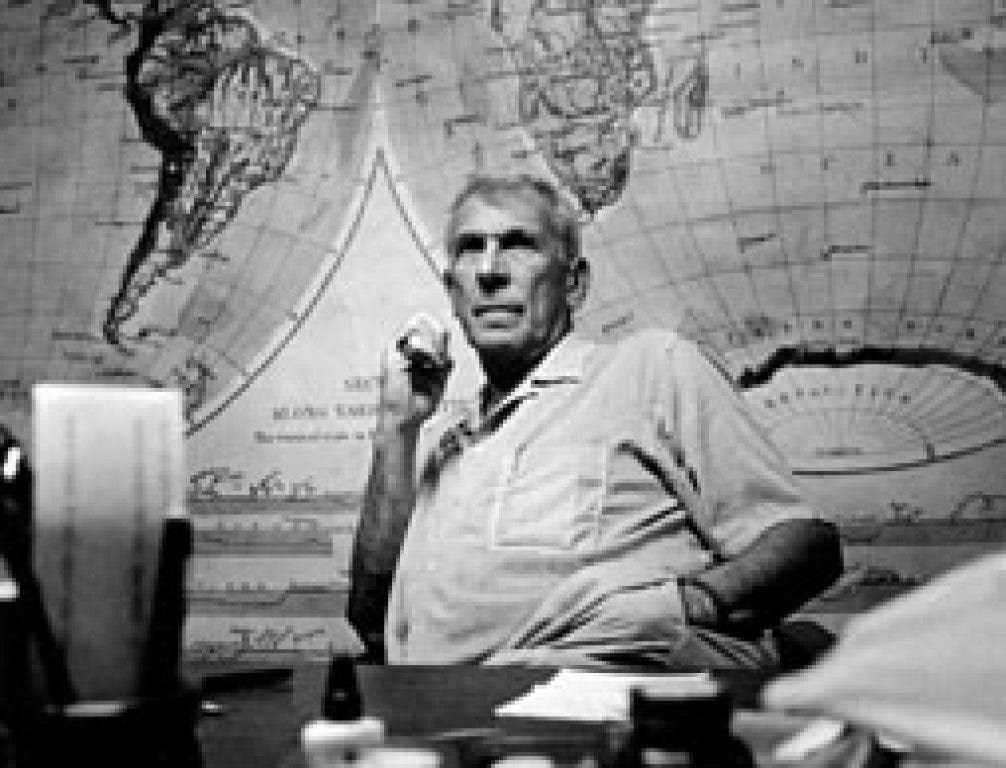
The UCLA Film and Television Archive will be hosting a celebration of one of Hollywood’s most underrated hyphenates with "Looking for Richard Brooks: An Appreciation" screening selected movies from through May 25.
It seems appropriate that this event will take place at the Billy Wilder Theater since Brooks, himself, was the first recipient of the "Billy Wilder Award" given jointly by the Writer's Guild and the Director's Guild for a lifetime of achievement as a writer/director.
Known as "God's Angry Man" by friends, because of his willingness to speak out against the injustices of man, Brooks' body of work naturally examined topics that were important to him. Some of the issues he tackled are strangely even more relevant today, from gays in the military to sex scandals in the Catholic Church and from animal rights to the death of print media. It seems that his views and concerns were almost a half century ahead of the rest of the country.
His prescience even predicted major world events when "Wrong is Right" (unfortunately not part of this fest) depicted a 24-hour news network uncovering a plot by Middle Eastern terrorists to blow up the World Trade Center. Sadly, this movie failed at the box office since these ideas seemed laughably absurd in 1982, when few houses had cable TV, and everyone was still afraid of the "evil empire" known as the U.S.S.R.
Then, there's casting acquitted murder suspect, actor Robert Blake, as a homicidal killer for "In Cold Blood" back when he was best known as one of "The Little Rascals." Brooks seemed to have a knack for seeing aspects of life and people that were invisible to most others. Some scholars have even claim that his use of rock and roll in "Blackboard Jungle" (screening April 16) took this regional music and thrust it into the national spotlight, creating the billion dollar industry it is today.
Appropriately, Brooks' first foray into the film industry was as a newsreel cameraman during World War II. He was the crazy Marine that, when a battalion stormed a beach or charged a hill, went first into the gunfire, so that he could turn around and film the other soldiers advancing into battle.
Find out what's happening in Westwood-Century Cityfor free with the latest updates from Patch.
This training proved useful in "Something of Value" (screening April 2), when he not only recreated the racially charged Mau Mau Revolt in Africa in the same streets where it occurred, but while the fighting still continued nearby (sometimes one block away). Or, the film "Battle Circus" (screening with "Something of Value"), a irreverent comedy about a MASH unit in the Korean War, which was originally entitled "MASH," until his studio bosses rejected it, claiming audiences would never go to a movie with that title. Obviously, an Academy Award winning film, and a long running, highly rated TV series with that same name (and subject) would ultimately prove them wrong.
Additionally, Brooks, who wore a regulation buzz-cut until his death in 1992, also famously ran his set like a military operation, and would blow a whistle and bark orders at his actors like a drill-sergeant. This madness was captured in the BBC documentary "Do It On The Whistle."
Likewise, the stories of how he ran the pre-production and post production on his movies like a classified covert mission are legendary. It is said that he would only give out small segments of the script to cast and crew on a "need to know" basis, which had to be read in his presence, and returned. Also, it is said that the film from each day's shoot was secretly shuttled to a hidden location where it was edited in private (away from the eyes of studio executives). It wasn't until the movie was completed that anyone was allowed to see it (and learn what it was really about), and by then, it was too late to make changes.
However, despite his strict and intimidating demeanor, he was ironically beloved by just about anyone who ever worked for him, who were thankful for the experience.
Find out what's happening in Westwood-Century Cityfor free with the latest updates from Patch.
Recently deceased film legend, Elizabeth Taylor was forever grateful to Brooks for not only casting her in "Cat on a Hot Tin Roof" (April 10), but when her then husband, film producer Michael Todd, died during the production, and she wanted to continue working, Brooks quickly rearranged the shooting schedule, so that all the film's party scenes were shot in the following days.
Taylor eventually realized that Brooks (although he never expressed it verbally) was concerned she wasn't eating enough, so he made sure she always had plenty of food in front of her in every scene. She greatly appreciated the quiet way he protected her during her most fragile time.
It could also be argued that many of the actors who appeared in his films, gave Brooks the best performances of their career, including his wife, actress Jean Simmons, who received an Academy Award for "The Happy Ending" (May 1). This drama is not only about the subject of divorce, but it features recreated, and transcribed, moments from their own broken marriage.
As the UCLA Film and Television Archive's promotional literature proclaims "A stalwart creative force of the American film industry for more than four decades, writer-director Richard Brooks stands as one of the most significant filmmaking voices of the second half of the 20th century. " Ironically, Brooks always insisted he had nothing to do with "filmmaking." The way he looked at it, "film" is what you put inside the camera.
He also detested, and never understood, the term "movie." He proclaimed that he simply made "pictures." Although we can debate the terms, his "pictures" are anything but simple.
This series is a great opportunity to see these rarely screened "pictures," and why so many varied directors from Oliver Stone to Steven Spielberg were influenced by the work of this so-called "angry man."