Chances are high that you have a portable device that requires a memory card. It could be a camera or even a phone with a memory card slot. While these cards are useful, they do present one problem: There's so many different types and subtypes that it can be taxing to distinguish the difference between them and figure out which is the one you need.
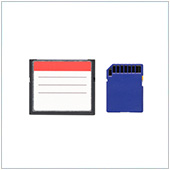
This article is an overview of the two most popular types of removable memory cards that most electronics use: SD and CF.
SD Secure Digital cards, more commonly known as SD cards, are the most popular storage medium for smaller devices like smartphones and most digital cameras. There are three main types of SD card:
Find out what's happening in Claremont-La Vernefor free with the latest updates from Patch.
- SD
- SD Mini
- SD Micro
Each size of SD card usually comes in three different types. This designation actually dictates the maximum storage capacity of the card:
- SDSC - SD Standard Capacity - can store up to 2GB of data. Some cards can go as high as 4GB.
- SDHC - SD High Capacity - can store up to 32GB of data.
- SDXC - SD eXtended Capacity - can store up to 2TB (Terabytes) of data, although the highest you will likely see at this time is 128GB.
Another important point to be aware of with SD cards is the write speed - how fast data can be written, or saved, on the card. Manufacturers designate their SD cards in classes. Most manufacturers will use one of five class designations:
Find out what's happening in Claremont-La Vernefor free with the latest updates from Patch.
- Class 2 - These cards write at 2MB per second.
- Class 4 - These cards write at 4MB per second.
- Class 6 - These cards write at 6MB per second.
- Class 10 - These cards write at 10MB per second.
- UHS (Ultra High Speed) Class 1 - These cards write at 10MB per second and faster.
CF CF, or Compact Flash cards, are traditionally found in higher-end cameras like DSLRs. These cards tend to be much larger than SD cards, measuring 36mm length by 43mm wide. They are generally more robust - able to work harsher conditions - than their smaller SD counterparts.
Currently, CF cards are available with up to 128GB of storage capacity. While this is seemingly lower than SD cards, CF can write data a heck of a lot quicker. Take a look at most CF cards, and you will see the words UDMA - Ultra Direct Memory Access. This technology allows for faster data transfer between the memory card and the device.
There are eight different UDMA numbers which indicate how fast data can be written.
- UDMA - can write at speeds up to 16.7MB per second.
- UDMA 1 - can write at speeds up to 25MB per second.
- UDMA 2 - can write at speeds up to 33.3MB per second.
- UDMA 3 - can write at speeds up to 44.4MB per second.
- UDMA 4 - can write at speeds up to 66.7MB per second.
- UDMA 5 - can write at speeds up to 100MB per second.
- UDMA 6 - can write at speeds up to 133MB per second.
- UDMA 7 - can write at speeds up to 167MB per second.
If you are looking for a new memory card, it's important to pay attention to what your device's manufacturer recommends, largely because these cards - both SD and CF - can be expensive.
Looking to learn more about memory? Why not give why not contact ISN Global Enterprises (www.isnglobal.com) today, they'd be happy to sit down with you.