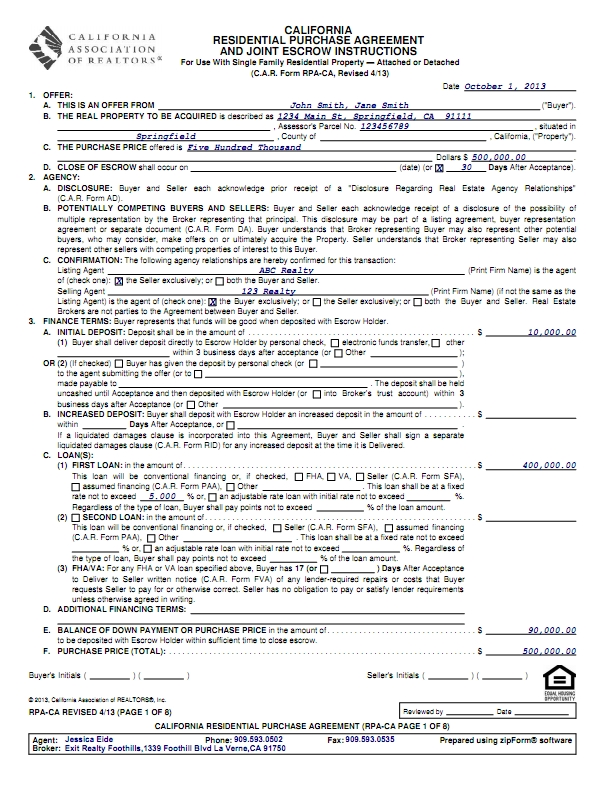
The California Residential Purchase Contract – Page 1
Purchasing a home can be a very overwhelming task. First you have to find a Realtor you trust and then pre-qualify with a lender to see how much you can afford. After that, you have to pick a neighborhood you want to live that fits the price tag, and then it’s time to search for that perfect home. When you find that home you have been looking for, that is when the fun begins. All of sudden you are signing paperwork and sometimes nobody has taken the time to explain what it is you are signing.
The California Residential Purchase Contract (RPA) by the California Association of Realtors (C.A.R.) is the most widely used contract in our area to purchase a home. It is an eight page contract with a lot of information on it. Let’s go over page 1. Page 1 is the “money” page making it one of the most important pages in the whole contract.
Find out what's happening in Claremont-La Vernefor free with the latest updates from Patch.
The contract is separated by paragraphs that are numbered and most of the paragraphs have sub paragraphs that are indicated by letters. You will notice that there is a place for a date in the top right hand corner. This is very important to fill in because the offer goes void after so many days and following contracts during escrow can be based off of this date too.
Paragraph 1 is very straight forward. 1A names the person/people the offer is from AKA the buyers. 1B names the property with the address and parcel number. 1C shows how much money the offer is for and 1D dictates how long the buyer thinks it will take to close escrow, usually 30 days.
Find out what's happening in Claremont-La Vernefor free with the latest updates from Patch.
Paragraph 2 is all about agency. What is agency? Agency is the function of the agent. More often than not there will be two agents in the transaction. One represents the buyer and one represents the seller. This will go into more detail C.A.R. form AD which should be attached to the eight page RPA. This is the purpose of 2A, to inform the seller and buyer that there should be another form attached to the offer that discloses agency. 2B advises both buyer and seller that the agent named in this agreement may also be representing another offer for this particular property or another home for sale in the competing market. This happens often when there is low inventory in a particular area. 2C names each brokerage that will be working in the transaction if the offer is accepted. Sometimes it is the same agency. It is important to pay attention to the boxes checked in this section. On occasion, the same brokerage will be named for both buyer and seller, even though there are different agents working in the same office representing either side. This is still considered a dual agency and “both buyer and seller” box should be checked.
Paragraph 3 is all about the money. This is why it is important to pre-qualify with a lender before searching for houses. When you find a home you love, usually you want to put an offer on it right away, especially in today’s market. If you have not already spoken to a lender, you cannot even finish page 1 of the offer. This will delay the process 24 to 48 hours depending on the lender and how fast the buyer can provide the lender with information. Once that aspect is complete, you can finish filling out paragraph 3.
Paragraph 3A names how much to offer for the initial deposit. Most agents will advise the buyer to offer 1-3% of the purchase price. The more you offer; the more serious the seller will think the buyer is. In this contract the buyers are offering 2% of the purchase price or $10,000. 3A (1) dictates how this money will be sent to escrow once the offer is accepted. If no boxes are checked the buyer will deliver to escrow the check within three days of acceptance. 3B is very rarely used. It is usually only used if the initial deposit in 3A is a small amount. 3C is the first loan usually 80% of the purchase price, but there are many lending programs out there, the loan officer will find the one that fits your needs best. It is important to fill in that the rate shall not exceed a certain APR. This gives the buyer a little more security when making the offer. The number should be above the current rate. If the buyer is need of down payment assistance the second loan section will be used. If the buyer is using FHA or VA financing they must fill in section (3). 3D would be the place to ask for closing costs, making an all cash offer or any unusual financing terms. 3E names the down payment or remaining balance that must be sent into escrow near the end of escrow. 3F names the total amount offered for the home.
At the bottom of the page there is a place for the both buyer and seller to initial. The buyer must initial before presenting the offer to the seller.
This is just the first page of an offer, but it is one of the most important ones. Please feel free to contact me if you have any questions about putting an offer in on a home.
Jessie Eide is a Realtor at EXIT Realty Foothills specializing in the Claremont community and helping people invest in Real Estate all along the foothills. For more information call 626.523.1822 or visit her website at www.SimplyYourRealEstate.com to have free access to the most comprehensive MLS Listing Service.