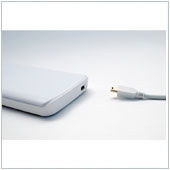
Your computer has many important components, with one of the most vital being your hard drive. Because you store all of your data and programs on this device there is a space limit. One way to add more space is to use an external hard drive. While these drives are popular, some business users wonder whether they should be using them or not.
Hard drives are separate drives that you can connect to almost every computer. The vast majority of drives use a USB cable, while some are Apple specific and use the Thunderbolt cable. Because computers, by default, don't rely on these drives in order to operate, they can usually be connected to other devices as long as they have the correct formatting.
There are numerous ways these hard drives can be used in the office. The most obvious is to back up data. Because many of these drives now come with a large amount of storage, you can easily fit computer backups and even systems onto a drive. Add in the fact that they are relatively cheap to purchase, and you can see how they can be a useful tool, especially when combined with other backup solutions.
Find out what's happening in Claremont-La Vernefor free with the latest updates from Patch.
Four benefits of using an external hard drive in your business The majority of external hard drives are used as some form of backup solution e.g., to actually back up systems, or to keep a copy of files, which afford several benefits:
- Portability - Most external devices are small enough to move easily. This makes it easier to move copies or backups off site for safe keeping. And, due to their smaller size, these drives can be used to easily move data from one system to another, without the need for an Internet connection or cables.
- Security - While cloud-based backup and storage solutions are useful, there are occasional security issues or concerns. In order to ensure that your data is completely secure, having a redundant and equally secure solution is important. External hard drives are secure, largely because you are in control of them. Of course, these drives could be stolen so taking measures to ensure they are secure is important e.g., they don't leave the office, or are signed out and in.
- Accessibility - When you don't have an Internet connection or are away from your office, trying to access data that is online or in the office can be tough. Because these drives don't need an Internet connection, the data stored in them is readily available as long as you have the hard drive with you.
- Reliability - There are times when other systems are down, rendering the data stored on them unreachable. As long as you have data on an external drive, you can easily access it. This makes the drives reliable, not to mention that many have cases around them to protect the device from physical harm.
Two different types of external hard drives
Find out what's happening in Claremont-La Vernefor free with the latest updates from Patch.
- Portable - Portable devices can range from USB thumb-drives to devices about the size of a passport. They are usually powered by USB cable and are meant to be highly portable. Despite their portable size, you can find units with over 1TB of storage space.
- Desktop - These devices require a power connection and are designed to sit on your desktop. Despite the name, this type of device is usually smaller, around the size of a novel, and can come with up to 4TB (Terabytes) of storage space.
If you are looking to learn more about how you can leverage external hard drives in your business, please contact ISN Global Enterprises (www.isnglobal.com) today, and see how they can help.