Business & Tech
Global Increase of Apple Sales; Steve Jobs' Two Surprise Appearances, and the Apple App You Won't See Anymore
A look at the ways our favorite backyard giant has made the news this week.

Every week, makes news with technology developments, business deals and, sometimes, controversies.
That’s where our weekly Core Bytes column on Apple comes in. We’ll relay the past week’s news highlights from our favorite backyard tech giant.
•Apple’s Steve Jobs rarely makes public appearances these days. But he made an exception at a Cupertino City Council meeting on Tuesday evening, when Apple’s plans to move into Hewlett-Packard’s property, which the company purchased in December 2010 and will be vacated by HP next year. Their new stomping grounds will include a circular, futuristic looking building that will house 12,000 employees.
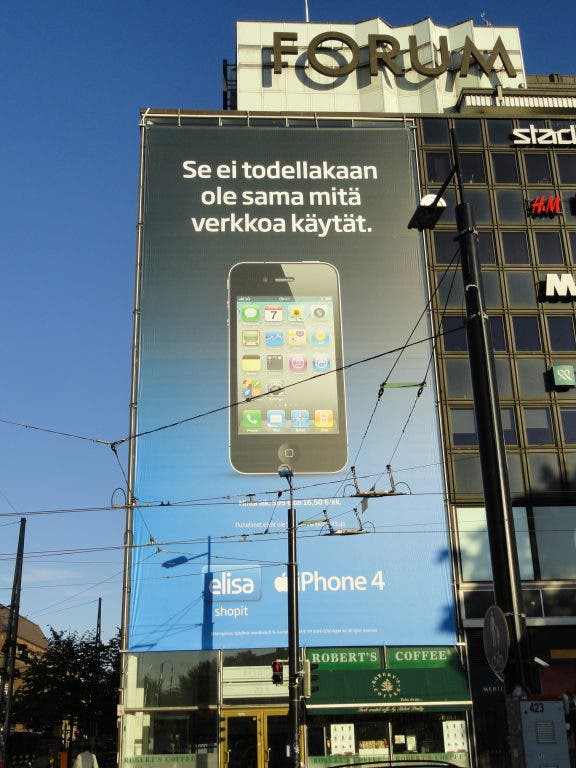
•The growth of iPhones and Google Androids has come at a cost to other cell phone giants. Nokia now accounts for one in four cell phones sold, as opposed to one in two four years ago. Even in Finland, the country that spawned Nokia, sales and advertising for the two competitor phones has gone up, presenting more competition. In the capital of Helsinki (the author's current locale), we spotted a few large billboards this week for the phone, including the one shown in the picture above which roughly translates to, “It really isn’t the same what network you’re using.”
•In general, global sales of Apple have shot through the roof, with an 87 percent increase in May. That’s in part due to the a newly released model of the iPhone 4. But the sales are still slightly less than the 100 percent increase in April.
•Steve Jobs also made a return to the center stage to announce Apple’s new iCloud service, which allows users to store data online without having to use their home computers. Similarly to Apple’s cloud drive service, it will offer upwards of 5 gigabytes of storage for free and charge $25 a year for additional storage.
•Sorry, hooligans: Apple has officially banned all apps that encourage drunk driving. The move came four months after four U.S. senators sent a letter to Apple, Google and R.I.M. asking them to scratch apps that reveal the location of police checkpoints, red light cameras and speed traps.
Get more local news delivered straight to your inbox. Sign up for free Patch newsletters and alerts.