Community Corner
Local Joy Luck Club
Mah Jongg, a little luck and a lot of fun at the Cupertino Senior Center.
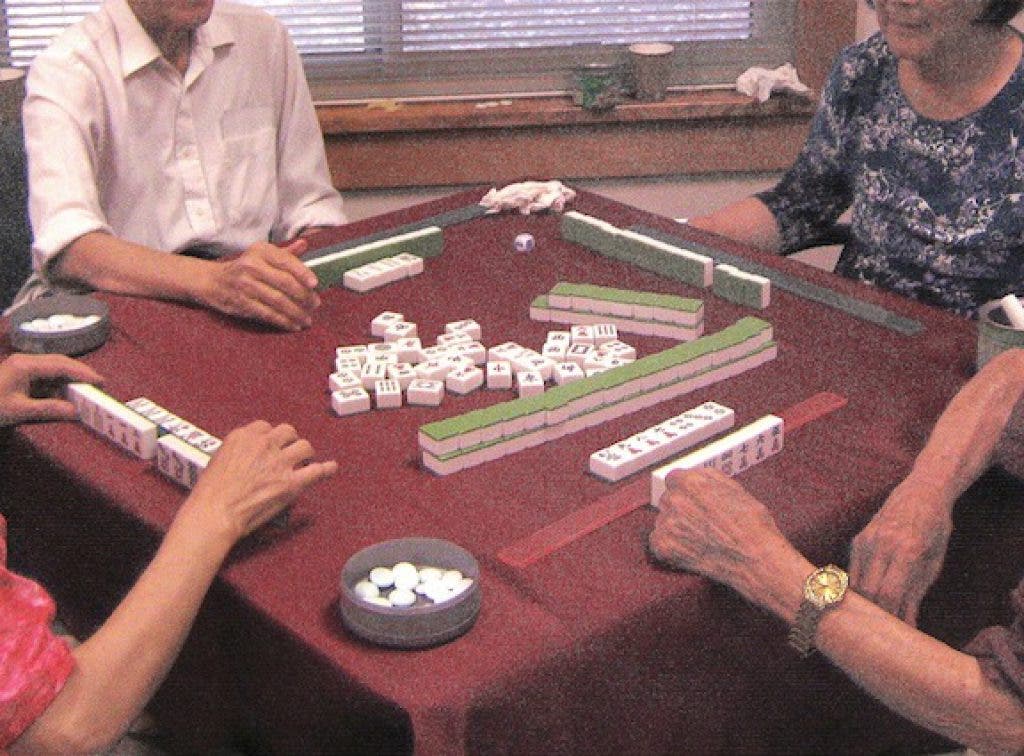

The clicking sound of tiles signals the start of another Mah Jongg game as four players sit at a square table "washing the tiles"—mixing them—face down.
This sound gives Mah Jongg its name, which in Chinese means "clattering sparrow"—the noise squabbling sparrows make over scattered food crumbs.
The tiles are stacked, two high, into a wall in front of each player that symbolizes the Great Wall of China.
Find out what's happening in Cupertinofor free with the latest updates from Patch.
This ritual is repeated daily throughout the world. And at the , it's every Friday from noon to 4 p.m.
Each game may last 15-20 minutes with play continuing for several hours. The object of the game is to score points and win (sometimes a small cash jackpot), but no money changes hands at the senior center.
Find out what's happening in Cupertinofor free with the latest updates from Patch.
"We play Mah Jongg for fun, just for a few dollars, winner take all," says one of the characters in Amy Tan's The Joy Luck Club. Losers take home left-overs! So everyone can have some joy."
The game became popular with the British and Americans living in the international colony in Shanghai in the late 19th century and was brought to America in 1922 by Joseph P. Babcock, an employee of the Standard Oil Company, because he noticed its popularity.
Babcock copyrighted the name "Mah Jongg, and issued a simplified set of rules with each Mah Jongg set sold. Babcock also gave English translations to the tiles to ensure ease of use by Americans," according to Gareth Reagan of Mind Sports Organization Worldwide Ltd., and columnist Ayi from beijingscene.com.
With the Mah Jongg craze sweeping the United States before the Great Depression, cow bone was shipped from Kansas City and Chicago to Shanghai to meet the demand for production of new sets.
In 1937, official American rules were established by the The National Mah Jongg League Inc., and each year new scoring combinations are published. The 2011 edition marks the 74th year.
In the original Chinese version of the game, sets consist of the four Winds (East, South, West and North), three Dragons (Green, Red and White), nine Bamboo tiles, nine Circles tiles and nine Wan tiles.
In the The Joy Luck Club, the narrator tells how her mother formed the first club when four refugees during World War II were brought together around a Mah Jongg table. "Each week one of us would host a party to raise money and to raise our spirits. The hostess had to serve special foods to bring good fortune of all kinds."
At the Cupertino Senior Center, playing Mah Jongg is an opportunity to get together and talk.
"Several of our players have been coming for 10 years," says recreation coordinator Teresa Mo. "It's a healthy, fun game."
Cupertino's sister city, Hsinchu, Taiwan, presented the senior center with a Mah Jongg set several years ago. But it isn't only Chinese games that are played at the center.
"We offer a variety of classes," says director Julia Lamy. "Our services are available to all active adults over 50 years old."