Schools
VOTE: 18.4 Percent of Cupertino Kids Are Fat. What Should We Do?
What do we do about the fact roughly 1 in 5 our 5th and 7th graders are overweight or obese? What should families do? What should government do?
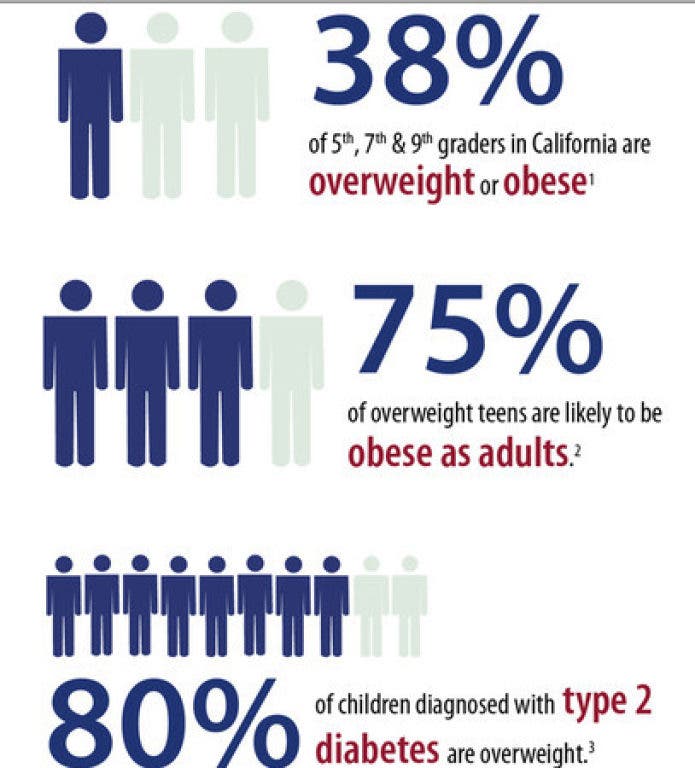
Over 18 percent of Cupertino children are overweight or obese according to a new study analyzing rates of childhood obesity in California cities.
The study was done by the California Center for Public Health Advocacy (CCPHA) and the UCLA Center for Health Policy Research, and funded by the Robert Wood Johnson Foundation.
The state's lowest rate was found in Manhattan Beach, where 11 percent of youths are overweight or obese. Huntington Park topped the scale with 53 percent.
Find out what's happening in Cupertinofor free with the latest updates from Patch.
Here are what rates look like in the 10 other Santa Clara County cities analyzed by the study:
- Gilroy (43.6 percent)
- Santa Clara (37.5 percent)
- San Jose (36 percent)
- Milpitas (33.3 percent)
- Sunnyvale (31 percent)
- Morgan Hill (30.3 percent)
- Campbell (30.1 percent)
- Palo Alto (18.4 percent)
- Saratoga (18.2 percent)
- Los Gatos (15.4 percent)
While Cupertino fell towards the bottom of the list, having a 5th and 7th grade population where nearly 1 in 5 is overweight or obese is troubling.
Find out what's happening in Cupertinofor free with the latest updates from Patch.
The 2010-2011 Physical Fitness Reports (PFRs) for elementary and middle schools show that of 2,109 CUSD 5th graders, 15.1 percent fell into the high-risk category for body composition. For 7th graders, 14.2 percent were deemed high-risk in the same assessment.
Study calls for government action
The study's authors detailed their methods and the ramifications of their findings, principally that overweight kids tend to grow into overweight adults with all the health problems associated therewith.
The findings are accompanied by nine policy recommendations, including:
- eliminating the sale of fatty foods and high calorie drinks on public facilities;
- establishing taxes on sugary drinks at the state and local levels to pay for the harmful effects of those products and remediate their effects;
- eliminating advertising of unhealthy foods and beverages to children and youth.
Dr. Susan H. Babey, the study's chief researcher, said focusing on changes in advertising was paramount to solving the problem in her mind, because there's already work in creating more access to healthy foods and playgrounds.
“I think one of the areas that we haven’t really made that many strides yet is the area of marketing to kids," she said.
Babey also pointed out that the state legislature is currently considering eliminating the mandate for physical testing. If testing becomes voluntary, Babey said many schools will likely drop the tests.
"If that mandate goes away, due to the budget constraints many of our schools are facing I think a lot of schools will choose not to do the testing," she said.
No tests means no data for future analysis of statewide and local obesity trends.
Where do you stand?
Do you consider youth obesity primarily a family problem or a community problem?
Would you put the primary responsibility on parents to cut back on junk foods and video games and promote healthier foods and exercise?
Or should the community play the leading role, all the way from promoting good food and exercise to imposing taxes and advertising restrictions?
Or do you favor a mixture of the above?
Leave a comment below and vote in our poll.