Schools
Read This Danville's Student Hilarious, Award-Winning Essay
"How To Win A Fight With Your Parents" by Monte Vista senior Prakriti Saxena won 1st place in the Tri-Valley Writers high school contest.


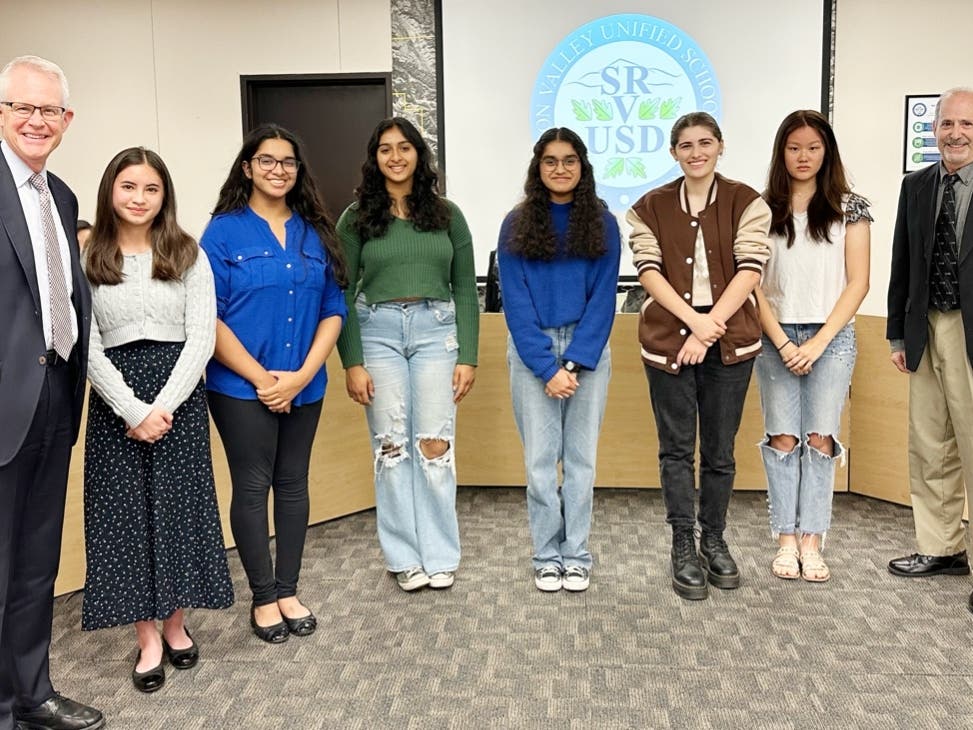
DANVILLE, CA — A senior at Monte Vista High School was awarded 1st place in the Tri-Valley Writers Club Branch high school writing contest, which asked students to submit creative fiction, nonfiction or poetry under the theme “My Story, My Vision.”
Nine SRVUSD students won awards in the contest, and six attended a recent board meeting recognizing their contributions.
Literary Non-Fiction category:
Find out what's happening in Danvillefor free with the latest updates from Patch.
- Prakriti Saxena – current Senior at Monte Vista - 1st Place
- Gayathri Viswanath – current senior at Dougherty Valley – Honorable Mention
- Angelina Ge -current senior at San Ramon Valley High - Honorable Mention
Short Story Fiction category:
- Meghan Boyle - current junior at Cal High – 3rd Place
- Alexandra Hanin – graduated in 2022 from Cal High - Honorable Mention
- Sneha Ganesh - current senior at Dougherty Valley - Honorable Mention
- Shriya Sridhar - current senior at Dougherty Valley - Honorable Mention
- Sarah Ham - graduated in 2022 from Monte Vista- Honorable Mention
Patch obtained permission to reprint the winning essay, a delightfully informative and poignantly wise piece by Monte Vista senior Prakhiti Saxena regarding a topic of vital importance to teens - and people of most ages: “How to Win a Fight with your Parents.”
Find out what's happening in Danvillefor free with the latest updates from Patch.
If you would like to submit creative work to Patch, email michael.wittner@patch.com.
How to Win a Fight with your Parents
By: Prakriti Saxena
“No, you can't go there.”
“No, you can’t do this.”
“No, no more friends over.”
“No, you're not spending 100$ on shoes!”
I don't like hearing “no'' and most likely neither do you. Especially from parents, who have used their hierarchical status to systematically oppress their children, while also paying for, housing, and feeding them- but for the purpose of this essay, ignore that. With my tried and true method to achieve victory in every situation, you will never have to hear “no” again! Use the power of your words, to unlock a future of desire.
First, design your case, based on the situation. The object at hand, you want to have a sleepover with your best friend, but due to “unforeseen circumstances” you have a C+ in Math. Here is your leverage, bad grades = bad focus in class = low sleep = mental health strain: BINGO. By constructing your case surrounding how your mental health has been deteriorating due to lack of socialization, you appeal to your parents' sense of logos; because if there's one thing parents love, it's hard core logic. Pro-tip: use your phone, that you use for 4 hours everyday anyway, and search up just one fact that links socialization to mental health. And now- you have the building blocks for a case.
But, for your case to really hit home, you gotta understand and use that knowledge, to manipulate the result. Are your parents doctors? Find a medical study showing the importance of socialization. Does your dad really love the Great British Baking Show? Show your parents that with a friend, you may also take part in baking, maybe bringing them home a treat the next day. The power of personalization allows you to specifically target the core interests of your parents: thus, making your case more convincing. Now of course, in order to achieve this aspect of personalization, you will have to, regrettably, spend time with your parents. But, what's a few hours of mommy and me time, for years of manipulative information. The personalization of your case touches a part of your parents prefrontal cortex, and almost guarantees a positive result. Now, it's time to construct.
The order of your ammunition makes all the difference in the result. The difference between a good and a bad soldier, is that the latter knows how to use their weapons. Heres your list, Facts, Story, and, the nuclear bomb: emotion. The order of your ammo should always be, fact, story, and last and only last: emotion. It's incredibly risky but has the potential to be incredibly effective. With this order, you first attach your parents logic, and give them a fact they simply can’t ignore. Then, you put a face behind that fact, and illustrate your story. And last, when all else fails, you use your emotional appeal to really hit your case home: but beware, emotion can cause an extreme adverse reaction from your parents.
Next, this step is crucial. It can make all the difference. Precondition. Similar to how you pretreat your toughest stains, before putting them in the wash; preconditioning your parents allows them to better receive and appreciate your case. This can include making tea, or snacks, or perhaps, a hug. Now, while parents appreciate the love and attention from their children; it's important not to seem ingenuine: such a feeling can cause an extreme adverse reaction. So, when asked “why are you being so nice all of a sudden” reply with “why not.” This vague but poignant reply signals to your parents that your act is somewhat genuine, therefore making them more receptive to your last step. Delivery.
Now, we’ve done all this researching, prepping, preconditioning, and planning: but this last step makes all the difference. The delivery needs to include confidence, but not cockiness. It needs to be bold, but also shy. It needs to be powerful, yet humble. The delivery needs to be impeccable. Start off with an informative tone. Before, making a dramatic shift of a story to personify that statistic. Make sure you analyze how that situation connects to your request for a sleepover. Make that link very clear! Then, when you're finished, it's time to wait that painful two seconds before your entire fate gets decided.
“No, you can’t go.” And now, you're living in a real life nightmare. But wait, we’ve planned this. We have that one more wildcard weapon in our armory, emotion. Now, this simple debate has become a bloodthirsty war. While you dodge the emotional bullets of “but were your parents” and “what we say is final” make sure, you keep the final tool in your arsenal intact; tears. And when you hear the words “thats it” it's time to let them loose. Start slow, but slowly work at a pace. By putting all your cards on the line in one final emotional appeal, you appear vulnerable: like a child. And when you hear “Ok, we’ll see” don’t withdraw your weapon. Hold it, but maybe ceasefire. And almost 100% of the time, this final appeal has done the miracle. “OK fine, you can go.”
And there you have it! You won the fight. You went through war, and signed your peace treaty. But did you really win? Because in the war, not just this scrimmage, you haven’t won. Your parents have won, because they got to see you be happy, grow naturally as a child. They got to see you use facts and rhetoric: you didn’t win the fight, you simply lost some territory in exchange for a ceasefire. Parent-child relationships aren’t a matter of winning or losing, they are a matter of growing and understanding. And for the 18 (maybe more years) that you live with your parents- viewing that relationship as mutualistic and not parasitic allows the both of you to gain the most from each other. Because if you “win” a fight with your parents, then in reality, you have lost that relationship.
Get more local news delivered straight to your inbox. Sign up for free Patch newsletters and alerts.