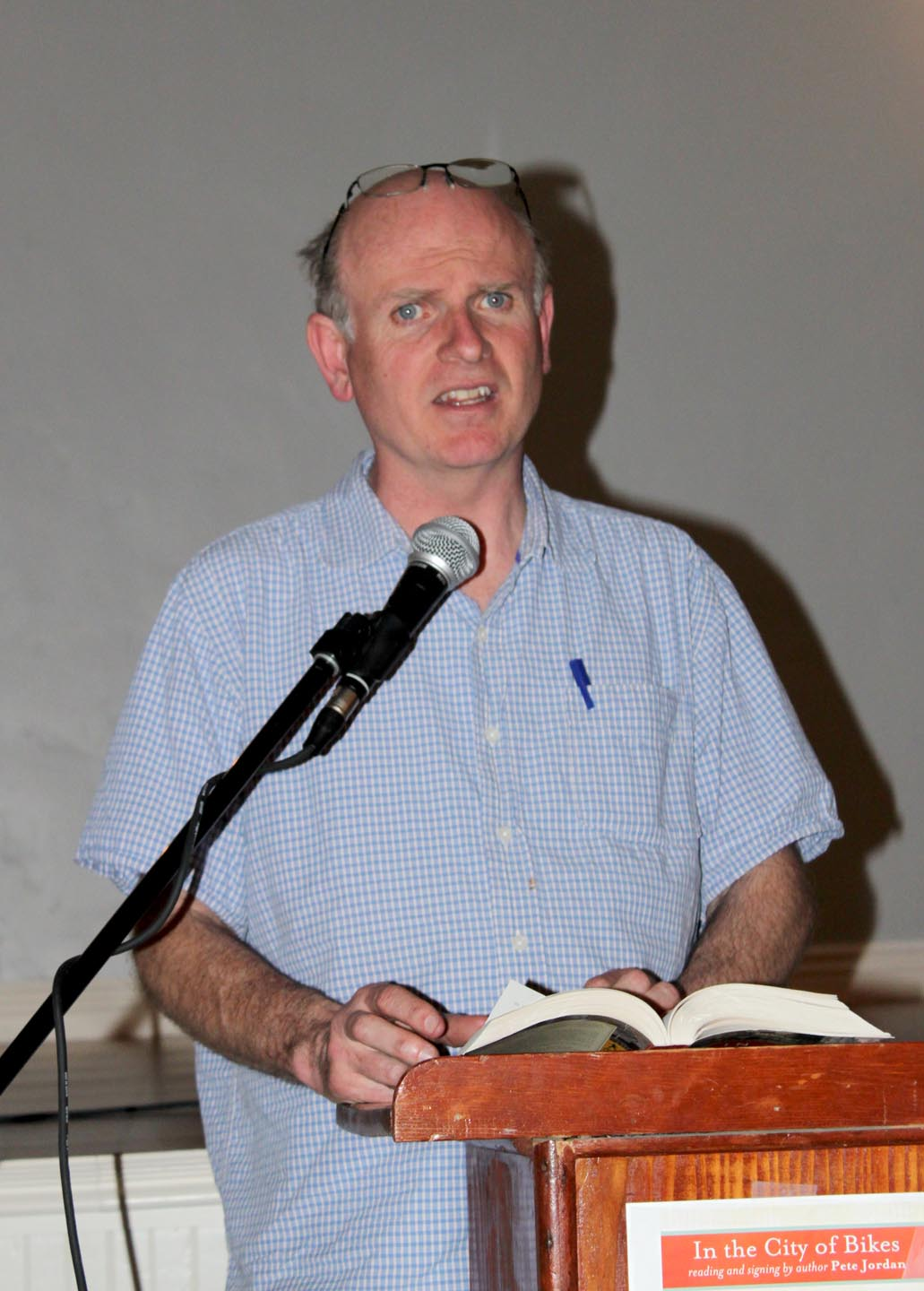

A month ago, Pete Jordan – courtesy of the Dixon library and a Davis bookstore – made an author’s appearance at Dixon’s Olde Vet’s Hall. This sort of cultural event is pretty rare in Dixon, especially when the author has been nationally published by Harper Collins.
Pete wrote the recently published book In the City of Bikes: The Story of the Amsterdam Cyclist. You’d think that since Davis is such a mecca for bicycles that the appearance should’ve been over there. But no, and I don’t know why.
At any rate, as an avid cyclist I attended the reading, but the turnout was embarrassingly small. The kind of thing where there are lots of empty chairs and you wonder what’s going through the author’s mind. Maybe something like, “I hope this doesn’t forecast what my book sales will be.”
Pete turned out to be a 50-ish fellow, whose previous book, One Man's Quest to Wash Dishes in All Fifty States, turned out to be a hit. Despite his 11-year stint as a dishwasher, it turns out that Pete is also an academic who loves researching things.
He went to Holland as an urban planning student and ended up staying permanently, bringing his wife over to join him (they had a son there). As a bicyclist, he was fascinated with the popularity of bicycles in Holland.
Probably part of the popularity is the smallness of the country – it’s about the same size as Delaware or Rhode Island, yet with the same population as our own nine-county Bay Area – six or seven million. We’re different in the U.S.; we think nothing of driving 100 miles to visit someone. We’re an automobile-centric nation.
Over there, he liked the slower pace. Also there was more social equality and no ghettoes. In his book he describes lawyers and CEOs riding bikes to work alongside teachers, and, yes, dishwashers, and just about everyone else.
The beginning of the book is devoted to the history of bicycling in Amsterdam. Early Dutch bikes tended to be all black, and even after the auto was first invented, bicycles remained the main form of transportation.
Bicycling gave the Dutch their opportunity to display their anarchistic side, and huge clots of cyclists on their way to work or on errands frequently ran through stop signs or ignored police doing traffic control. Couples on bike rides would often ride side by side, holding hands. Those with cars often became very frustrated when their progress through the city was impeded by cyclists flowing every which way.
During World War II, when the Germans overran Holland and occupied it (Holland was where Anne Frank and her family were apprehended) bicycles became even more important. One of the few ways the Dutch could protest the occupation was by bicyclists getting in the way of German vehicles and playing innocent. The Germans ordered many Amsterdamers to turn in their bicycles several times, for possible use by German soldiers. Only the worst bikes were turned in.
Another tradition in Amsterdam has been bicycle thievery. It was so prevalent that bicyclists expected to lose a bike every year or two. Then they might go to a popular place to buy another “hot” bike from middlemen. The thieves, often drug addicts, became quite adept at cutting locks, and their work was made easier by many residents leaving their bikes outside at night. (Amsterdam has a number of public garages devoted entirely to bicycle storage.)
Pete Jordan offers many fascinating facts and observations throughout the book. As he brings the reader into the post-World-War-II era, he concedes that automobiles began to predominate in Amsterdam, and most city planning began to revolve around making car travel easier. Cyclists began to revert to second-class status, and bike travel along certain streets was even prohibited. Eventually cyclists realized that they had to organize to prevent Amsterdam from becoming another auto-dominated and -polluted New York City or L.A. They realized that expensive autos were becoming status symbols and they wanted to return to the social equality of bicycles.
So, even before the monthly Critical Mass anarchistic bicycle rides began to take place in San Francisco and other American cities, the Dutch were using the carefree mass bicycle ride to make a statement. Nowadays, the bicycle has regained popularity and clout in Holland, especially among young people. Just the other day I heard someone say on the radio that driving an auto into Rotterdam (the second- largest city in Holland) was difficult, probably due to an emphasis on reducing auto traffic there.
Recently, online, I found a ranking of the best bicycling cities in the world. They were, beginning with the best, located in Denmark, Germany, France, Hungary, Spain, Brazil, Japan, Canada (Montreal), Ireland, Sweden, Holland and Belgium. No American city, such as Davis or Portland, made the list.
Bicycling in Dixon is definitely a novelty (but back before the advent of the auto, bicycling was a very popular pastime and sport here). There are a number of categories today: students going to school, adults on their way to work, recreational cyclists riding around town or out in the country, adults riding to the store to buy food or run other errands, and a few folks taking their dogs out for a run.
Fortunately we don’t have as many bike thefts here as compared to Davis. And we’re lucky to have two good bike stores in town: Fisk’s on Adams for repairs and bike sales and Peregrine Bicycle Works on North First Street which sells recumbent bicycles and tricycles (I had the pleasure of riding one of their bikes in the May Fair parade). Recumbent bikes and trikes are where you virtually sit in a chair, low down to the ground.
Almost all of my bike riding is recreational: I like to log in at least 50 miles per week, and have ridden just about every back road within 30 miles of Dixon and beyond. I ride the flatlands or in the nearby hills and mountains. I have also ridden a bike in Canada, Germany, Mexico, and Cuba. I have a great biking partner (my friend Jeff Brook) and that makes the riding much more enjoyable. Over my 50 years of cycling I have never been hit by a vehicle. However I have had a few accidents that were entirely my fault.
Pete Jordan writes that Dutch cyclists don’t wear helmets, but I wouldn’t be without one after having ridden over a railroad track the wrong way in my younger days, getting thrown over the handlebars and having my forehead swell up like half a grapefruit. And for a bald guy like me, a helmet keeps the sun off my head.
Bicycling is definitely on the rise around here. Thanks to Pete Jordan for writing an interesting book and for talking about it in Dixon.