Health & Fitness
What I Saw: A Two-Wheeled Trip Through Cuba (Part One)
From horse- and oxen-power to the Internet: Cuba is on the brink of change


I recently returned from a three-week bicycle tour in Cuba (accompanied by my son Bruce and a Canadian from Vancouver, Phil). If you wonder why I chose such an unusual place to vacation, I can attribute the idea to Phil, who I had toured with previously in the Rocky Mountains in Canada and Montana. He’s a semi-retired geologist who worked in many parts of the world including Central America and has bicycle-toured in remote parts of Europe. But Cuba always intrigued him and so he suggested the trip. I was taken by surprise when my wife said, “Why not do it?” You could say it was a once-in-a-lifetime sort of opportunity because I’d never toured outside North America.
I’m 69 going on 70, still in good bicycling shape, but nonetheless I added 30 pounds of books to my biking jaunts around Dixon prior to leaving. That’s because we were going to do self-supported touring, with no tour group support or support vehicle.
First off, my son and I had to fly via Mexico to get to Havana (it’s expensive to carry boxed bikes on planes these days). We met Phil in Havana. Besides our bikes we had saddlebags (or panniers) and handlebar bags full of clothing, tents, toiletry articles, cameras, notebooks, money and so on. My gear weighed in at around 40 pounds.
Find out what's happening in Dixonfor free with the latest updates from Patch.
We chose to bike in February because that’s during the coolest and driest time of the year down there. Still, we weren’t quite prepared for average daily temperatures of 80 (nighttime) and 90 (daytime). We had heard that the temperatures were usually between 60 and 88 this time of the year, and so had brought warm clothing just in case. It wasn’t needed.
Fortunately, both my son and Phil speak decent Spanish because I only know a few basic words.
Find out what's happening in Dixonfor free with the latest updates from Patch.
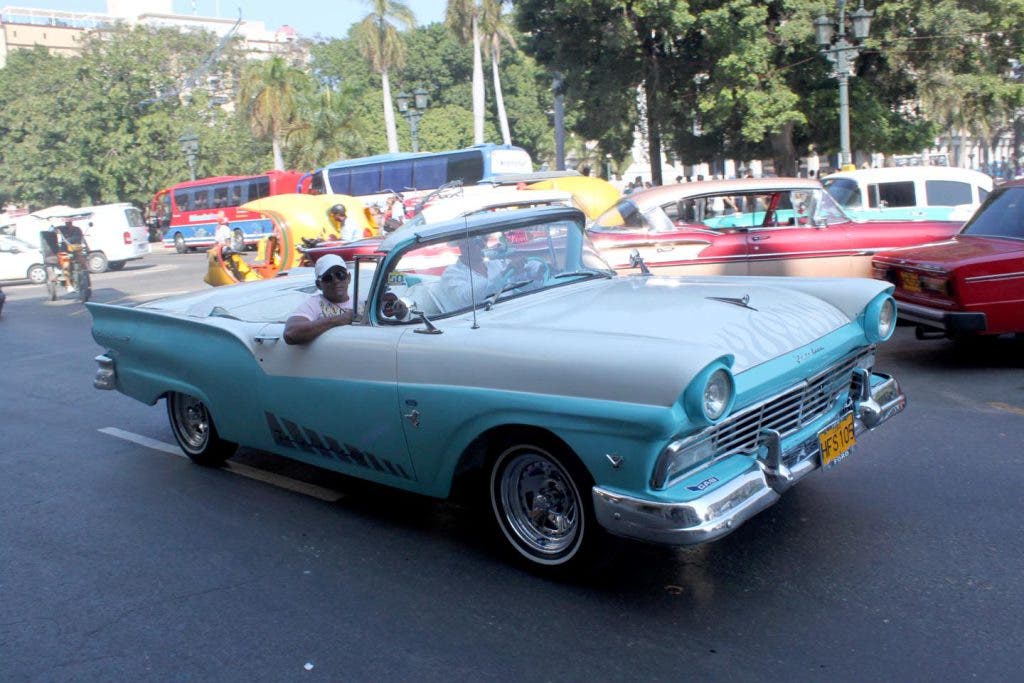
Upon reaching Havana, we found a really large, busy city with the well-known legions of 1950s American cars, often serving as taxis – some kept pristine and others falling apart. Many of these cars and many of Cuba’s trucks belch black smoke that pollute Havana’s air – and the air out in the countryside as well. The downtown streets of Cuba’s larger cities are always full of people – women shopping, food vendors, schoolkids in their uniforms, taxi drivers soliciting for business, and families.
I found the Cuban people to be uniformly friendly and helpful. There appears to be little crime there, and I never worried about walking around at night in any neighborhood. Compared to some other countries, there’s almost no direct begging and no pockets of homeless people.
Cuba has free medical care and schooling for its citizens, but on the other hand, most Cubans are equally poor. A doctor makes about the same as a teacher or other worker (around $30 U.S. per month). Citizens still use ration books to buy staples such as rice or meat (but at very low prices). One would think that Cuba, then, is a classless society. But the rise of tourism over the last two decades to help the Cuban economy has created a more moneyed class – those (including taxi drivers) who serve the well-off tourists.
I didn’t like Cuba’s two-tier currency system that reflects the split. For visitors and for Cubans purchasing big-ticket items like microwaves, TVs and refrigerators, convertible pesos (CUCs) are used. One convertible peso is worth approximately one U.S. dollar. Then there are so-called local pesos for average Cubans to use. There are approximately 27 local pesos to a convertible peso or CUC. Whenever possible, we kept some local pesos to spend, because food and snacks at some establishments could be purchased much more cheaply with them.
When one mixes the coins of both systems together, counting them out can be confusing.
We found that most foreign visitors came from Europe (Germany especially) and Canada. The whole time we were there we didn’t meet one American. There are resort enclaves here and there in Cuba where foreigners stay to enjoy the beaches and facilities (such as at Veradero), but those staying there hardly relate with any authentic Cubans.
Our trip was based on staying in what are called casa particulars or hostals (Spanish spelling) – licensed homes which rent out one or more rooms to visitors, and often provide meals as well. This gave us a good chance to meet and talk with Cubans. The typical charge for a room overnight was $25 U.S. – with an evening meal adding $8 or $9 U.S. per person. This was paid in the more valuable convertible pesos (or CUCs). The quality of the homes varied from so-so (where there was only a cold-water shower) to upscale and spiffy. Air conditioning was usually provided.
This brings up the subject of buildings and architecture in Cuba. In Havana and the larger cities, many of the homes and buildings have a worn elegance about them – hinting at past, pre-revolutionary times when there was a wealthier class. There’s a resemblance to the French Quarter in New Orleans. In some of the less prominent areas of the larger cities, homes present a blank front to the street, but behind plain front doors can be sumptuous interiors with intricate tile work and patios full of sunlight and plants. Out in the countryside are very basic and small concrete or wood homes with only a couple rooms.
It’s said that due to universal schooling in Cuba, there’s very little illiteracy. There were elementary and high schools everywhere. It seems that every home, even way out in the countryside, has electricity, and most people have TV sets. But all of Cuba’s radio and TV stations and newspapers are government-run and of course not critical of the government. Ordinary Cubans don’t have Internet access, although those in the larger cities can go into state-run stores to rent time on Web-connected computers. However, it’s refreshing to walk down city streets and not see every other person zoned out, conversing or messaging on a cell phone, or accessing the Internet on a phone or iPad. There is cell phone coverage over large parts of the country, but most Cubans probably can’t afford to use them.
American and other foreign movies are shown on Cuban TV, so Cubans can get an idea of life outside the country that way. Foreign visitors outside of resort areas find that getting unfiltered international news is difficult unless they can access the Internet.
Present-day Cuba is a result of the major revolution (Latin America has had its share of them!) led by Fidel Castro and others (including Che Guevara) during the 1950s. After ousting the dictator Batista, the leaders took Cuba in a sharp left direction, installing communism. When out bicycle-touring in the countryside, we saw many, many billboards, signs and painted buildings extolling the revolution and urging citizens to carry its spirit forward. The stories and legends surrounding Che Guevara make him the heart and soul of past glories. As the original revolutionaries die off, however, one wonders if the memory of the revolution will be able to inspire succeeding generations.
We trekked through the countryside of far-western Cuba for about two weeks, biking about 45 miles per day, and staying in the before-mentioned homes with rented rooms. At first we had some steep mountain-area biking in lush, thick-wooded terrain that had us walking our bikes up the steepest grades. However, most of our travel was in flat or rolling dry-ish agricultural land between the mountains and the sea. It’s trite to say, but sugar cane growing is still king in Cuba. In the old days it was harvested by hand, but today mostly with machines. We also saw tobacco, corn and rice fields and groves of banana and other tropical fruit trees.
(Part two of this account will appear in several days.)