Crime & Safety
Cars vs. Motorcycles: Reminders We All Need To Safely Share The Road
May is Motorcycle Safety Awareness Month. Do you check for bikers in your blind spot?


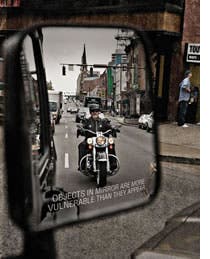
News from the National Highway Traffic Safety Administration:
May is Motorcycle Safety Awareness Month, designed to encourage all drivers and motorcyclists to “share the road” with each other.
Motorcyclist fatalities decreased in 2013 to 4,668, accounting for 14 percent of total fatali¬ties for the year. This decrease in motorcycle fatalities breaks a tragic trend over the last 16 years, which saw only one other decline in 2009. Injured motorcyclists also decreased from 93,000 in 2012 to 88,000 in 2013.
Find out what's happening in Dixonfor free with the latest updates from Patch.
Safe riding practices and cooperation from all road users will help reduce the number of fatalities and injuries on our nation’s highways.
Reminders:
Find out what's happening in Dixonfor free with the latest updates from Patch.
• Road users should never drive, bike, or walk while distracted. Doing so can result in tragic consequences for all on the road, including motorcyclists.
• A motorcyclist has the same rights, privileges, and responsibilities as any other motorist on the roadway.
• Allow a motorcyclist a full lane width. Though it may seem as if there is enough room in a single lane for a motor vehicle and a motorcycle, looks can be deceiving. Do not share the lane: a motorcyclist needs room to maneuver safely.
• Because motorcycles are smaller than most vehicles, they can be difficult to see. Their size can also cause other drivers to misjudge their speed and distance.
• Size also counts against motorcycles when it comes to blind spots. Motorcyclists can be easily hidden in a vehicle’s blind spot. Always look for motorcycles by checking your mirrors and blind spots before switching to another lane of traffic.
• Always signal your intentions before changing lanes or merging with traffic. This allows motorcyclists to anticipate your movement and find a safe lane position.
• Don’t be fooled by a flashing turn signal on a motorcycle—it may not be self-canceling and the motorcyclist may have forgotten to turn it off. Wait to be sure the rider is going to turn before you proceed.
• Allow more follow distance – three or four seconds – when following a motorcycle; this gives the motorcycle rider more time to maneuver or stop in an emergency. Motorcycle riders may suddenly need to change speed or adjust lane position to avoid hazards such as potholes, gravel, wet or slippery surfaces, pavement seams, railroad crossings, and grooved pavement.
FACTS ABOUT HELMET USE
• Use of DOT-compliant motorcycle helmets increased to 64 percent in 2014, up from 60 percent in 2013, based on the National Occupant Protection Use Survey (NOPUS).
• Helmet use among motorcyclists on expressways increased significantly to 81 percent, up from 64 percent in 2012.
• Helmet use among motorcyclists in the southern states increased significantly to 78 percent, up from 65 percent in 2013.
• Use of non-compliant motorcycle helmets decreased significantly to 5 percent, from 7 percent in 2013.
• In 2013, 41 percent of fatally injured motorcycle riders and 53 percent of fatally injured motorcycle passengers were not wearing helmets at the time of the crash.
FACTS ABOUT MOTORCYCLES AND ALCOHOL
• The percentage of motorcycle riders who were intoxicated in fatal crashes (27%) was greater than the percentage of intoxicated drivers of passenger cars (23%) and light trucks (21%) in fatal crashes in 2013.
• In 2012, 29 percent of all fatally injured motorcycle riders had BAC levels of .08 or higher.
• Motorcycle riders killed in traffic crashes at night were over 3 times (3.2) more likely to have BAC levels of .08 g/dL or higher than those killed during the day (45% and 14%, respectively).
• Forty-three percent of the 2,030 motorcycle riders who died in single-vehicle crashes in 2012 had BAC levels of .08 g/dl or higher. Sixty-four percent of those killed in single-vehicle crashes on weekend nights had BACs of .08 g/dl or higher. TIPS FOR MOTORCYCLISTS
• Wear a DOT-compliant helmet and use reflective tape and gear to be more visible. NHTSA estimates helmets saved the lives of 1,630 motorcyclists in 2013.
• Never ride while impaired or distracted—it is not worth the risk of killing or injuring yourself or someone else. Plus, a DUI costs $10,000 on average, and can lead to jail time, loss of your driver’s license, and higher insurance rates.
For more information, visit www.trafficsafetymarketing.gov.
--Image courtesy of the NHTSA
Get more local news delivered straight to your inbox. Sign up for free Patch newsletters and alerts.