Politics & Government
Dixon Then and Now: The City's Barbary Coast years
Upstanding people avoided the block which the library and park now occupy
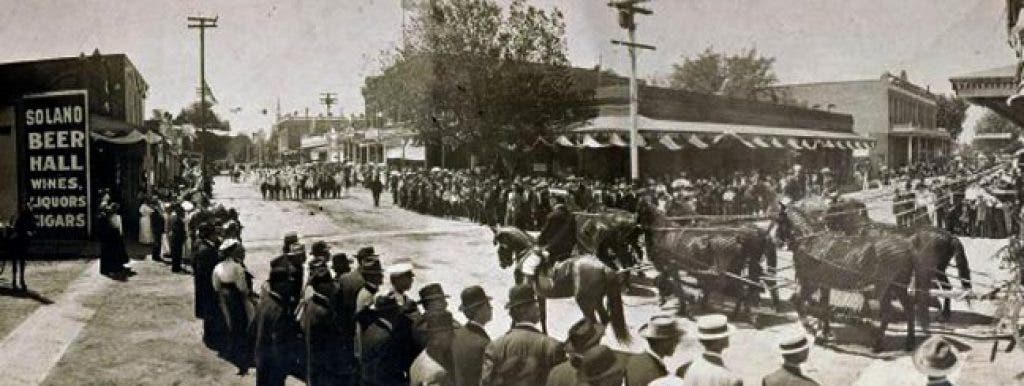


When the California gold rush began in 1848, San Francisco went from being a small, sleepy town on the Bay to being the busy starting-off point for gold seekers. The city grew fast, and not always in the best ways. Part of its waterfront became known as the Barbary Coast, the seedy home of prostitutes, thieves, gamblers, con-men, and opium addicts. That section of San Francisco wasn’t really erased until 1914.
Believe it or not, Dixon had its own self-named Barbary Coast for many years, located along what is now First Street, in the block now occupied by the and park. It was a milder version of San Francisco’s, but it bothered the more upright citizens of the town a lot. This was in an era when it was considered improper for a woman to say, “Damn!”
I haven’t seen any photos of Barbary Coast establishments from this era, and newspaper accounts don’t get very specific (except in the cases of violence). But I have pieced together what I can.
Find out what's happening in Dixonfor free with the latest updates from Patch.
First of all, I want to offer Colonel Albert Evans’ description of San Francisco’s Barbary Coast from a book published in 1873 (about the time Dixon was founded) that may offer a few hints as to what our own Barbary Coast resembled:
“It is Saturday evening, in the middle of the rainy season, when no work is doing upon the ranches, and work in the placer mines is necessarily suspended, and the town fairly swarms with ‘honest miners’ and unemployed farm-hands, who have come … to spend their money, and waste their time and health in ‘doing’ or ‘seeing life’ … . The Barbary Coast is now alive with … card sharps … pickpockets, prostitutes and their assistants and victims … . There is a snug little saloon (where) everything is as neat and orderly and business-like in appearance as possible. At the rear of the room is a green door, on which hangs a card inscribed in large letters, ‘Club Room--Now Open.’ Near the door sits a well-dressed, gentlemanly man (who acts as a doorman for a gambling operation just beyond).”
Find out what's happening in Dixonfor free with the latest updates from Patch.
Some of Dixon’s saloons had such back rooms as well. Con Lunney, who operated Con’s Saloon from 1879 to 1994 at minimum, advertised a “good reading room and private club room.” Somehow I can’t picture drinking men gravitating toward reading books in a saloon. So what these code words actually meant, I can’t say, although I expect gambling at a minimum.
The above writer said that in San Francisco’s Barbary Coast, “every second building is occupied as a saloon.” That was nearly the case in early Dixon too. In 1876 there were 15 saloons, which were gradually whittled down over the years until there were nine in 1905 (today, Dixon has two bar-only establishments). They had colorful names like U&I, The Local Option, Little Casino and The Pearl, which reminds me of the profusion of bars catering to American soldiers when I served in Viet Nam.
Back during the 1870s and 1880s, along Dixon’s Barbary Coast, some rundown buildings or even shacks became a haven for the disreputable, including prostitutes and opium smokers. A map showing the location of businesses along that block in 1887 shows three Chinese places (mostly washhouses), two houses, a hotel, and a saloon with lodging. The actual function of these businesses is unknown. Many Chinese were inveterate gamblers and some were opium (heroin) addicts. Across the street were two more saloons.
As the years rolled by, the from time to time passed on nuggets of news concerning Dixon’s Barbary Coast, Dixon’s East of Eden:
Saloon keepers often staged dog or chicken fights in public to generate clientele.
Like in the movies, in 1875 “There was a general fight all round, at one of our … saloons … in which one of the combatants were (sic) laid out, having a billiard cue broken over his head, another had a finger bitten off (along with black eyes).”
August Gieseke, who opened Dixon’s brewery, was shot and killed in 1875. The brewery remained on the north end of the Barbary Coast for years.
A July, 1876 Tribune story mentioned that “Francis Stern and wife were arrested on Monday … upon a charge of keeping a house of ill-fame … . A jury trial was demanded, and nearly half the night was occupied in taking the testimony, the particulars of which are too disgusting to bear recital. The jury brought in a verdict of guilty, and Judge Brown fined Stern $299.99 and 100 days in the county jail, and his wife $100 or 100 days in the county jail.” Later, Mr. Stern went berserk at home and tried to grab a revolver and knife.
In 1877, a “colored citizen” had a “fistic” encounter with the female keeper of a house of ill repute.
Dixon’s Board of Trustees (today’s city council) made the rounds in search of opium joints in 1885. In a house of “ill fame” along today’s First Street that they visited, several were arrested for smoking and selling opium.
In 1892, Mrs. S. E. Emerson pleaded guilty to running a house of ill-fame, and was allowed to leave town. “The fate of the Emerson establishment has sealed the doom of several vile dens on Barbary Coast,” said the Tribune, “which are far worse and which have given the officers infinitely more trouble to keep under control.” In the same year, another article said, “There is a gang of opium fiends and ‘lovers’ at present making its present headquarters on the Barbary Coast, that ought to seek a more congenial climate … .”
The Tribune noted in 1893, “The crusade against ladies’ entrance saloons is spreading … No more demoralizing influence is at work … than (in) those saloons. They are the destroyers of homes and the recruiting stations of the brothel. Pure womanhood is the greatest mainstay of our civilization.”
In 1893, Manuel Lopez was fined $25 for keeping some sort of illegal establishment along the Barbary Coast.
A Tribune editorial in 1892 was titled, “Clean Them Out,” saying “It is high time that a move was being made to clean out the vile dens which are clustered along upper Main Street (today’s First Street). They are becoming a stench in the nostrils of a law-abiding people. Not a week passes but some of the denizens of that quarter are in court on a charge of robbery or disturbing the peace.” Elsewhere in the same newspaper, someone wrote that “The citizens are being roused to the urgent necessity of putting a check to the sin that is and has been making Barbary Coast a disgrace to the town … . A petition should be drawn up and signed by property-owners praying the Board of Town Trustees to compel every saloon-keeper in town to execute a bond for $1,000 before obtaining a license. This would close all the deadfalls in town … . This plan has been successfully tried in Oakland, Alameda and other places, and should be given a trial here.”
The forces of morality and temperance were hard at work. In 1891 there was a move afoot to force businesses to close on Sunday, aimed, I expect, at saloons. In 1903 an ordinance closed saloons at midnight.
In January, 1888, the Tribune asked if an existing ordinance prohibiting houses of prostitution would be enforced. In July of that year, Ordinance 54 was passed, levying a $100 fine for running a bawdyhouse.
In 1893, an ordinance or ordinances were passed which really clamped down on the Barbary Coast, forcing some of the regulars there to head elsewhere. “The notorious Louis Jacobs and his wife took their departure this week and a number of other Barbary Coast denizens are preparing to follow their example,” noted the Tribune.
Dixon at one time even had a ban on card playing in public.
The final death knoll for our Barbary Coast was when Oscar C. Schulze, owner of the large general store across the street, bought up most the Coast’s buildings except for the brewery and removed or demolished them after 1902. However, there was another building that he didn’t buy at first. At that place in 1904, “Supposedly driven momentarily insane by a mad infatuation for a woman of the lower world, George Easton cut the throat (and killed) Charles Horigan, who he regarded as his rival in the affections of the woman, in the house on Barbary Coast.” Perhaps that event was the final straw for that establishment, because Schulze soon bought and demolished it too.
So ended one of Dixon’s lesser-known chapters. Though I’m sure the world’s oldest profession is still practiced in this area, at least it’s not out in the open. Today’s library and park, with its farmers’ markets and celebrations, is a far cry from the old days.