Business & Tech
Dixon Then & Now: At Same Site for 100 years, Local Bank Now Has Regional Outreach
First Northern Bank now employs 230


Back around 1900 Dixon had one bank and one bank only: the Bank of Dixon, located in a building which was later demolished to become the present Bank of America’s parking lot. My understanding is that it was owned and run by the Rice family.
For whatever reason – perhaps some of the town’s leading citizens wanted a bank that was more responsive and community controlled – 25 influential men and women came together to form a new bank in 1910. To many of them, that meant putting their money where their mouth was by collectively buying $60,000 in startup bank shares.
As though challenging the other bank, they set up business directly across Main Street (now First Street) from it, on the opposite corner. Their first modest storefront was a former ice cream shop.
Find out what's happening in Dixonfor free with the latest updates from Patch.
They called their new state-chartered savings institution The Northern Solano Bank, and with two employees it gradually attracted depositors. Henry Timm (of Timm Dairy fame) was the bank’s first president. The bank soon sought to expand by buying the entire building on the southwest corner of what is now First and ‘B’ streets. Its competitor across the street perhaps saw the writing on the wall and bid against the new bank for the property, but lost.
Even after it bought and fitted out the building as a bank, it still rented out space to, among others, a harness shop and cigar maker. The reception to inaugurate the new bank premises included the Dixon Orchestra, singers, fruit punch for the ladies and cigars for the men. Bursting with local pride, a article stated that “We can say without danger of contradiction that (the new bank) is one of the handsomest banking rooms to be found in any town on the coast.”
Find out what's happening in Dixonfor free with the latest updates from Patch.
Two years later, the bank added a twin, the First National Bank of Dixon, a bank of commerce. The two existed side by side until 1954, when they joined to become the nationally-chartered First National Bank. The stated reason was to save money and avoid duplication of records. At that time the bank had two managers and a staff of eight. Finally in 1980 the bank reverted to a state-chartered bank renamed
The early farm-town bank had a down-home attitude about banking: Long-time bank head cashier Angus Madden is quoted as having said, “There must be ethics in big and little banking, that bankers should be rated as more than interest collectors. … There are such things as social, religious and good-citizenship considerations. … (A bank should) help the aspiring boy to get a start. … Give any worthwhile person a loan after you have first found that there is a chance for him to make good; if not, then have the courage to tell him there is no chance at that particular line and point a way if possible to some other line of activity.”
The Great Depression that began in 1929 with the stock market crash raised the potential for depositors to lose confidence in a bank and make a run on it, causing it to fail. Dixon’s twin banks reassured its depositors and stockholders by issuing a letter in 1933 which stated in part, “… You should allow no instances of what might have happened elsewhere … to cause you to lose confidence. … Bank patrons hear rumors of all descriptions … Our recent regular examination by the National Banking Department … found this bank in excellent condition, with capital and surplus untouched. … Our stockholders are all local property owners and are among the best and most substantial people in our community.”
An ad run in the during the Depression stated, “Money in the bank is liquid – funds are ready, in case of sudden need, at full 100 cents on the dollar.”
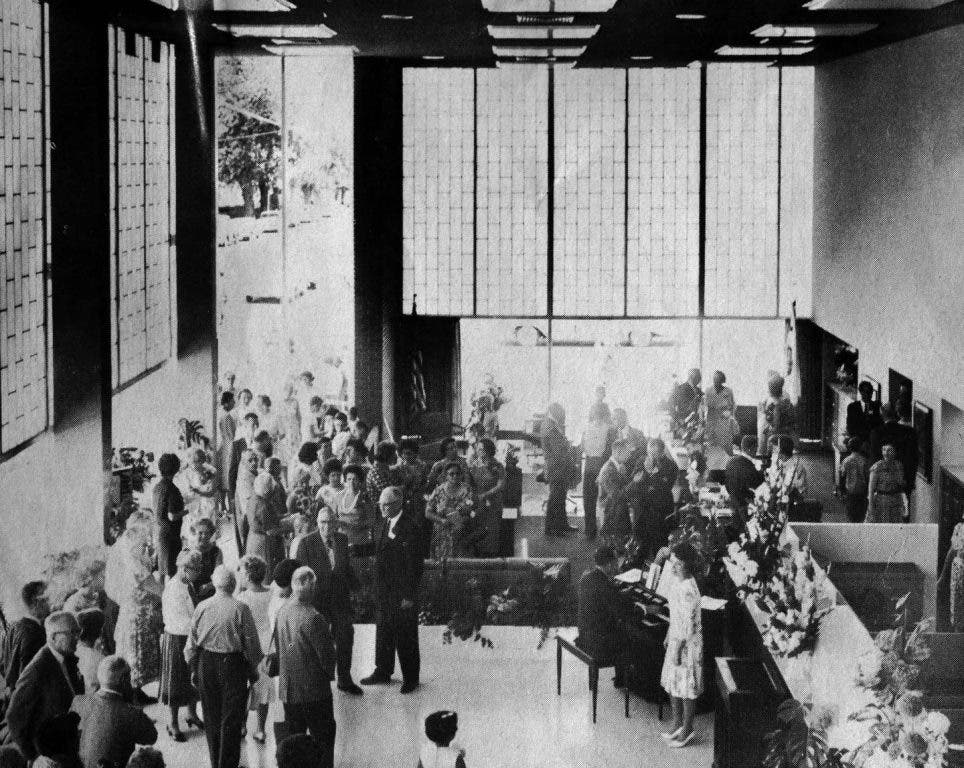
During the first half of the 1900s the bank’s assets had steadily expanded. In 1953, the bank building was modernized and the old cupola removed. In 1962, the bank took the bold step of completely rebuilding the bank at First and ‘B’, and banking operations were temporarily relocated across the street in the old Bank of Dixon building. A contemporary two-story design was erected, using the Mondrian- and Bauhaus-influenced architecture of the time, featuring extensive glass walls on the north and east sides which flooded the bank lobby with daylight. Air conditioning was included, as were administrative offices in the rear of the building. Again, a large open house was held. This is the building remaining today.
Not long after, the bank began to expand to other communities. The first branch was established in Winters in 1970, followed by many more branches in Solano, Yolo, Sacramento, Placer and El Dorado counties. A few branches and other offices have come and gone because they failed to do the business expected of them, or due to consolidation with nearby branches.
Specialized operations were also set up with a Small Business Administration loan office and trust department in Sacramento, and investment/brokerage and real estate offices in the Sacramento and Davis areas. Also, a large operations center was built in 1993 in Dixon, with a curious uninhabited “open room” included at the top, ostensibly as a design element.
As the bank celebrated its 100th anniversary in 2010, it was emerging from an economic downturn that was perhaps nearly as challenging to its well-being as the Great Depression. Then-bank-president and CEO Owen Onsum stated in 2009, “Management continues to strengthen its balance sheet by reducing its problem assets with … commercial and industrial loans and commercial real estate loans.”
In that year, the bank received a loan of $17 million from the U.S. Treasury’s Troubled Assets Relief Program’s (TARP’s) Capital Purchase Program. Onsum had earlier stated, “The additional capital would enhance our ability to support local economic activity” and “We believe the company is well capitalized with strong capital reserves and the earning capacity to remain steady, disciplined and focused."
In northern California, approximately 28 banks – including Wells Fargo – received TARP funding.
Recently, Louise Walker took over the president-and-CEO reins from Mr. Onsum as the banking company headquartered in Dixon headed into its second century. The bank has grown from the original two to approximately 230 full-time employees (half of them in Dixon) and the bank’s assets have grown from the original $60,000 seed money to approximately $650 million. The current chairman of the board is Greg DuPratt.