Community Corner
Here Are The Most Endangered Animals In California
There are 301 threatened or endangered animals in California. Here are the two most at risk.


When you think of the planet’s most endangered species, some common examples that might come to mind include rhinos, elephants, tigers, gorillas and leopards. But a new report has identified the two most endangered species in every state — and the answer might not be what you think.
In California, the two most threatened animals are the Riparian brush rabbit and the Buena Vista Lake Ornate Shrew, according to the report released Wednesday by 24/7 Wall St.
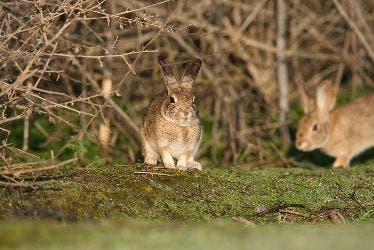
Riparian brush rabbit
Find out what's happening in Dixonfor free with the latest updates from Patch.
- Scientific name: Sylvilagus bachmani riparius
- U.S. Fish and Wildlife Service classification: Endangered
- Description: The riparian brush rabbit is a medium to small cottontail in the Leporidae family. Its colors vary from dark brown to gray above to white underneath. Adult rabbits are about 11 to 14 inches long, weighing less than 2 pounds.
- Geographic range: Sacramento, San Joaquin and Stanislaus counties, California
- Habitat: Sylvilagus bachmani riparius makes it home in wooded and forested areas adjacent to bodies of water, specifically in Caswell Memorial State Park on the Stanislaus River and the South Delta area of the San Joaquin River, including Paradise Cut and Tom Paine Slough, according to the IUCN Red List Of Threatened Species. It occupies both old-growth riparian forest, dominated by Valley Oak and riparian communities dominated by thickets of willows, wild roses, blackberries and other successional trees and shrubs and when available dense tall stands of herbaceous plants adjacent to patches of riparian shrubs. Sylvilagus bachmani riparius stays close to dense stands of vegetation into which it retreats for escape, resting and nesting. It does not normally burrow or use burrows. Much of its foraging is concentrated at the edge between thickets of woody plants and more open ground with herbaceous plants. A favored habitat is willow thickets along stream banks.
![]()
Riparian brush rabbit (Photo via U.S. Fish & Wildlife Service)
Buena Vista Lake Ornate Shrew
- Scientific name: Sorex ornatus relictus
- U.S. Fish and Wildlife Service classification: Endangered
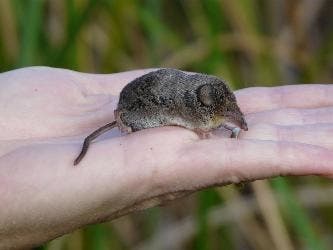
- Description: The Buena Vista Lake ornate shrew is one of nine subspecies of ornate shrew, an insect-eating mammal similar to a mouse in size and appearance. Shrews have a long snout, tiny bead-like eyes, ears that are concealed, or nearly concealed, by soft fur, and five toes on each foot. The Buena Vista Lake shrew's back is predominantly black with a buffy-brown speckling pattern, its sides are more buffy-brown than the upper surface, and its underside is smoke-gray. The tail is faintly bicolor and blackens toward the end both above and below. The Buena Vista Lake ornate shrew grows to around 4 inches in total length, including a tail of about 1.5 inches. Adults weigh less than half an ounce.
- Geographic range: Kern, San Luis Obispo and Ventura counties, California
- Habitat: Active day and night, shrews spend their waking hours searching for insects, their
favorite food. Shrews can eat more than their own weight daily. Water is a vital component of the BVLS’s environment. Moisture and appropriate vegetative structure and cover are required to support the varied insects that maintain the shrew’s high metabolism. Shrews benefit surrounding plant communities by consuming large quantities of insects, thereby helping to control pests. Biologists believe the BVLS historically occupied a wide range within the once abundant marshlands of the Tulare Basin in the southern San Joaquin Valley of California. By the time biologists first discovered the shrew in 1932, most of these marshes had been drained or dried up as a result of water diversions. Today, the subspecies has lost more than 95 percent of its historic habitat.![]()
Buena Vista Lake ornate shrew (Photo via U.S. Fish & Wildlife Service)
According to the U.S. Fish and Wildlife Service, there are 301 threatened or endangered species in California, including the California red-legged frog, the Stephens' kangaroo rat and the San Diego fairy shrimp.
Find out what's happening in Dixonfor free with the latest updates from Patch.
Hawaii has by far the most number of animals on the federal registry at more than 500. While accounting for just 0.2 percent of America’s land mass, it is home to a quarter of the federally endangered species, according to the Mother Nature Network.
Other animals on the 24/7 Wall St. list include various species of sea turtles, rabbits and cranes. More broadly, it features mammals, marine animals, fish, insects, birds, amphibians and reptiles, to name just a few. Various species of mollusks — a key sustenance source for fish — make the list, including the spectaclecase, a freshwater mussel. This is often because of the construction of dams, which disrupt the flow of water and can even change its temperature, leading to massive mollusk losses.
The financial news and opinion site reviewed the U.S. Fish and Wildlife Service’s listing of endangered animals to identify the most threatened animals in every state. The site says many of the animals appear in multiple states.
“Only 31 states have animals endangered only there,” the authors said.
To identify which of the threatened animals in those states were in the most dire circumstances, the site used the International Union for Conservation of Nature’s inventory of threatened species. Many of the most threatened animals on the IUCN’s “Red List of Threatened Species” were labeled “critically endangered.”
"We used this same approach to evaluate the threat level of endangered animals in the remaining 19 states, but in these cases animals may be listed as endangered in other states as well," the authors said.
Patch reporter Dan Hampton contributed to this report.
Photo credit: Darren J. Bradley/Shutterstock
Get more local news delivered straight to your inbox. Sign up for free Patch newsletters and alerts.