Schools
Kids Will Love This Sunday At Bohart Museum in Davis
Open house includes arts and crafts. And parents will love that it's free!


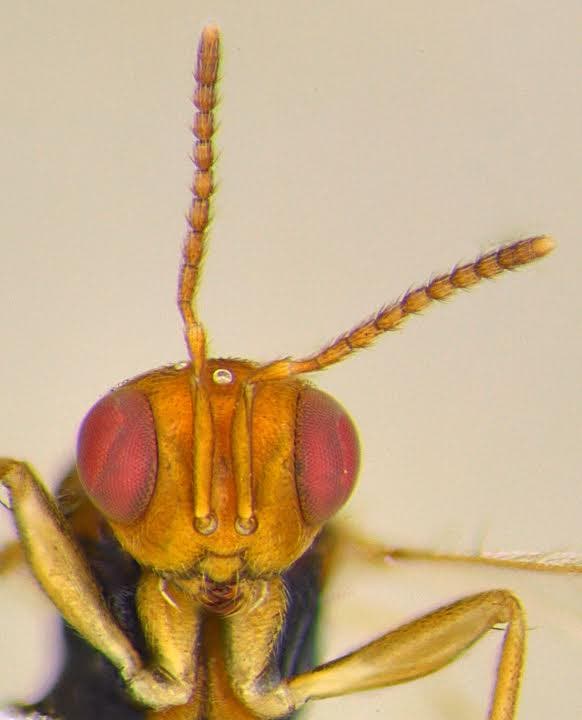
PHOTO: This is the Bockler Wasp, named for an award-winning biology teacher Donald Bockler of Arlington, Mass. (Photo by Andrew Richards, Bohart Museum of Entomology)
---
By Kathy Keatley Garvey
Find out what's happening in Dixonfor free with the latest updates from Patch.
How do insects get their names? What process is involved?
Find out at the Bohart Museum of Entomology open house from 1 to 4 p.m., Sunday, May 17 in Room 1124 of the Academic Surge Building on Corcker Lane.
Find out what's happening in Dixonfor free with the latest updates from Patch.
The theme is “Name That Bug! How About Bob?”
Scientists at the Bohart Museum and the California Department of Food and Agriculture will explain how insects are named. There also will be family arts-and-crafts activities. The event is free and open to the public.
The Bohart Museum sponsors a nonprofit biolegacy program, an opportunity to name an insect after you or a loved one. This is a lasting dedication and will help support future research and discovery at the Bohart, said Lynn Kimsey, museum director and a professor of entomology at UC Davis.
For example, there’s a new wasp species named “The Bockler Wasp,” thanks to a concerted drive to memorialize a beloved science teacher, and the taxonomy work of the Bohart Museum and the BioLegacy Program.
When award-winning biology teacher Donald “Doc Boc” Bockler of Arlington (Mass.) High School, died at age 65 of an apparent heart attack on Sept. 2, 2008 at his home, two of his former students from the Class of 1993--Tabatha Bruce Yang of the Bohart Museum and Margaret Dredge Moore of Arlington--launched a fundraising drive to name an insect after him.
They selected a newly discovered species in the genus Lanthanomyia and sought the name, Lanthanomyia bockleri.
Senior museum scientist Heydon recently published his work on Lanthanomyia bockleri Heydon in Zootaxa, a worldwide mega-journal for zoological taxonomists and the name is now official.
“Once an article goes through the scientific review process and is published in a peer-reviewed scientific journal, the name of the new species is official and immortalized in the scientific literature,” explained Kimsey.
Kimsey described species-naming as “a unique, lasting form of dedication” and “a great honor both for the person giving the name and for the individual or other honoree whose name is being given to the species.”
Heydon said Lanthanomyia is a genus whose species are restricted to central and southern Chile and adjacent parts of Argentina. The new species is found in the Nothofagus forests of Patagonian Chile, including Chiloe Island. It belongs to a family of parasitic wasps called the Pteromalidae. “Unlike other related species, this one has a unique dorsal attachment of the head to the thorax. If you see a specimen of Lanthanomyia with the neck attaching close to the top of the head, you know it isbockleri,” Heydon said. “Adults are reared from galls on Nothofagus and are thought to be parasites of gall-forming weevils.”
“Donald Bockler was fascinated by evolution and nature and he would have been proud,” said Yang, education and outreach coordinator at the Bohart Museum. Like many other Bockler students, she credits him for influencing her decision to pursue a career in science.
For more information, and to get a list of species available for naming, contact bmuseum@ucdavis.edu.
The Bohart Museum houses a global collection of nearly eight million specimens. It is also the home of the seventh largest insect collection in North America, and the California Insect Survey, a storehouse of the insect biodiversity. Noted entomologist Richard M. Bohart (1913-2007) founded the museum.
Special attractions include a “live” petting zoo, featuring Madagascar hissing cockroaches, walking sticks and tarantulas. Visitors are invited to hold the insects and photograph them.
The museum’s gift shop, open year around, includes T-shirts, sweatshirts, books, jewelry, posters, insect-collecting equipment and insect-themed candy.
The Bohart Museum’s regular hours are from 9 a.m. to noon and 1 to 5 p.m. Mondays through Thursdays. The museum is closed to the public on Fridays and on major holidays. Admission is free. Open houses, focusing on specific themes, are held on weekends throughout the academic year.
The last open house of the year is “Moth Night,” set from 8 to 11 p.m., Saturday, July 18 on the grounds just outside the Bohart Museum. Participants will learn how to collect moths and identify them.
More information on the Bohart Museum is available by contacting (530) 752-0493 or Tabatha Yang, education and public outreach coordinator at tabyang@ucdavis.edu

Get more local news delivered straight to your inbox. Sign up for free Patch newsletters and alerts.