Schools
Celebrating the Nuts and Bolts of John Cage’s Music
Oxy Professor Robert Ward presents a lecture-recital of Cage's masterpiece for 'prepared piano.'


This year marks a century since the 1912 birth in Los Angeles of John Cage, the iconoclastic American composer who died in 1992 and whose radical innovations overturned existing views of how music can be composed, performed—and even what constitutes music.
The Los Angeles Festival celebrated Cage’s 75th birth anniversary in September 1987 with a week of concerts. A perennial mainstay of the contemporary music scene, Cage’s music is being presented with increased frequency in this centennial year of his birth. More than 100 concerts of his works are scheduled worldwide, as listed on his official website (johncage.org/2012).
This season in the Los Angeles area, Southwest Chamber Music, Piano Spheres, and other noted new-music presenters are featuring Cage’s music prominently. And this past Monday, April 2, did its part to honor the great pioneer with a lecture-recital in the School of Music’s intimate Bird Studio.
Find out what's happening in Eagle Rockfor free with the latest updates from Patch.
Titled “East Meets West: The Gamelan Music of John Cage for Prepared Piano,” the event was presented by Oxy’s Professor of Piano Robert Ward, a personal friend of Cage.
Cage's Music
Find out what's happening in Eagle Rockfor free with the latest updates from Patch.
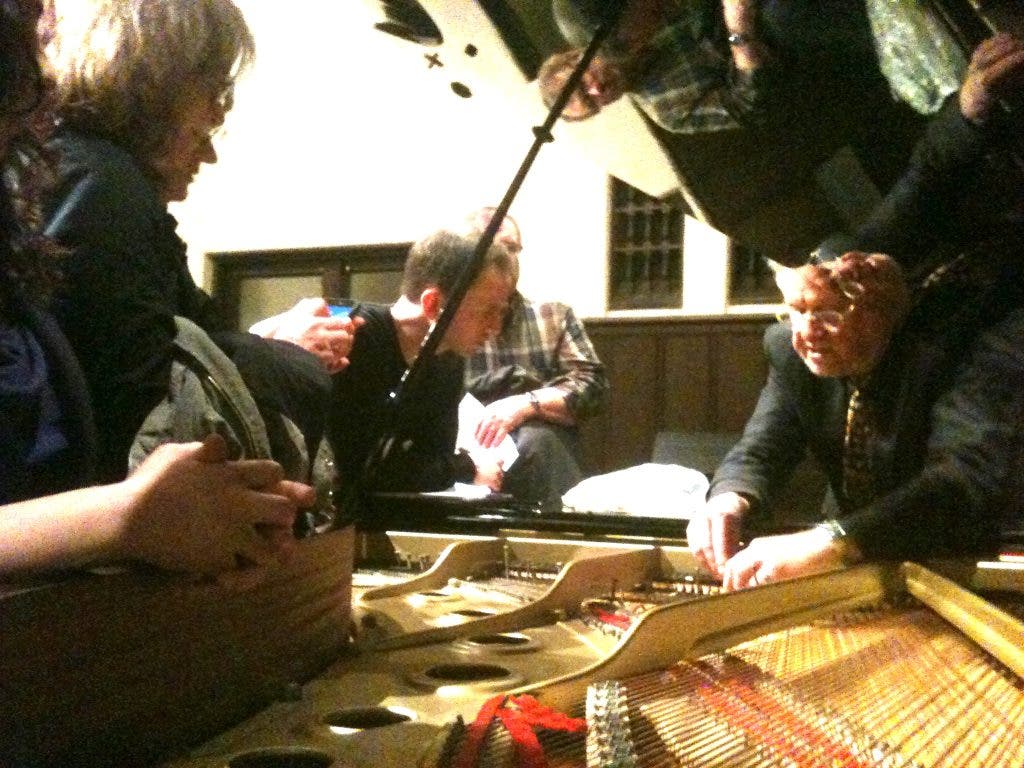
Ward offered an illuminating discussion about the composer’s life and works, followed by an inspired rendition of movements from Cage’s landmark Sonatas and Interludes, his magnum opus for “prepared piano,” that is, a piano whose sound has been altered by placing objects (preparations) inside the instrument, including between or on the strings.
“Cage began experimenting with the piano’s coloristic possibilities in the 1940s, placing pie pans and nails on the strings—and later bolts, screws and other objects between the strings,” explained Ward to the full-house crowd. Such preparations, he added, opened up an unprecedented timbral palette, providing Cage and subsequent composers a virtual orchestra of unique sounds using the piano alone.
Ward touched on the numerous, remarkable aspects of Cage’s music, including the use of “random chance” in crafting compositions, and the use of silence itself—as music. The professor then promptly resumed focus on Cage’s preparations, the salient feature of Sonatas and Interludes. Ward has played the piece worldwide since 1968 as well as before Cage himself—at the composer’s home in 1988.
Birth of Prepared Piano
“Cage’s invention of the prepared piano was a product of necessity,” noted Ward. It all began when Cage was asked to write ballet music on an African subject. Initially, he thought it most fitting to compose a piece for percussion ensemble.
But an undersized stage mandated fewer instrumental forces. Realizing that a single piano could be prepared with foreign objects to produce various percussive effects, he set to work on Bacchanale, his first piece for prepared piano. He went about it “quickly and with the excitement continual discovery provided,” Ward said, quoting Cage.
Prepared Piano—and Zen
Galvanized by his success in conveying non-Western music with the prepared piano, Cage embarked on his most substantial work of the genre, the monumental Sonatas and Interludes.
More than 70 minutes long, the work integrates the sounds and spirit of Asia into a Western concert music context. Cage’s use of rhythm in the piece is generally unpredictable, however: Listeners are coaxed into a state of heightened attention reminiscent of Zen meditation, of which Cage was an ardent practitioner.
Gamelan
At the same time, the awesome array of rattles, thuds, jangles and thumps from Cage’s preparations, notated with scientific precision, evoke sounds of the Indonesian Gamelan, a ceremonial ensemble of pitched percussion instruments. Ward expanded upon this frequent comparison by opening the concert with a video presentation of Gamelan music, assisted by his colleague in Occidental’s School of Music, Edmond Johnson, adjunct instructor of Music History and Cultural Studies.
Concluding his performance of selected movements from Sonatas and Interludes with the contemplative final movement, Sonata XVI, Ward treated the audience to a surreal encore of J. S. Bach’s Invention No. 1. No one present in the audience had ever heard it played as Ward did. The pianist then invited audience members to examine and even play the prepared piano. Several students leapt up to the bench and did just that. “They seemed thrilled by the performance,” noted Johnson.
West Meets East
The title of Sonatas and Interludes refers to a series of sonata-like pieces, similar in structure to the late Baroque sonatas of Scarlatti or Soler, separated by periodic free-form interludes of an improvisatory character. Cage’s fusion of such Western musical forms with Asian musical timbres and spiritual sensibilities undermines cultural distinctions, creating a uniquely international piece that applies equally to all groups.
Had Cage been alive, listening, he might well have restated his 1988 remark to Ward: “Thank you for playing so beautifully.”