Arts & Entertainment
Eagle Rock Pianist Enthralls Audience with Music for Left Hand
Mark Robson gives a thrilling performance at a sold-out recital.
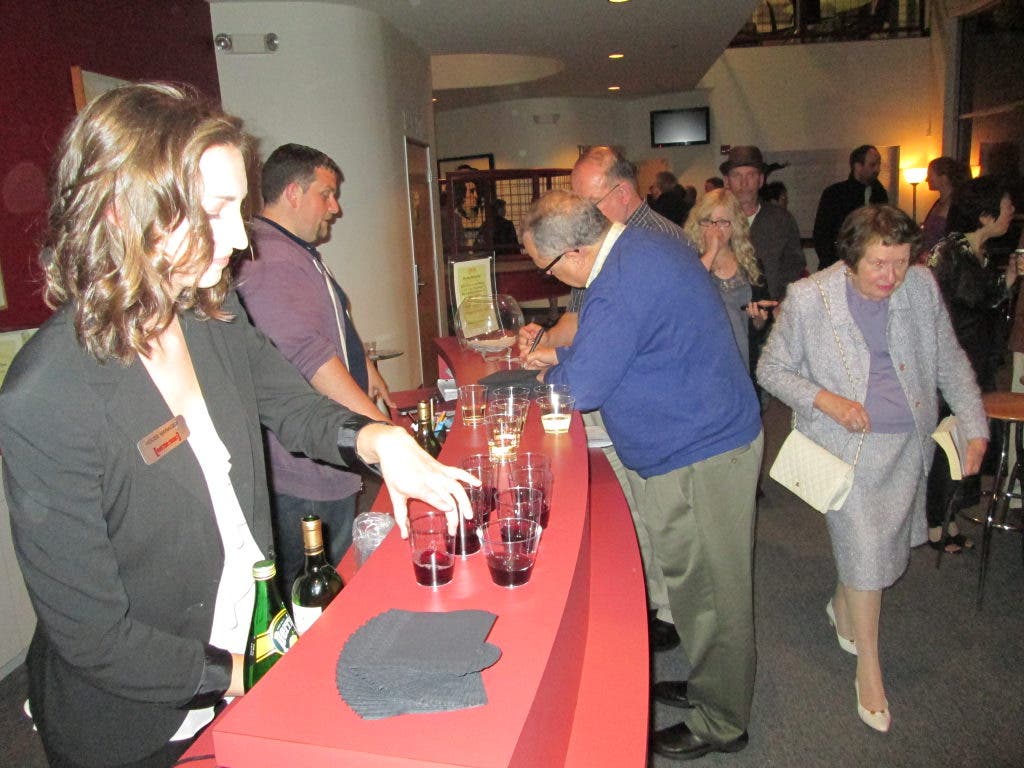


Eagle Rock-based pianist Mark Robson, consistently acclaimed for his inquiring musicality and commanding virtuoso technique, performed a sold-out recital of his own music at Pasadena’s Boston Court last Friday.
Sold-out concerts of contemporary classical music are rare. But Robson can be counted on for stirring, memorable performances, all the more charming at a venue such as Boston Court, whose intimate recital space attracts aficionados keen on a personal experience of music.
At 70 seats—all good ones—Boston Court’s auditorium fills up quickly. “I felt badly that people had to be turned away tonight,” Robson noted in his introductory remarks from the stage, with a restrained twinkle.
Find out what's happening in Eagle Rockfor free with the latest updates from Patch.
Another Round of Spheres
Many attendees were regulars at the Piano Spheres series held at Zipper Concert Hall (in The Colburn School across the street from Disney Hall), of which Robson is one of four regular pianists to perform recitals each season. The mission of Piano Spheres is to present “broader spheres of music,” implying non-canonical works of past and present. Those spheres are set to broaden further still with a new, additional series at Boston Court running throughout the summer and into the Fall, of which Robson’s was the inaugural event.
Find out what's happening in Eagle Rockfor free with the latest updates from Patch.
“We wanted to offer the Piano Spheres artists an opportunity to expand on their regular programming, to let them have fun and experiment with new concepts,” explained Boston Court Executive Director Michael Seel. Mark Robson seized upon that opportunity by presenting a highly focused program of one piece, by one composer, for one hand: Robson’s own monumental 24 Preludes for the Left Hand.
Limitation or Opportunity?
Hundreds of piano pieces for the left hand have been written since the advent of the instrument, primarily for the benefit of maimed or injured pianists. (Oddly enough, far fewer pieces have been written for right hand alone.) Notable examples include Ravel’s piano concerto for left hand and orchestra, written for a pianist who lost his right arm in World War I. At the same time, fully able-bodied pianists frequently perform piano music for one hand alone as an enlightening technical challenge. Robson’s recital exemplified that latter purpose, though the genesis of his preludes had its roots in the former.
Robson wrote the work for his friend, pianist Christopher Brennan, while he and Robson were graduate students at USC. Brennan injured his right arm, prompting Robson to write left-hand repertoire on Brennan’s behalf. Robson’s final set of 24 preludes for left hand, the first such set of its kind, evolved into completion over a five-year period, at which time a fully recovered Brennan premiered the work. He attended Robson’s May 18 recital.
“It was a moving, emotional journey preparing the piece for performance,” remarked Brennan in a post-concert discussion with Patch.
The Sound of One Hand
Robson’s Preludes easily fulfill the essential requirement of single-handed repertoire: to evoke the illusion of a complete aural texture, despite the obvious limitations of technical means. A deft left hand gracefully floats from the booming bass range to the scintillating bells of the high treble in quick succession, a process that plays itself forward and backward throughout the piece. Robson negotiated such acrobatic feats with characteristic mastery, but it was his singing tone, his ability to distinguish melody from accompaniment—all within the confines of a single hand—that impressed the most.
Contemporary Piece Rooted in the Past
Listeners were treated to an astonishing array of styles and tonal colors in this inherently diverse piece, which might as easily be called “a summary of the piano.” In an ancient practice, Robson paid homage to his predecessors in building the work’s form. The number 24 is significant for composers of preludes. J. S. Bach wrote a set of 24 preludes twice in his life (albeit interspersed with fugues). Chopin followed in his favorite composer’s example by writing his own set of 24 preludes. Debussy went on to write 24 preludes, as well. Rachmaninoff and Shostakovich, the same.
Beyond observing the classic number of preludes, Robson adhered with some regularity to the key order used by his great forerunners in the prelude genre, and openly evoked their styles at times. There were Baroque moments, haunting in their richly woven counterpoints and relentless ground bases, French-inspired pastorals, and lyrical Chopinesque atmospheres, among other influences. Homages notwithstanding, the music was uniquely Robson’s. A refreshing originality emerged from the surprisingly full, left-hand piano writing.
A Fitting Beginning
A celebration of the past and present, Robson’s Preludes made a fitting inaugural program of the new Piano Spheres series, in their home city after eight years away. “Zipper Auditorium is a professional and beautiful setting for recitals,” said Piano Spheres Executive Director Catherine Uniack, “but it is also nice to be back in Pasadena.” The Piano Spheres series was originally held in Pasadena’s Neighborhood Church beginning in 1994. With more successes like Robson’s, the series may be compelled to take up residence in Pasadena once again.