Business & Tech
Protesters at Fresh & Easy Say Their Campaign is Part of Larger Struggle
Monday's protest in front of the Fresh & Easy Neighborhood Market is the latest clash in the underlying conflict between the UCFW and the British-owned company.
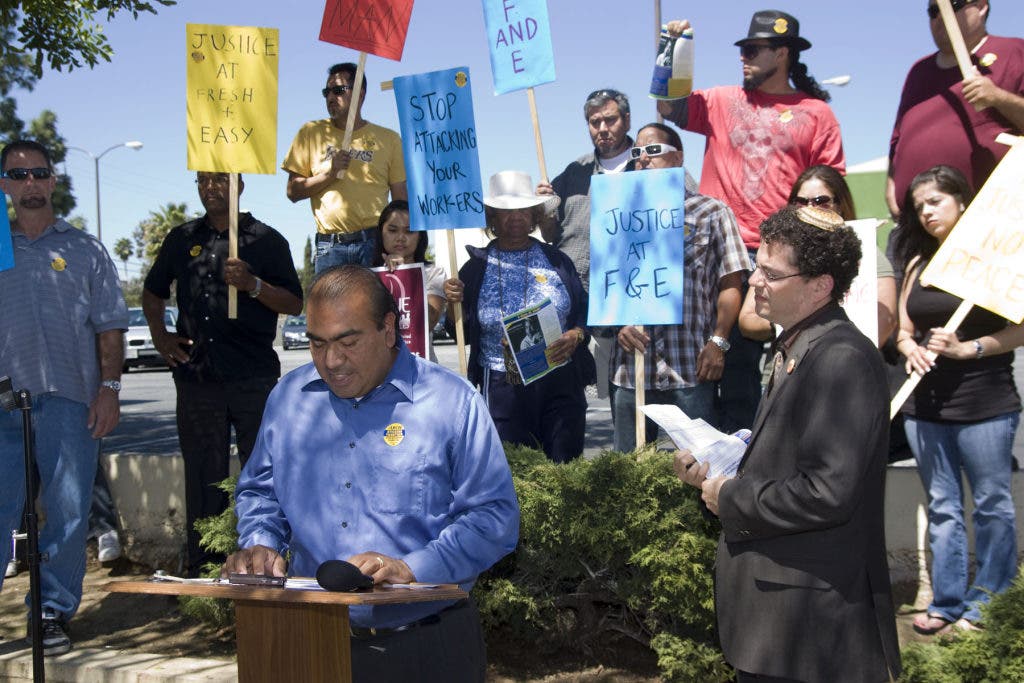

The way Michael Acuna and Carlos Juarez tell it, Fresh & Easy is a pretty good company to work for. But they were troubled by the number of workplace injuries occurring among the 28-person workforce at the on Eagle Rock Boulevard, and were worried about the cost of their health benefits.
So, last year, together with 14 other employees, they signed authorization cards and wrote a public petition to the company in an effort to unionize their fellow employees. They hand-delivered the petition to their superiors on March 26, 2010, with the support of the United Food and Commercial Workers union’s Local 770 and some local politicians in attendance.
That's when, they say, their troubles began. Soon after they delivered their petition, the company transferred six new employees into the store and changed the store manager in what the unionizing employees see as Fresh & Easy’s attempt to defeat the minimum “50 percent plus one” majority needed for workers to unionize. With a new total of 34 employees in the store, the 16 pro-union petitioners were two workers short of a majority.
Find out what's happening in Eagle Rockfor free with the latest updates from Patch.
Acuna and Juarez also accuse the company of increasing their team’s workload, using audio and video surveillance to monitor employees (specifically when they happen to be talking about union issues), transferring and/or firing pro-union employees and general retaliation against pro-union employees for their opinions and activities.
According to Nancy Cleeland, director of communications at the National Labor Relations Board (NLRB), the federal government entity that oversees employee representation issues, the pro-union workers allegations were filed by the UFCW with the NLRB on Sept. 1, 2010. Subsequently, on Nov. 5, 2010, the workers alleged that the company unlawfully prohibited employees from discussing work related investigations. Juarez also claims that he was forced to hand out anti-union pamphlets by the company, which led to yet another complaint filed with the NLRB on Jan. 13, 2011, alleging that employees were unlawfully required to engage in anti-union activities.
Find out what's happening in Eagle Rockfor free with the latest updates from Patch.
In December 2010, the regional director of NLRB’s region 34 dismissed most of the allegations the Fresh & Easy workers made in September. The allegations of engaging in threats to employees on account of their union and/or protected concerted activity, telling employees that they could not talk about the union in the store, interrogating employees, engaging in surveillance of employees as described in the first charge and the subsequent charges in November and January are still under investigation by the NLRB.
There are two legal ways to unionize a workplace, according the NLRB’s website—one utilizing the NLRB, the other outside of the agency’s formal procedure. The NLRB-guided method necessitates a petition seeking unionization of a work place, signed by at least 30 percent of the employees, and the designation of an appropriate bargaining unit. After both prerequisites have been verified by the board, it organizes a secret ballot election, which decides the certification of a union through a majority of votes cast.
The other method involves the employer voluntarily recognizing a union, after the union has proven that a majority of the employees have given their support. Currently, the Glassell Park Fresh & Easy employees are attempting to unionize through voluntary recognition, after having shown support for their cause by 75 percent of the location’s employees.
Brendan Wonnacott, a spokesman for Fresh & Easy, did not return several phone calls as well as an email inquiry regarding the allegations against Fresh & Easy. But Wonnacott told Eagle Rock Patch earlier this week that the company strives “to uphold the employees’ rights to democratically join a union,” in effect endorsing their right for a NLRB-guided secret ballot election.
Why, then, is the union still trying to unionize the Fresh & Easy stores through voluntary recognition?
According to UFCW spokesman Evan Yeats, the union believes that the NLRB process is “not beneficial” to either party, be it the company or the employees, given that during the election process a lot of animosity is generated. Both the union and local employees constantly reiterate that Fresh & Easy is a great company, and that they want to cooperate with company.
This ties into a larger narrative: Fresh & Easy, which is owned wholly by British retail giant Tesco, was founded in 2007 as a vehicle for Tesco to establish itself in North America. Tesco has a long history of working together with unions in the United Kingdom, and, according to UFCW spokesman Yeats, the labor union “looked at [Tesco’s] track record [of union labor], and said, ‘this is a great company, we want to work with them." Yeats said UFCW repeatedly tried to reach out to Tesco and Fresh & Easy, trying to establish a good working relationship, and even brought in some big guns: Then presidential candidates Barack Obama and Hilary Clinton reportedly both wrote letters to the company, urging Tesco’s then-CEO Sir Terry Leahy to “meet with the UCFW and other community groups,” as Obama put it.
The company, according to Wonnacott, “prefer[s] direct relations with our employees, but this a choice only our employees can make,” and thus did not engage with the union. Ever since then, the UFCW has been running a grassroots unionizing campaign at Fresh & Easy’s stores, tying in new locations as employees expressed the wish to unionize.
Local politicians also have weighed in on the issue: At the demonstration outside the store on Eagle Rock Boulevard last Monday, representatives for Councilmembers Richard Alarcón, Eric Garcetti and José Huizar were in attendance, as well as a representative from California Assemblymember Anthony Portantino's office. In response to a request for a comment from Eagle Rock Patch, Eric Garcetti's office issued following statement: "Council President Garcetti believes that workers should be able to organize and supports their efforts to hold a vote."
The problem is that in all this back and forth between the union and the company, the concerns at the heart of the issue have moved into the background: Since the petition filed by the Glassell Park employees, there have been 18 workplace injuries, says Juarez, with four of them needing surgical attention.
Juarez and his coworkers say that they aren’t given any safety training for the job at hand, leading to back injuries from heavy lifting (Eagle Rock Patch is still waiting for confirmation of these numbers from the company). Employees say they also have problems with the company’s high cost of the health benefits contributions, which are not easy to pay when the company is cutting back on employees’ working hours.
Juarez, who is raising three kids in Highland Park, feels that he is underpaid for the hard work he is putting in. The pay scale starts at $10 per hour, he says, and he and his pro-union co-workers would like to be represented by the UFCW—just to be in a better bargaining situation.