Health & Fitness
Blog History: The Lady in the Lake
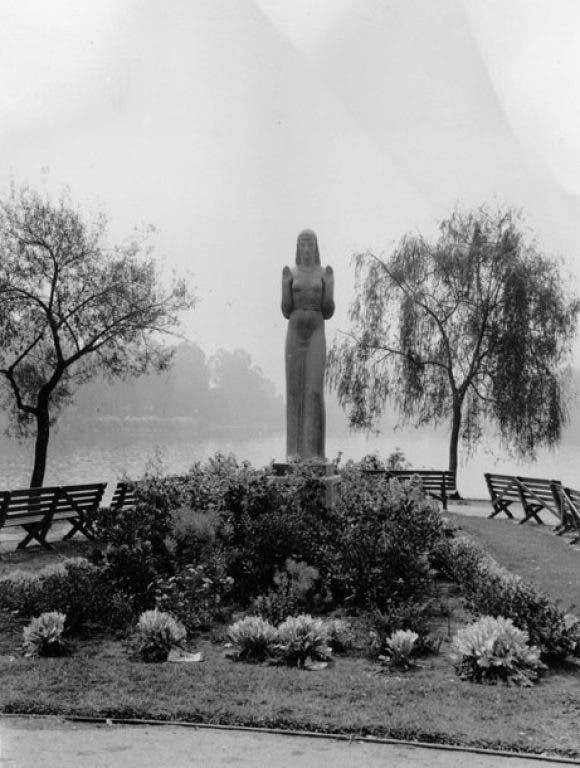
In 1934, the federal government's WPA paid artists to create public works. One of those works was Echo Park's Lady in the Lake, soon to be returned to her original location.
During the Great Depression, unemployment in the United States rose to twenty-five percent of the working population in 1933. Hundreds of thousands of Americans found themselves homeless, and many of the homeless lived in shanty towns called “Hoovervilles” (named after Herbert Hoover, President of the United States). People too poor to buy gas sometimes drove a“Hoover buggy,” which was an automobile pulled by a horse. http://en.wikipedia.org/wiki/Great_Depression.
Under Franklin Delano Roosevelt, government took on an entirely different approach to joblessness from that taken by previous administrations. His New Deal “Brain Trust” felt that – to keep people fully employed – the government would have to run deficits when the economy slowed, as the private sector would not invest enough to keep production at the normal level. http://www.u-s-history.com/pages/h1851.html.
Today, candidate rhetoric and public sentiment appears to be that government must be reduced and taxes cut during a period of significant unemployment.
Find out what's happening in Echo Park-Silver Lakefor free with the latest updates from Patch.
The New Deal's most ambitious program for full employment was the Works Progress Administration (later the Works Projects Administration). Between 1935 and 1943, the WPA provided almost eight million jobs. http://en.wikipedia.org/wiki/Works_Progress_Administration. Often, walking along the sidewalk, or across a bridge, you may come across the stamp “WPA.” The acronym show that the Works Progress Administration employed out of work men and women to build that sidewalk or bridge.
The WPA also put writers, historians and artists to work on public buildings and monuments. The first WPA art project consisted of the vivid murals of working people painted inside Coit Tower on Telegraph Hill in San Francisco by twenty-six Bay Area artists. http://www.kqed.org/arts/profile/index.jsp?essid=23728.
Find out what's happening in Echo Park-Silver Lakefor free with the latest updates from Patch.
In 1934, the WPA awarded Ada Mae Sharpe a commission to sculpt “Nuestra Reina de Los Angeles.” This Art Deco stone sculpture has been called the “Lady of the Lake” since its placement on the tip of the peninsula that juts into the north end of the lake (now the site of pumping station).http://www.historicechopark.org/id34.html. More recently she had resided on the east side of the lake near the boathouse.
The City's Echo Park Lake Restoration project will return the Lady to her original location.