Sports
Heat Wave to Bake Olympic Marathon Trials
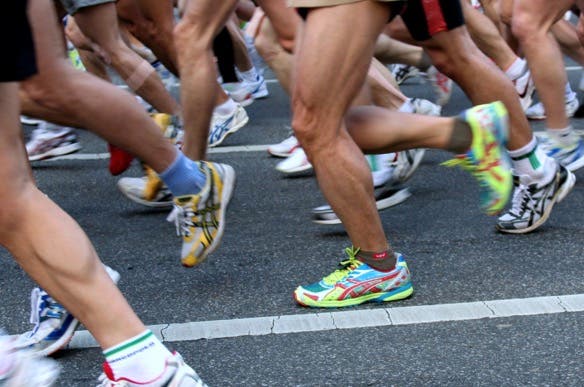
A record 373 runners will race through downtown saturday in 80 degree temperatures for a chance to qualify for the summer Olympics.


By STEVEN HERBERT
LOS ANGELES, CA - The heat will be a factor in Saturday’s U.S. Olympic Team Marathon Trials, according to America’s top male marathoner.
“It’s tough and it’s going to take its toll, but at the same time, you’ve just got to monitor,” said Meb Keflezighi, who has the fastest qualifying time in the men’s field, two hours, eight minutes, 37 minutes, established when he won the 2014 Boston Marathon.
Find out what's happening in Echo Park-Silver Lakefor free with the latest updates from Patch.
Keflezighi expects times to be slower because of the heat.
The record field, expected to be 373 runners, will have to contend with temperatures in the low-to-mid-70s at the start of the race and upper-70s to low-80s at its conclusion.
Find out what's happening in Echo Park-Silver Lakefor free with the latest updates from Patch.
The men’s field will start at 10:06 a.m. and the women’s 16 minutes later.
The 26-mile, 385-yard race will begin at Gilbert Lindsay Plaza, in front of the Los Angeles Convention Center, then start a 2.2-mile loop which will take runners north, mainly on Flower Street, to between Fifth and Sixth streets, then back south to Gilbert Lindsay Plaza for the first of four runs on a six-mile loop.
The six-mile loop will take the field south on Figueroa Street to USC, where it will pass the Tommy Trojan statue.
The runners will then head into Exposition Park, passing the Rose Garden, California Science Center and Los Angeles Memorial Coliseum, before returning to Figueroa Street bound for Gilbert Lindsay Plaza, where the race will conclude when the loop is completed four times.
This is the first time the U.S. Olympic Team Marathon Trials have been held in Los Angeles, which was awarded the race by USA Track & Field, the sport’s national governing body, over Cincinnati and Houston in 2014.
The 2016 Summer Olympic marathons in Rio de Janeiro, Brazil, will be run on a course with a loop being run multiple times and “we wanted to create something similar,” said Tracey Russell, the CEO of Conqur Endurance Group, the trials’ local organizing committee.
The course benefits runners “who are tactical on the turns” and “know how to run the race tactically,” Russell said.
The marathons in London’s 2012 Summer Olympics and the 2012 U.S. Olympic Team Marathon Trials, held in Houston, were also run on courses with a loop being run multiple times.
“I like the setup,” said Desiree “Desi” Linden, whose qualifying time of 2:23:54 was second fastest among women, behind Shalane Flanagan, who finished 17 seconds ahead of Linden to win the 2012 women’s Olympic Team Marathon Trial. “I think it’s great for spectators and just getting a big crowd in a single place.
“For the athletes, it’s a great way to break down the marathon and just focus on each segment. You can learn that course a lot quicker. Here you can come in and do a couple runs on it and cover distance and understand it pretty quickly.”
The loop course will also mean fewer street closures.
Figueroa Street between 11th and 34th streets will be closed from 8:30 a.m. to 2 p.m., with heavy traffic expected in the area of the Convention Center. Organizers did not provide a complete list of street closures.
There will be limited, controlled pedestrian crossing locations at several spots on the course.
When asked what he would say to people inconvenienced by the street closures, Mayor Eric Garcetti stressed the race’s economic benefits.
“This brings millions of dollars to Los Angeles” with spending by the runners and their families, Garcetti told City News Service.
“It also shows us off to the world. It will be on NBC, broadcast for the first time, which means more people will come to Los Angeles, more people will invest in Los Angeles, so it’s a net economic gain.
“You have a lot of fans who probably never come out, standing in front of your store or restaurant. Along the route, you’re going to see hundreds of new people who will be there who hopefully can become customers for local businesses.”
To qualify for the race, men had to complete a marathon in or under 2:19 or a half-marathon in or under 1:05 between Aug. 1, 2013 and Jan. 17, 2016.
Women needed to complete a marathon in or under 2:45 or a half-marathon in or under 1:15 in the same time period.
The top three male and female finishers under the Olympic qualifying standards of 2:17 for men and 2:42 for women will receive spots on the U.S. Olympic team.
The 40-year-old Keflezighi is seeking to become the oldest male U.S. Olympic marathoner and the only one to make three Olympic marathon teams.
In 2004, Keflezighi became the first American man to win an Olympic medal in the marathon since Frank Shorter in 1976.
The race has a record purse of $600,000, with equal prize money for men and women. The top 10 finishers among both the men and women will receive prize money.
The winners will each receive $80,000, runners-up $65,000 and 10th-place finishers $7,000.
City News Service
Get more local news delivered straight to your inbox. Sign up for free Patch newsletters and alerts.