Sports
El Cerrito Judo Olympian Recalls 2008 Games in Beijing
El Cerrito resident Sayaka Matsumoto, who represented the U.S. in judo at the Summer Olympics in Beijing and is now senior instructor at the East Bay Judo Institute, took years to achieve her goal of making the Olympic team.

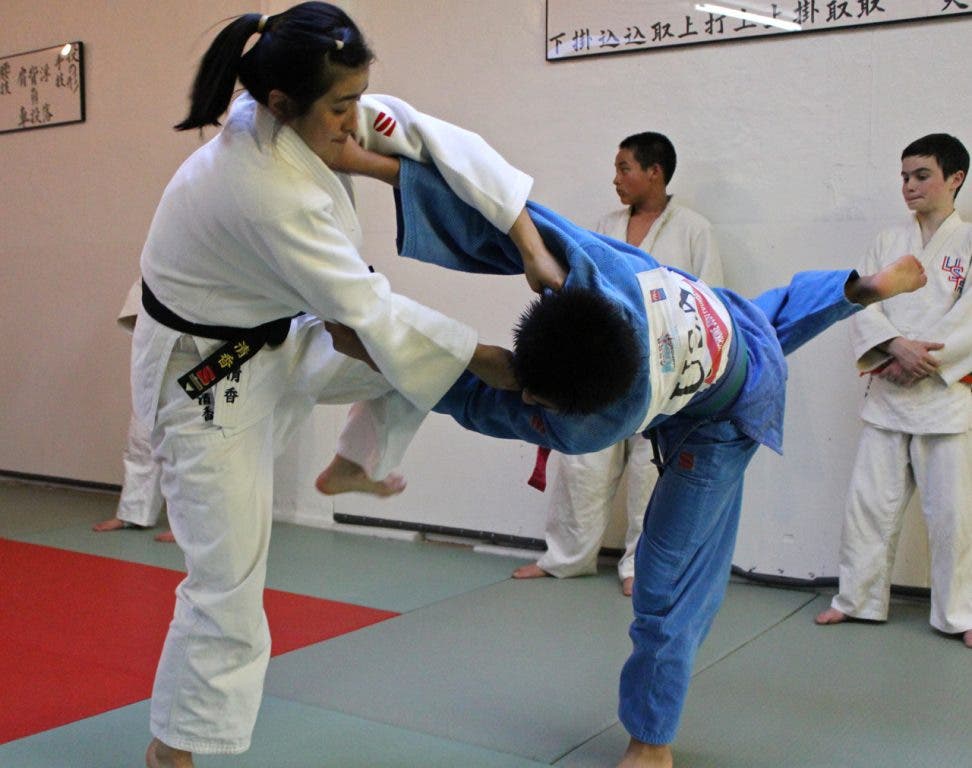


Editor's Note: As we approach the upcoming Summer Olympics in London, here is the first in what we hope will be a series about Olympians in El Cerrito.
She worked out six days a week, two to three times a day, running, lifting weights, and practicing at the dojo. She frequently traveled across the globe for day-long competitions, only to immediately return home to continue training. And at 5 feet 2 inches, she was on a strict diet to qualify to compete in the 105-pound weight division.
“It’s very stressful, on your mind and on your body,” Matsumoto said. “It’s a totally different world that very, very few people understand.”
Find out what's happening in El Cerritofor free with the latest updates from Patch.
But being in that world—a world with few friends and even fewer moments of respite—eventually paid off for Matsumoto.
Today, the 29-year-old is a seven-time Senior National Champion, a three-time competitor at the World Championships, and a former Olympian.
Find out what's happening in El Cerritofor free with the latest updates from Patch.
Since competing in the 2008 Beijing Summer Olympics, Matsumoto has left behind the grueling lifestyle that made her one of the top judoka in the world.
But as a fourth-degree black belt and a senior instructor at the in El Cerrito, she remains attached to the her life’s passion.
Family beginnings
Matsumoto, born in Japan and raised in the Bay Area, never really had a choice about whether or not she would study judo.
Her father, David Matsumoto, a psychology professor at San Francisco State University, began judo at age 7. Now, nearly 53 years old, he is a seventh-degree black belt and a decorated coach at the national and international level.
For the last 28 years, he has been the head instructor of the East Bay Judo Institute, where his daughter grew up watching him coach.
“Because she’s my daughter, she used to be there all the time,” he said. “So one day, I decided it was time to get her started.”
At age 5, Sayaka Matsumoto began her training. As she progressed, her father set the rule that she had to continue judo until she was at least a black belt, an accomplishment that came when she was 15.
With a few successes at big tournaments already under her belt, Matsumoto decided that she would continue training, and aim to be a competitor at the global level.
“I presented the options and let her decide, and she said she wanted to get in there and try it,” Matsumoto’s father said. “But once she made the decision, I set a very different and very difficult training track.”
When Matsumoto first started judo, she was in beginner classes that her father did not teach. But as she advanced and decided to pursue high-level competition, her father became her main coach.
Father and daughter tried to keep judo separate from family life. On the mat, Matsumoto’s father was her coach. At home, he was her dad. And looking back, both agree that it was a successful relationship.
“I think it gave us a certain understanding of who we are,” Matsumoto said. “He knew me the best. To be a good coach you need to know who your players are. You need to know how far you can push them, when they’re breaking down, when you need to be there for them.”
For her father’s part, it required him to not second-guess putting his daughter through punishing training regimes.
“I ran her through the gauntlet just like I ran everyone else through the gauntlet,” he said. “During training, I didn’t think about it. But later, I would feel bad about it.”
Matsumoto continued with her father as her primary coach through her entire competitive career—a rare situation, but one that helped Matsumoto reach her dreams.
Reaching Beijing
Earning the opportunity to compete in the 2008 Olympic Games came with its low points.
While at Saint Mary’s College High School in Berkeley, Matsumoto realized that to be an elite judoka, she had to give up a large part of her social life, along with activities like cross country and theater.
“I learned very quickly within that short four years of time that I had to really sacrifice certain things in order to focus on judo,” she said. “At the time you’re upset…, but now I understand that you have to do that."
It was in 2000 that 17-year-old Matsumoto set her sights on the Olympics. After winning a silver medal at the Junior World Championships, Matsumoto earned a spot on the U.S. judo training team for the Summer Games that year in Sydney.
“That was really the first time that I had ever seen judo at that level,” she said. “I was just awestruck.”
The experience of seeing the Sydney Olympics gave birth to Matsumoto’s goal of making the 2004 Olympics in Athens.
After graduating from high school in 2001, Matsumoto attended the UC Berkeley. When juggling judo and college classes became too much to handle, she chose to take three semesters off from school, and focus solely on judo.
But in 2004, her hard work and sacrifice only yielded heartbreak.
Despite winning the U.S. Olympic Trials that year, Matsumoto did not get to compete in the Olympics because based on the complex qualification system, the United States did not earn a slot in the 105-pound weight division.
“I didn’t make the team, which was really devastating, because I had just taken off school and my parents had spent thousands of dollars for me train and travel all over the world,” she said.
But Matsumoto’s determination was only strengthened by her disappointment in 2004. She went back to UC Berkeley to finish her degree, took on a part-time job at the , and trained with hopes of going to Beijing.
For Matsumoto, the most stressful obstacle on her path to the 2008 Olympics was the last round of that year’s Olympic Trials. Her ticket to Beijing and years of work all came down to one match.
Ann Shiraishi, who had been training at the EBJI since 2004, was Matsumoto’s teammate and friend, but also her competition.
Shiraishi and Matsumoto, who compete in the same weight division, both made it to the finals of the Olympic Trials, and were forced to fight each other for the one spot to the Olympics.
“I went out there knowing it was going to be one of the toughest matches of my life,” Shiraishi said. “I didn’t come out on top, but I was very happy she was the one who beat me. She’s one of the hardest workers I’ve ever met. And leading up to the trials, she was one of the best training partners that anyone could ask for.”
Living the Olympic dream
Matsumoto had been to the Olympics before in 2000 and 2004 as a training partner, but when she was an official athlete in 2008, the experience was completely different.
It began with team processing, an orientation meeting for the athletes during which they receive their official Olympic gear—a ring, a watch, clothes, shoes, suitcases, and more.
“That’s when I realized, ‘Wow, I’m really a part of this,’” Matsumoto said.
When she arrived in Beijing, she and the athletes went to the Olympic Village, the self-contained living center of all the athletes for the duration of the games.
Matsumoto remembers the surreal experience of being surrounded by famous U.S. athletes—sitting on a plane with Shawn Johnson, and eating tables away from Michael Phelps.
But what stands out in Matsumoto’s memory, apart from competing, was walking with the U.S. team into the stadium of thousands of cheering spectators during the Opening Ceremonies.
“That’s something I envisioned as a child, before I really even understood what it meant to go to the Olympics—you see it on TV,” she said. “To be a part of that, to be on the other side of that—you can’t even put it into words what that feels like.”
For Matsumoto’s first-round match, she faced Japan’s Ryoko Tani, a seven-time world champion who was the reigning gold medalist for the past two Olympics.
Though Matsumoto lost to Tani by points, she stretched the match out to its five-minute limit, not allowing Tani to score an ippon—a match-winning throw or a 25-second pin.
Matsumoto’s father, who was watching in the crowd, said still to this day he receives comments when he goes back to Japan about how close of a match it was.
“I think I fought really well, and that really gave me the validation that I deserved to be there,” Matsumoto said.
With the loss, Matsumoto’s Olympic run ended. But with the weight of competition off her shoulders, she was able to enjoy her remaining weeks as an Olympian.
Back at East Bay Judo Institute
Immediately after her loss to Tani, Matsumoto had plans of making another Olympic run in 2012. But soon after she came back from Beijing, she realized she would rather focus on coaching and take a step back from competitive judo.
“There’s an aspect to being an athlete where you have to be very selfish,” she said. “I had really shifted my role into helping these other kids that wanted to compete, and that didn’t coincide with the life of an athlete.”
Now, Matsumoto works for her father’s company, Humintell, and remains an instructor at EBJI, which was founded in the 1960s and moved to El Cerrito in 1991.
Matsumoto is only one of many decorated members of the EBJI. Her father not only helped run the International Judo Federation for several years, he also served as the head coach of the U.S. Olympic judo team in 1996 and the High Performance Director of USA Judo from 1996 to 2000.
Ann Shiraishi, 26, whom Matsumoto defeated at the Olympic Trials, is also an instructor at EBJI. She made a run for this year’s Olympic judo team, but fell short.
Matsumoto, her father, Shiraishi, and the many other instructors at EBJI all volunteer their time at the dojo without compensation.
Matsumoto’s father said his passion for judo and the amazing people he has met through his study of judo continue motivating him to volunteer and coach.
“It’s my very strong belief that judo is an amazing activity—I don’t want to just call it a sport,” he said. “I’ve been very successful in my professional life, and I attribute all my accomplishments to judo.”
Matsumoto has lived in El Cerrito for about 10 years now, and though she has competed in more countries than she can count, she said her travels have only made her more appreciative of her home in El Cerrito, where she went to school at many years ago.
Matsumoto plans to continue as a coach, training the next generation of judoka, including her three younger brothers, who are all working towards their black belts.
For aspiring athletes, Matsumoto makes it clear that achieving a goal like competing at the Olympics is never easy.
“The road to the Olympics is full of ups and downs…It’s filled with days when you want to give up, when you want to quit, when you hate what you’re doing or you may feel frustrated,” she said. “But it’s really the ability to persevere at times like that, and to never give up, that defines a true champion.”
Get more local news delivered straight to your inbox. Sign up for free Patch newsletters and alerts.