Neighbor News
Emily Fraser: Inspiring change, finding poetry in our lives through storytelling
Interview with documentary filmmaker Emily Fraser on her short film, "Lady Parts", part of Lunafest East Bay 2015.
Film is incredibly democratic and accessible; it’s probably the best option if you actually want to change the world, not just re-decorate it.
– Banksy, pseudonymous English graffiti artist, political activist, film director, and painter
Real life is stranger than fiction, as the saying goes, which is what interests Emily Fraser about documentaries. “There are so many interesting, amazing stories out there that are waiting to be told, and once told they can affect our understanding and our experience of the world,” the filmmaker and graduate of Stanford’s Documentary Film and Video MFA program related to me in a recent interview. Emily and fellow Stanford classmate Katherine Gorringe directed “Lady Parts,” which was one of eight films chosen for the 2014-2015 Lunafest film festival, “short films by, for, about women.” Emily graciously took time out of her busy schedule to talk with me about her chosen path.
Marrying two passions
Emily, who hails from Virginia, studied environmental policy at the College of William and Mary, and worked in the environmental nonprofit sector in Washington, DC, and with a consulting firm that focused mostly on renewable energy issues. “I really cared about the subject matter that I was dealing with, but I felt that my strengths weren’t being fully utilized,” she said. Emily has always loved watching documentary films, but while the 2002 documentary “Spellbound,” about the 1999 National Spelling Bee competition, was one of the first films that she started thinking about “the people behind the camera,” she never considered it as a career or felt that it was accessible to her. As she continued with her day job, however, she began the journey of determining what she really wanted to do with her life and building up the confidence to pursue it. “One morning, I literally just woke up and had this thought in my head: ‘You need to be making documentary films. That’s what you need to do,’” she said.
Find out what's happening in El Cerritofor free with the latest updates from Patch.
While working full time, Emily completed the George Washington University’s Institute for Documentary Filmmaking certificate program, which was at once difficult and rewarding. “I just clearly loved it. By the end of the program, I knew for sure that’s what I wanted to be doing,” she said. Having an audience respond to her film was also an affirmative experience for her. “A big part of it was having the drive to work on environmental issues and realizing that film and storytelling can be such a powerful vehicle for changing people’s minds and affecting their emotions,” she explained. Film, Emily believes, is going to play a big role in driving the “sea change” needed to address global climate change and environment destruction wrought by our unsustainable economic system. “I want to tell stories that bear witness to the destruction but also that celebrate the beauty of the world that we still have,” she said. “I hope that I can create films that tap into our emotional intelligence as human beings and that can help us react emotionally to the problem and inspire change.”
In-between her two years at Stanford, Emily spent six weeks in the summer of 2013 in Birmingham, Alabama, on a film fellowship sponsored by the Southern Environmental Law Center (SELC). The organization brings together a group of new documentary filmmakers to work on short films about environmental issues that SELC is working on. Of course, environmental activism is perceived differently depending upon the region – with the San Francisco Bay Area being more receptive and the South more hostile than not – which is what makes the establishment of the fellowship a smart, strategic move. “They [SELC] realize the power of storytelling and the power of film to help people to understand and then change their minds and hearts,” Emily said.
Find out what's happening in El Cerritofor free with the latest updates from Patch.
While her film dealt with storm water issues, which required interviewing people who were active in that area and supportive of SELC’s stance, another filmmaker who was focusing on energy issues in Alabama faced resistance from potential interviewees who opposed SELC’s position. Roadblocks and challenges, especially unforeseen ones, are part of the documentary filmmaker’s world. Chalking it up to lessons learned from all of her films, Emily noted that the solution is to find a creative way around these problems. In the case of trying to access uncooperative subjects who shoulder opposing views, she responded, “It’s all about connecting with people individually and understanding where they’re coming from, empathizing with them, and trying to be very respectful of their opinions. There’s a reason why everybody feels what they feel and thinks what they think, and we’re not going to be able to have a conversation if we aren’t respectful and acknowledge that.”
Emotional connection, emotional resonance
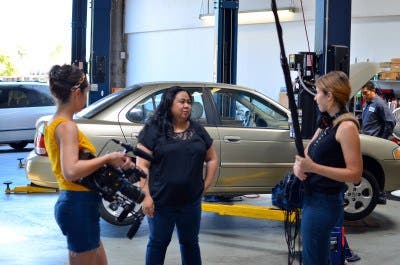
The themes of human connectivity and empathy not only guide Emily’s work, but they, more often than not, lead her to her subjects. At Stanford, Emily and Katherine applied for and received a grant in 2013 from the Revs Program, whose mission is to “forge new scholarship and student experiences around the past, present and future of the automobile.” The only requirement was that the short films had to involve cars. Although neither personally considered cars a burning topic of interest, they nonetheless wanted to continue to make movies over the summer and brainstormed for ideas. In a serendipitous moment, Emily was driving through nearby Redwood City and at an intersection saw a big sign for Lady Parts Automotive (3033 Middlefield Road, Redwood City, CA 94063, 650.369.5239). Amused, she and Katherine reached out to the shop to satisfy her curiosity. “We met Mae [De La Calzada] the owner of the auto shop and had just an amazing connection with her,” Emily recalled. The scheduled 30-minute meeting evolved into a four-hour conversation. “We were inspired by her and her vision of the shop,” Emily went on. “We got along really well. In that moment, we knew that was the film we wanted to make.”
What transpired between the filmmakers and Mae is a critical component of the filmmaking process for Emily. “When I’m looking for subjects, the most important part for me is having an emotional connection to it, having a visceral, emotional resonance, whether it’s to a character or the setting or the ideas that I’m dealing with,” Emily explained. “The challenge for me is finding things that resonate for me emotionally, that are creative and artistically inspiring, but also have a message that I want to convey.”
Finding poetry in our lives
For Emily, artistic inspiration can be found in unexpected places. When she was at Philmont Scout Ranch in northern New Mexico, producing short educational and marketing films for the Boy Scouts in the summer of 2011, she heard about a nearby ghost town. Dawson, once a bustling coal-mining town founded in 1901, was shut down in 1950 when the company closed its mines. Buildings were either relocated or razed, and the company told everyone to leave. Isolated, set in a canyon, Dawson today boasts nothing more than a giant cemetery. Still, Emily said, “I was really blown away by how beautiful this place is. I felt this magic when I was there.” She never forgot about Dawson and now this ghost town is her current project. Emily has been meeting with and filming former residents, most of whom are in their 80s. [Interestingly enough, the town’s most notable resident is Dolores Huerta, farm labor activist and one of the leaders of the United Farm Workers, who was born there in 1930.] Many of the former residents return every other year for a Labor Day Weekend reunion. “I love the metaphor of these older people who are losing their loved ones and their health, and they’re getting ready to say good-bye to the world,” Emily said. “But they’re doing it in the context of this town that no longer exists.”
Her filmmaker’s approach to this project speaks to her commitment “to finding the poetry in everyday while provoking discussion around pressing social and environmental issues.” Emily loves poetry – reading and writing it – and she brings that love to her work. “I try to come to filmmaking with a poetic sense of metaphor and playfulness and attention to language,” she explained. “I’m trying to say more by saying less.” At the same time, Emily pointed out, “There are also moments of poetry in our daily lives, and part of my job as a filmmaker is to recognize these moments and give them a platform to live on and breathe, so that other people can appreciate them.”
Meet the filmmakers at Lunafest
Emily and Katherine will be honored guests at the VIP event hosted by the Lunafest East Bay Committee on March 21st at 6:00pm, 638 Clayton Avenue, El Cerrito. Following the reception, the Lunafest film festival will be shown at 7:30pm at the El Cerrito High School Performing Arts Center, at 540 Ashbury Avenue, one block up from the VIP event. Emily and Katherine will be introduced with a short interview after the welcome and will be available to meet after the screening. Come visit with them at either event. You can purchase tickets (for the VIP event/film festival or just the film festival) here.
Read the entire article by Patty Enrado at: http://www.thedressat50.com/emily-fraser-inspiring-change-finding-poetry....