Health & Fitness
What you need to know about celebrating the Lunar New Year
Start off the Year of the Dragon with good luck, good health and prosperity!


The Lunar New Year began Monday and will be celebrated for several days in many Asian and Asian-American communities. It's considered to be the biggest holiday in Chinese, Vietnamese and Korean culture. It is even bigger than Christmas. This year, we celebrate the year of the Dragon, a lucky sign in Chinese culture. Dragons are known for being passionate and enterprising free spirits.
Traditions
The Lunar New Year or "Spring Festival" is steeped in tradition which requires a lot of careful preparation and planning. Before the start of the new year, each household is supposed to give their home and themselves a thorough cleaning. Hair is also usually trimmed before the new year.
Find out what's happening in Elk Grovefor free with the latest updates from Patch.
The Food!
The biggest occasion of this holiday for Chinese people is usually a large family dinner complete with traditional foods. A fish is usually served whole with the head and tail intact. “Yu,” as fish is called, sounds like the word for “abundance.” “Jai” is an elaborate vegetarian dish served by Chinese families on the eve and the first day of the New Year. It’s also packed with good-luck foods such as sea moss (which is supposed to bring prosperity), lotus seeds (children/sons), noodles (longevity), lily buds (for “100 years of harmonious union”), and Chinese black mushrooms to “fulfill wishes from east to west.”
Find out what's happening in Elk Grovefor free with the latest updates from Patch.
Other special foods include tangerines and oranges for wealth and good luck, dumplings filled with pork or coconut, and "niangao"—sticky cakes made with glutinous rice flour, brown sugar, and oil.
Usually in China, Hong Kong, and other Asian countries that celebrate the lunar new year, a brilliant array of fireworks is set off to ward off evil spirits.
Not just "Chinese" New Year
As my friends have reminded me, the Lunar New Year is not just a Chinese holiday. Vietnamese and Koreans also celebrate this holiday. The Vietnamese New Year is known as Tet. The Vietnamese eat “banh chung," a traditional Vietnamese cake that looks like an adobe brick and is made from glutinous rice, mung bean, pork, and other ingredients and wrapped in bamboo or banana. When you buy it at Asian markets, it should also be wrapped in plastic and perhaps, tied with a little red ribbon for good luck. “Kho”, a caramel sauce dish made with beef, chicken, pork, fish, or seafood, is also a must have for Tet.
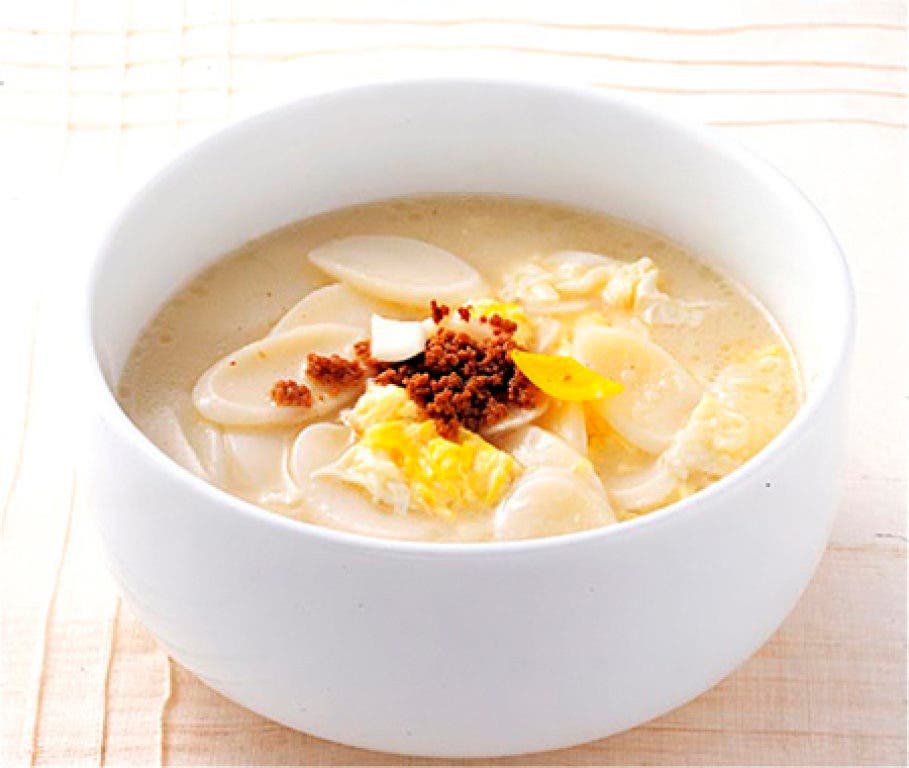
Korean New Year is known as Seollal. Many Koreans dress up in traditional Korean clothing called “hanbok.” “Tteokguk,” or soup with sliced rice cakes, is a traditional Korean food customarily eaten for the New Year. Most Koreans celebrate their birthday on the new year and in Korean culture you are considered to be one year older after you have finished your “tteokguk.” In a demonstration of filial piety, children wish their elders a happy new year by performing one deep traditional bow.
Taboos
Certain things are taboo during the new year's celebration. Sweeping the floor is not allowed because it is thought to sweep luck away. Cleaning should be done before the new year; it is considered bad form if your house isn’t clean for the new year. Hair should not be trimmed during the new year, and breaking things is frowned upon because it is supposed to bring bad luck. You should not kill any insects or animals. Also, anyone who has recently lost a loved one is prohibited from doing any visiting to prevent anything bad from the death from spreading.
Respect your elders
New Year’s is a time to show respect for ancestors who have passed on, to show respect to elders, and to honor and spend time with family. Families that are Buddhist will often set up altars with pictures of deceased loved ones, and offerings of fruit, food and incense. Children or unmarried young adults are given lucky red envelopes or “lycee” filled with money. I always loved getting these envelopes when I was a child. When I got married, I was informed that I would not be getting envelopes as often but that I would be expected to give them to children.
There are many ways to greet someone on the Lunar New Year, but Chinese people do it by saying “Gung Hay Fat Choy”(恭喜發財 Cantonese Chinese) or “Gong Shi Fa Cai!”(恭喜發財 Mandarin Chinese). This essentially translates to “Congratulations and be prosperous.” ”Chuc Mung Nam Moi” is the Vietnamese greeting of “Wishing you well in the new year.” Koreans say “Saehae Bok Mani Badeuseyo” (새해 복 많이 받으세요) which translates to “Receive many New Year blessings.”
I wish you all happiness, good luck, good health, good fortune and prosperity in the year of the Dragon!
Jacqueline Cheung is an Elk Grove resident and executive director of Go Jade Solutions.