Community Corner
Elk Grove: A Blue City in a Blue State
Bipartisan gerrymandering turned Elk Grove's congressional district from blue to red, but another sea change is on the way.
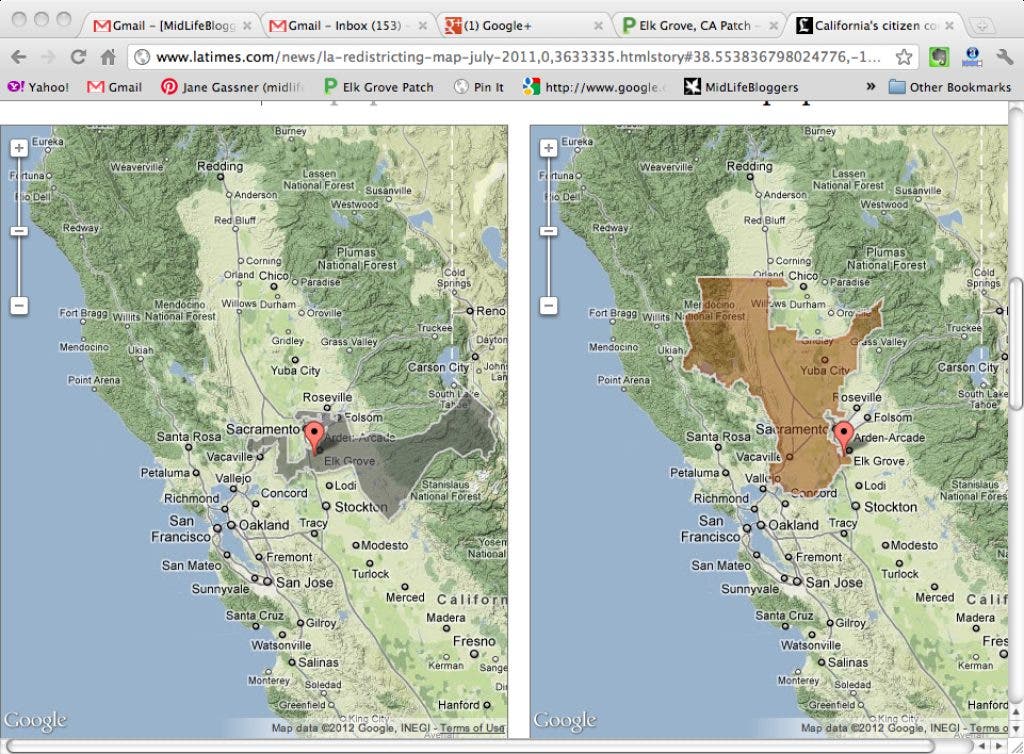
The 2012 General Election Season officially started on Tuesday, Jan. 3. What? You thought it had been going on since the first GOP debate several months ago? Nope, that was just the run-up. The real thing begins with the Iowa caucuses and ends on Nov. 6, some 11 months from now.
You may think—and it seems as if the mainstream media does—that the only election we’re having is the one for President. Actually, those of us in Elk Grove have several equally important races to consider. For one, our first ever election of a Mayor will take place Nov. 6. And then there’s our representation in Congress: This year our district lines have been redrawn and that is bound to make for some unusual electioneering in our city.
I thought it would be interesting to find out what results we might expect here in Elk Grove. Who are we as an electorate? Certainly our reputation in the wider region seems to be that we’re pretty much Republican, conservative, Christian, white—red city all the way. Is that true?
Find out what's happening in Elk Grovefor free with the latest updates from Patch.
To find out, I went back into the Secretary of State’s Voter Registration records, going all the way to 2000, the year we became a city. In October of 2000, there were 39,053 registered voters in Elk Grove, of which 15,916 were registered Democrats and 16,876 were Republican. That’s pretty evenly divided between the two parties. One could say, then, that we started off as a purple city. Two years later, not much had changed. There were 40,224 registered voters in Elk Grove, of whom 16,410 were Democrats and 17,050 were Republican—slightly more purple than before.
That all changed by the General Election of 2008. The huge influx of new residents from the years of the housing boom brought the population of registered voters up to 75,512. However, whereas in the past the difference between the Republicans and the Democrats was minor, now there were significantly more registered Democrats (31,798) than Republicans (23,938). Elk Grove had become blue, and it remains blue today.
Find out what's happening in Elk Grovefor free with the latest updates from Patch.
Surprised? I was too. Then I realized that one of the reasons we have a reputation for being a bastion of conservative thought is that our congressman, Dan Lungren, is a favorite son of the conservative movement. The American Conservative Union (ACU), a political action and lobbying organization that yearly ranks politicians on how they adhere to conservative ideals, has given him a lifetime score of 96 percent.
So if we’re such a blue city, how come we keep electing a representative to Congress who is so closely identified with conservative values and votes? For the answer to that, one has to look to the redistricting that was done in 2002. Federal law mandates that following every 10-year census, districts must be redrawn in order to ensure that the constitutional mandates of “one person, one vote” and the Federal Voting Rights Act are met. Traditional criteria for this, for what’s known as “maintaining communities of interest” include, according to Demographic Research, Inc.:
· Using identifiable geographic boundaries;
· Drawing election districts that are compact and contiguous;
· Basing the new plan on existing districts to the extent possible;
· Keeping incumbent elected officials in their own districts; and/or
· Using existing voting precincts when possible.
After the 2000 census, California was given seven additional Congressional seats. Our state legislature, which was controlled by Democrats, couldn’t come up with a redistricting plan that the Republican governor, Pete Wilson, would sign. So the redistricting effort was taken over by the California Supreme Court and a panel of retired judges redrew the districts. What was eventually agreed on by all was the Incumbent Protection Plan, in which the districts were configured so that one or the other party dominated. This was, quite simply, a case of bipartisan gerrymandering and the result was that the political status quo was maintained even if some districts had wild and woolly boundary lines.
Our District 3 was pared down from seven counties to five, of which two were the Republican strongholds of Amador and Calveras. The bipartisan gerrymandering turned District 3 from blue to red, and that is the story of how Elk Grove, despite being a Democratic city, has been represented by Dan Lungren, a career politician from Southern California and conservative poster boy.
Of course, that’s all about to change now. The new census demanded new districting, and Prop 11 took that job away from the legislature and gave it to a 14-member California Citizens Redistricting Commission. They have now drawn districts statewide that move away from the partisan makeup to one that is more equally representative. The Republicans, of course, are not pleased, but those in Elk Grove who are looking for more equitable representation should be.