Community Corner
Falling Property Values: Could the City’s Outdated General Plan Be Partly to Blame?
The halcyon days when the General Plan for Elk Grove was first adopted are long past, yet the City continues to use it when making zoning decisions.

The response to on the effects of continued new home building in Elk Grove at a time of falling property values sent me to the city archives, once a place of dust and grime, but now thanks to the internet, a place to pore over documents from the relative comfort of home. I was trying to put myself back in time to the days when Elk Grove was just beginning as a city. I wanted to see what the original vision had been so that I might better understand how close to it we have come.
The State of California mandates that every new city create a General Plan, a guide to the development of the city which will serve as the framework for all city codes and standards. Although Elk Grove was incorporated in 2000, our final General Plan was not adopted until November 19, 2003. During the intervening time, issues were raised, debate was enjoined, and ultimately consensus was reached. The overarching vision of our General Plan is this:
“Elk Grove in the future is envisioned by the residents to continue to reflect the attributes which brought them to the community: a diversity of high quality residential and commercial areas in a rural setting, a high level of public services provided by the City Elk Grove, and a pleasing environment in which to live and work. The future will also provide more shopping opportunities (including a regional mall), increased employment opportunities, and an increased tax base to support City government and the services it provides.”
Find out what's happening in Elk Grovefor free with the latest updates from Patch.
Reading reports and minutes of the meetings that took place during those early years, I can almost hear what went into creating that consensus. The decade leading up to our incorporation, the 1990s, saw unparalleled growth in Elk Grove. Some 1,500 new homes a year had been built and the population increased by about 4,000 residents annually. Growth was good; it was exciting; however, it was also, in the minds of some, beginning to go astray.
How much growth was too much? Would the rural character of the area that had made it such a desirable place to live be destroyed? How to avoid traffic nightmares that come with density? How to create commercial opportunities that would grow the economy? You can hear the echoes of those debates in the comments that followed my column.
Find out what's happening in Elk Grovefor free with the latest updates from Patch.
Eventually consensus was reached, the General Plan was adopted and the city continued to grow in a way that made the future seemed rosy for us all. That new regional mall was finally in the works, more homes were being built in subdivisions, and the CSD started putting in the parks.
Then the housing bubble burst, and Elk Grove became one of the poster children nationwide for the destruction that the sub-prime mortgage implosion wreaked on neighborhoods. Seemingly at the center of that storm for Elk Grove was the East Franklin area.
In the mid-1990s, the MacDiarmid Company, a land development consulting firm, put together for a group of developers “a master planned community located on 2,474 acres consisting of 10,103 residential units, 53 acres of commercial development, and over 180 acres of parks and open space.” That plan, called the East Franklin Specific Plan (EFSP), was approved by the Supervisors of Sacramento County in 1994 before being folded into the General Plan, and from then until now it has guided decisions on development in the area.
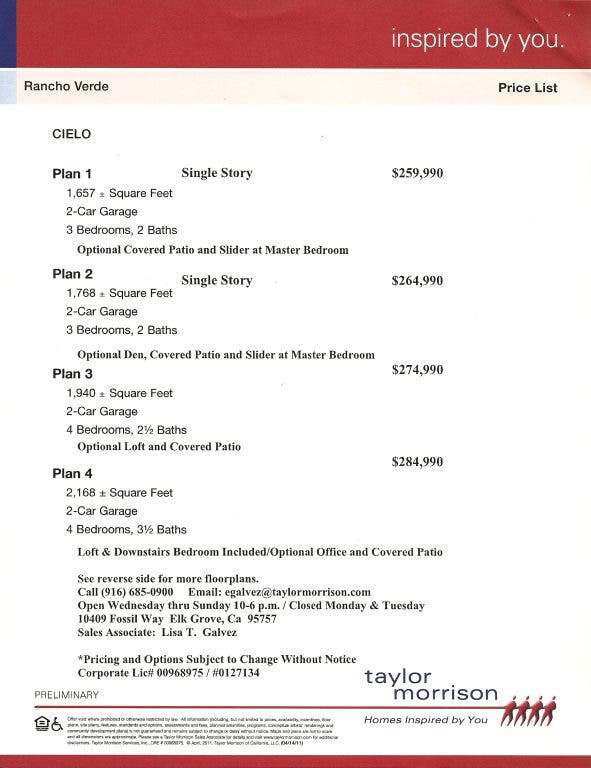
The Franklin Crossing subdivision that I wrote of in my last column is part of the EFSP, and last year, the Planning Commission received a request from developers Taylor Morrison for a change in zoning for the project. They wanted permission to build 74 additional single family homes, increasing the total number to 314. The lot sizes would shrink from 7,000 sq.ft. to 4,500 sq. ft. This increase, Taylor Morrison said according to the commission's staff report, “would ultimately allow for the development of a project that would better appeal to current residential house market.”
The Planning Commission staff put the proposed amendment out for comment from city and county agencies, and Public Works, Landscape, Fire, Parks, Sewer, Water, and SMUD all signed off on the project. Two significant agencies did not, however. Cal Trans recommended a Traffic Impact Study. The Elk Grove Unified School District was more direct in their disapproval: “The District is currently impacted and overcrowded. This and other development projects will have a negative impact on the District’s existing school facilities.” The Planning Commission staff did not consider either of these two concerns to have sufficient merit, and in June 2010 it recommended that the City Council approve Taylor Morrison’s request.
In its decision, the commission cited the General Plan, including the density standards of the EFSP from 1994.
The GP is designed to be a living document, updated regularly so that decisions reflect the contemporary state of the city. The plan itself calls for a “periodic revision of the Housing Element to reflect housing need numbers for Elk Grove.” Yet the current document was last changed in 2009. This may only be two years ago, but it is two years in which the economy continues to be fragile and recovery is constantly being questioned. You can see it driving around Elk Grove: Most of the commercial sites, at least west of 99, are operating with multiple vacancies, some once filled by small businesses who came here in the boom years and went belly-up when the bubble burst.
Each year, the mayor of Elk Grove gives a State of the City speech. If you have read them all, as I have, then you’ll know they are part booster, part To-Do list. Reality intrudes only when it must, and then it is glossed up. In 2009, then-mayor Patrick Hume spoke of the “troubling economic times [that] hang over everything we do and will drive many of the decisions we have to make...When things turn around, hopefully we can find an equilibrium that accommodates healthy sustained growth, vital to fuel our economic engine.”
This year in March, Mayor Steve Detrick opined that things have now turned around. “Ninety days into the new year, we’re seeing improvement. The Federal Reserve is predicting growth, and the banks are lending money again. Steel beams are once again rising from fallow ground as many sectors of the local economy begin to reinvest, to rebuild and to grow.” Listening to the news now some 180 days into the new year, I would say that Detrick got our economic present wrong. Those sectors in Elk Grove that are growing would seem only to be the development corporations and construction business. As for the rest of us—not so much.
The economic news continues to be dim and our house prices continue to fall. The jobs/housing ratio is still heavily skewed with far more housing than jobs in the city; yet the city approved Taylor Morrison’s request to build even more houses.
This is not, as some claimed two weeks ago, a knee-jerk response to the idea of building anywhere anyhow. Nor is it the complaint of an emigre from the big city who now wants to close the gates to the rest of the world. Rather, it is the anguished howl of a homeowner who thought she had done everything she needed to protect herself and found that everything was not enough.
To be at the mercy of the economic tides is one thing. I accept that, just as I accepted the first deep loss on my property. What I can’t accept is that the powers that be don’t seem to be interested in helping. I’m not in foreclosure; I don’t need aid. What I—and thousands of others in Elk Grove need—is to shrink the roster of homes waiting to be bought so that the value of our homes can return to something approaching reasonable.