Neighbor News
Effects of Sunlight and Vitamin D on Influenza and Coronavirus
Evidence to support vitamin D level is protective against influenza and to protect against COVID-19 has currently been demonstrated.

There is evidence to support that maintaining a vitamin D level of at least 40-60 ng/ml (100-150 nmol/L) is protective against influenza and at least 30 ng/ml (75 nmol/L) to protect against COVID-19 has currently been demonstrated.
People living closer to the equator get more UVB light from the sun and generally have higher serum vitamin D levels than those who live farther away. Within the United States, it has been found that the incidence of pneumonia and death from influenza are lower in lower latitudes. Several scientific papers have recently been published in the wake of COVID-19 that support vitamin D status and sun exposure as important factors to consider for reducing rates of transmission, infection, and symptom severity.
Find out what's happening in Encinitasfor free with the latest updates from Patch.
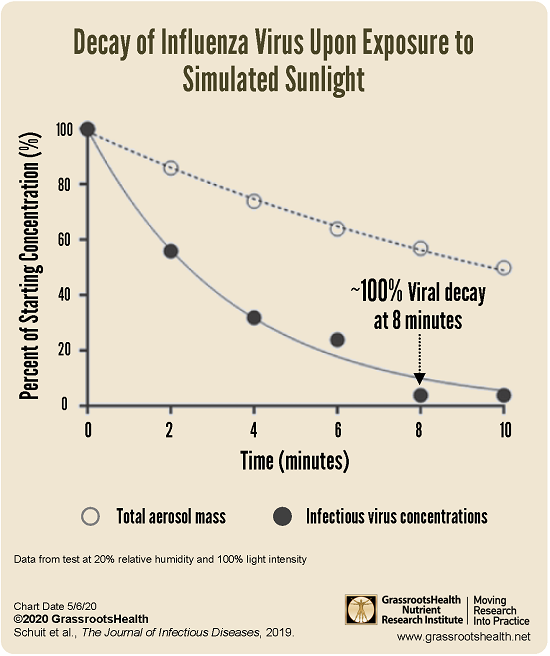
The results showed an inverse relationship between simulated sunlight intensity and transmission of the influenza virus over long distances regardless of humidity. In darkness, the half-life (the time it takes for half of the virus to decay) was 31.6 minutes. In simulated sunlight, the half-life was reduced to approximately 2.4 minutes, with nearly 100% viral decay after only 8 minutes, suggesting that it would be unlikely for long-range outdoor transmission of influenza to occur during the daytime sun. Transmission would be more likely over short distances and at lower light intensities.
Dr. Marc Sorenson, founder of the Sunlight Institute, commented on the Schuit et al. (2019) study saying, "The information from that simple paper is astounding... A decay rate (of influenza virus) 13-times higher for sunlight vs darkness is remarkable. It means instead of isolating at home, we need to either get out in the midday sunshine or get in a sunbed... Sunlight is the best disinfectant." He continues by saying, "This is a beautiful thing, because internally, vitamin D can shut down the cytokine storm (inflammatory immune response), and externally, sunlight can cleanse the air. A great one-two punch."
Latitude and climate may impact incidence of COVID-19
An editorial by Rhodes et al. (2020) indicates vitamin D deficiency as a risk factor for mortality from COVID-19, because without supplementation people at latitudes above 35°N do not maintain adequate vitamin D levels over the winter months. This may help explain why we saw such a massive outbreak and spread of COVID-19 during the winter in the U.S. (37° N), Spain (40° N), and Italy (42° N) compared to countries in more southern latitudes.
Find out what's happening in Encinitasfor free with the latest updates from Patch.
Aldridge et al. (2020) reports that another coronavirus, seasonal human coronavirus (HCoV), in England is most intense in the wintertime (Nov - Mar) with far fewer cases reported in the summertime (May - Sept), although there are a few instances of continued transmission. The authors also point out evidence that suggests immunity against recurring infection from the same strain of virus. This pattern may be useful to help guide response to the current SARS-CoV-2.
Correlation between COVID-19 and vitamin D deficiency
Rhodes et al. also point out that low vitamin D levels correlate with ethnicity, hypertension, diabetes, and obesity - all of which are associated with increased risk and severity of COVID-19. A review by Grant et al. (2020) supports this with data indicating vitamin D deficiency as a risk factor for acute respiratory distress syndrome and fatality from chronic disease, with the risk increasing with age. To reduce the spread of COVID-19 in older and immunocompromised populations, Laird and Kenny (2020) present results from the Irish Longitudinal Study on Ageing to advocate for vitamin D supplementation to increase vitamin D status and enhance the immune response.
To help protect against COVID-19, McCartney and Byrne (2020) also stress the importance of supplementing with vitamin D in vulnerable populations, including older adults, nursing home residents, those with diabetes mellitus, compromised immune function, darker skin, vegans, vegetarians, overweight or obese, smokers, and healthcare workers.
Overall, getting regular or daily exposure to sunlight, and taking additional supplementation as needed to achieve and maintain a vitamin D level of 40-60 ng/ml (100-150 nmol/L), may help decrease the risk of becoming infected with all types of coronavirus, including that which causes COVID-19, and help lower severity of symptoms if infected.